AI-Written Books Hit Iraqi Shelves, With Ghost Authors and Translators
A dispute over a collection of newly released Arabic-language titles has shaken Iraq’s publishing scene, raising questions about how books are verified, how International Standard Book Numbers (ISBNs) are assigned, and whether generative Artificial Intelligence (AI) is beginning to blur the line between translation, adaptation, and blatant fabrication.
The controversy centers on Dar Alka, a Baghdad-based publishing house run by Dr. Fatima Badr, which published a set of books marketed as translations of foreign works. Many of them were branded with “TIVOLI BOOKS – Bruxelles” on their covers.
Iraqi writer and journalist Sadiq Al-Ta’i published a lengthy Facebook post alleging that several Dar Alka titles were so-called “ghost books”
A few days after the Iraq International Book Fair (which ran until 13 December), Iraqi writer and journalist Sadiq Al-Ta’i published a lengthy Facebook post alleging that several Dar Alka titles were so-called “ghost books”: works attributed to authors and translators he said could not be traced, and written in a style he argued resembled AI-generated prose.
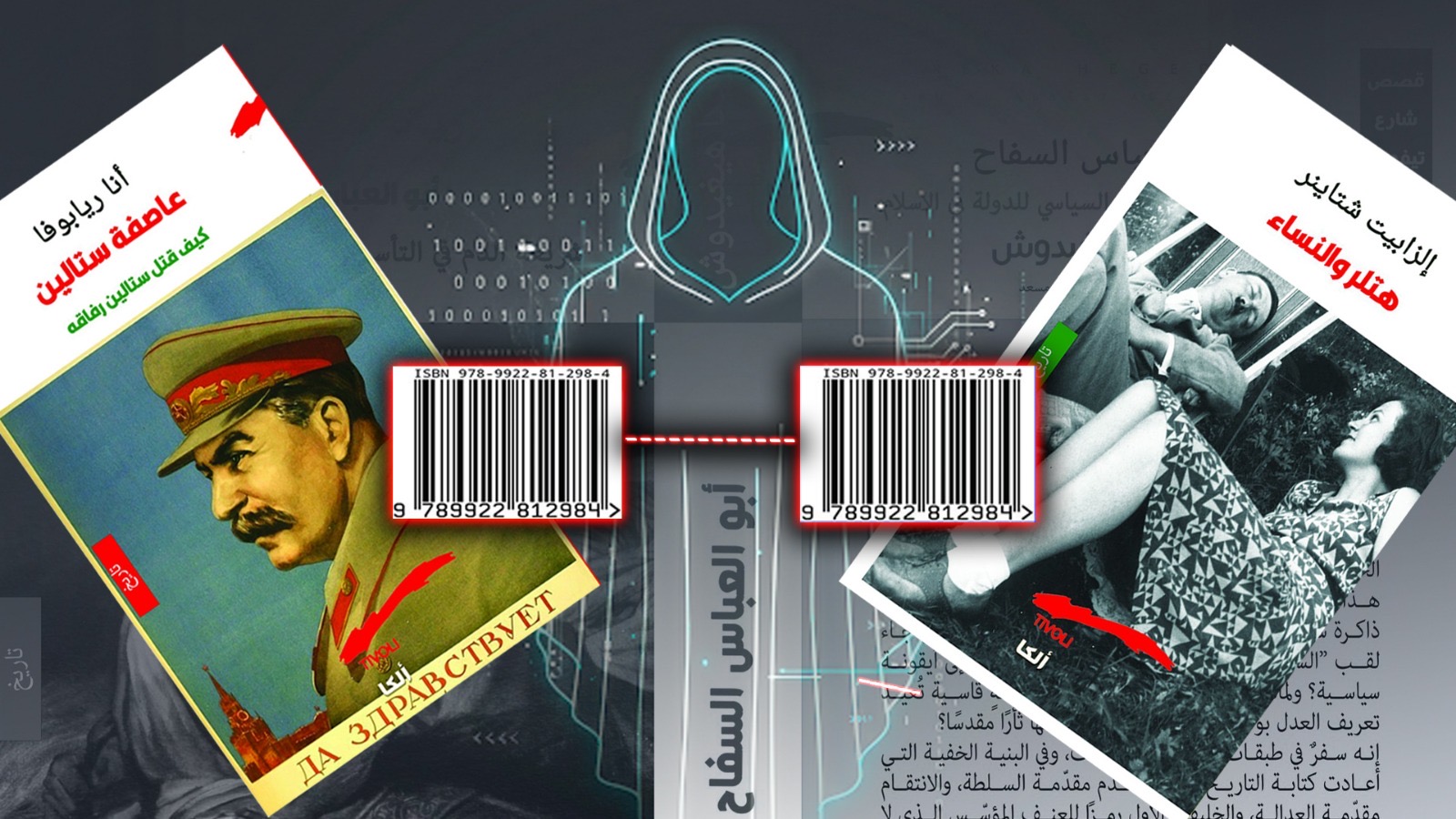
The books at the centre of the row were marketed as fast-paced, accessible nonfiction with headline-grabbing themes. Their covers promised readers a mix of scandal, intrigue, and “hidden history”: Hitler and Women teased intimate secrets behind Nazi power, while Stalin’s Storm: How Stalin Killed His Comrades presented Soviet politics as a story of betrayal and bloodshed. Other titles offered ‘new readings’ of well-known historical figures such as Hasan al-Sabbah and Abu al-Abbas al-Saffah, and broad, sweeping accounts of the Fatimid and Safavid states: a formula clearly designed to attract the widest possible audience at book fairs as well as book stores.
In an interview with The Amargi, Al-Ta’i said his suspicions were aroused three days before his Facebook post, after he commented “in a friendly way” on a Dar Alka-promoted title, asking for basic information about the author, the translator, and the meaning of the “Tivoli Street Stories” label that appeared on the covers.
He asserts that he focused on verifiability: whether the named author exists in relevant catalogues and whether an original foreign-language edition can be located.
As one example, he cited the book titled Abu al-Abbas al-Saffah: Shari‘at al-Dam…, evidently authored by Reka Hegedüs, and a translator listed as Dr. Majd Mas‘ad. Al-Ta’i said he searched several Hungarian and international catalogues but could find neither a Hungarian author by that name writing about early Abbasid history, nor any original work matching the purported title. He adds that he could not locate a professional record for the listed translator either. This methodology –author, original title, translator trail – is what he says he applied across multiple disputed titles.
However, we could not find public catalogue traces for these ISBNs through routine web searches, and the same ISBN appears on two different titles we inspected.
The Amargi inspected several Dar Alka covers circulated online and examined the ISBNs printed on them. The ISBNs are formatted as ISBN-13, and the checked digits appear mathematically valid (meaning the numbers are internally consistent as ISBNs). However, we could not find public catalogue traces for these ISBNs through routine web searches, and the same ISBN appears on two different titles we inspected. That is not how ISBN assignment works: an ISBN is intended to identify a specific edition of a specific book.
We also attempted to locate the original foreign-language editions implied by the cover branding (“TIVOLI BOOKS – Bruxelles”) and the named authors. Much of what surfaced publicly were posts promoting the Arabic editions, rather than bibliographic records of source texts.
There is a further complication. Some names do exist in the real world but appear unrelated to the subject matter attributed to them. For instance, “Réka Hegedüs” is a name that appears in academic contexts, but in fields such as computing and neural networks, not Islamic medieval history.
Separately, “Tivoli Books” is also the name of a real publisher elsewhere, but The Amargi found no clear evidence that it corresponds to the “Bruxelles-Belgique” imprint on the disputed covers.
None of this, on its own, proves a book is fabricated; small presses can be hard to track. But the combination of factors – untraceable bibliographic trails, imprint ambiguity, and ISBN duplication – has amplified concerns.
The dispute quickly became public and then personal, in part because celebrated Iraqi novelist Ali Badr had promoted some of the books on social media shortly before the fair.
According to her, texts are accepted when they appear “human to a reasonable degree”.
In a lengthy social media post, Badr stated he was no longer running Dar Alka and that the day-to-day operation was handled by his sister, Dr. Fatima Badr. He framed the episode as a publishing failure rooted in rushed production and reliance on third-party material.
Dr. Fatima Badr, for her part, defended the house’s practices, noting that changing titles is common in publishing. Regarding AI, she acknowledged using AI tools in the workflow, describing a process in which submissions arrive by email, are reviewed by specialists, and then undergo an AI-based check. According to her, texts are accepted when they appear “human to a reasonable degree”.
Ali Badr later went further, claiming that some books were “not translated but authored by one person”, while insisting they were not “forged” in the sense of being poor-quality or intentionally deceptive; a position that did not satisfy critics demanding original editions and transparent sourcing.
As the argument spread beyond social media into mainstream coverage, the Iraqi Publishers and Librarians Association launched an inquiry. In a statement dated 20 December 2025, the association stated that it had followed the controversy closely since 12 December, sent formal questions to the publisher on 14 December, and formed a committee comprising publishers, a translator, and legal counsel. It further reported that the committee found violations in the reliability of bibliographic data for most of the titles reviewed and described the publisher’s responses as insufficient.
The association announced it had struck Dar Alka’s membership, barred it from participating in association activities for three years, and said it would forward the findings to the Arab Publishers’ Union.
Iraq’s book trade has long operated under familiar pressures: weak enforcement of intellectual property rights, informal distribution networks, and limited institutional oversight. What distinguishes the Dar Alka episode is that it lies at the intersection of two distinctly modern vulnerabilities.
The first is a verification gap. Even basic publication metadata – author identity, original edition, publisher of record, and ISBN discipline – can be difficult to confirm quickly, particularly under the time pressure of book fairs. The second is the suspicion of AI involvement. Once readers believe a text “sounds like AI,” trust can erode rapidly, even in the absence of any clear or shared standard for proving AI authorship in publishing.
In that sense, Dar Alka has become a test case for an uncomfortable possibility: that Iraqi publishers suffer major reputational and professional consequences in a scandal framed, whether fairly or not, as an “AI-era” publishing deception.

Renwar Najm
Renwar Najm is an Iraqi Kurdish journalist with a career that began in the early 2010s at the esteemed Awene newspaper. He holds a master’s degree in Peace and Conflict Studies from the University of Kent and Philipps University of Marburg.