Are We Entering a New Sunni-Arc Middle Eastern Era?
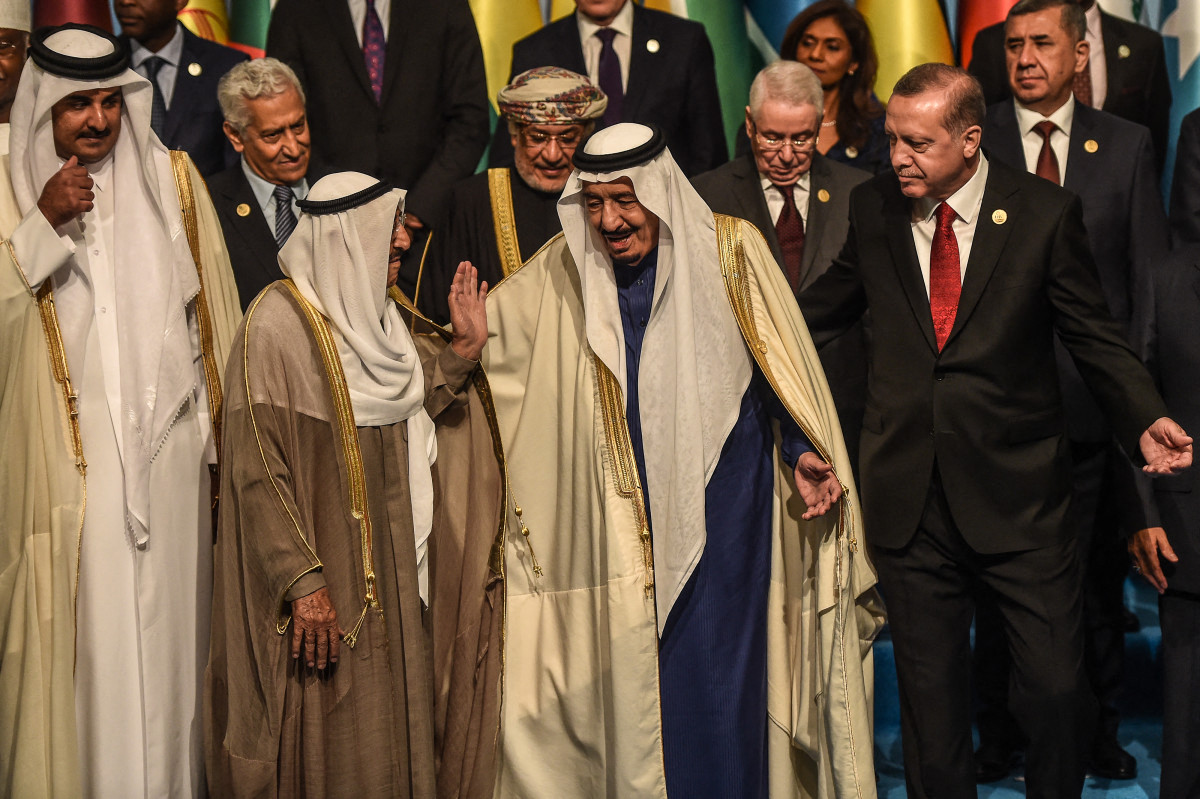
Turkish President Recep Tayyip Erdogan (R) poses Qatar’s Emir Sheikh Tamim Bin Hamad Al Thani (L), Emir of Kuwait Sheikh Sabah Al-Ahmad Al-Jaber Al-Sabah (2nd L) and King Salman bin Abdulaziz Al Saud of Saudi Arabia (2nd R) during the family photo of the 13th Organization of Islamic Cooperation (OIC) Summit at Istanbul Congress Center (ICC) on April 14, 2016. (Photo by OZAN KOSE / AFP)
On 3 February 2026, Turkish President Recep Tayyip Erdoğan told Saudi Crown Prince Mohammed bin Salman that Turkey was ready to take relations with Saudi Arabia to a “higher level.” Eight years earlier, Erdoğan had turned the killing of journalist Jamal Khashoggi into a global indictment of Riyadh. Today, however, that moral rupture has been quietly set aside as a Sunni Arc is replacing the Shi’a Crescent.
For more than two decades, Middle Eastern geopolitics was organized around Iran’s “Shia Crescent” expansionism. Stretching from Tehran to Beirut through Baghdad and Damascus, and later extending its reach to Yemen, the crescent represented a regional order built on ideological resistance to Israel and Western influence. Today, in the wake of October 7 and subsequent regional recalculation, that order is fracturing. In its place, a new alignment is beginning to take shape, one that is less ideological, more state-centered, and increasingly Sunni. Let us call it the “Sunni Arc” for the purposes of this article.
This axis was both geographic and ideological, and for years, it structured conflicts, alliances, and proxy wars from the Levant to the Gulf
The Shia Crescent emerged in the aftermath of the 1979 Iranian Revolution and matured after the U.S. invasion of Iraq in 2003. Iran used a network of allied governments and non-state actors – Hizbollah in Lebanon, the Assad regime in Syria, Shi’a militias in Iraq, and the Houthis in Yemen – to project power across the region. Ever since, Iran has been fighting its enemies through the proxy militias and armed groups it sponsors in the region. This axis was both geographic and ideological, and for years, it structured conflicts, alliances, and proxy wars from the Levant to the Gulf, spending billions of dollars to shape the Middle East. Its role is somewhat evident in the ‘Axis of Evil’ label it got from its regional rivals in contrast to the ‘Axis of Resistance’ label that the Iranian state used.
What distinguishes this Sunni Arc from the Shia Crescent is its emphasis on states rather than militias.
But the regional landscape has shifted dramatically. October 7 and Israel’s military campaign that followed have altered strategic calculations across the Middle East. Iran’s network, once seen as ascendant, now faces military pressure, diplomatic isolation, and increasing costs. The Shi’a Crescent was dealt its heaviest blow when the Assad regime collapsed in December 2024. At the same time, a group of Sunni-majority states, including Saudi Arabia, Turkey, Qatar, and Syria, are cautiously and collectively re-entering regional politics and are finding common ground amid the Middle East turmoil. One key aspect of these states coming together is their geopolitical anxieties. This emerging alignment is neither a formal bloc nor driven by a uniting ideology. Rather, it is a pragmatic response to a rapidly changing balance of power, to an extent wherein Turkey and Qatar have tirelessly lobbied President Trump not to attack Iran, fearing that Israel will be the key winner in the collapse of the Islamic Republic of Iran regime.
What distinguishes this Sunni Arc from the Shia Crescent is its emphasis on states rather than militias. While Iran relied heavily on non-state actors to extend influence, the Sunni Arc reflects a shared preference for centralized authority, territorial integrity, and state-led diplomacy. Saudi Arabia’s recalibration of its regional posture, Turkey’s assertive foreign policy, and Qatar’s role as mediator and financier all point to a new pattern: competition managed through diplomacy, economic leverage, and selective cooperation rather than permanent proxy warfare. What these countries also have in common is a significant influence on the current U.S. administration.
Their first geopolitical gain was in Syria, where they managed to prop up a Jihadi figure and therefore largely shaped and influenced the policy decisions of the new Syrian state. They jointly lobbied against the Kurdish-led Syrian Democratic Forces (SDF) and have largely dismantled the former Kurdish gains in northeast Syria.
At the same time, this does not mean the Sunni Arc is free of internal tensions. Saudi Arabia and Turkey, its two most influential poles, have distinct ambitions and occasionally conflicting interests. Until recently, they were rivals. The murder of Saudi journalist Jamal Khashoggi and Turkish support for the Muslim Brotherhood put these two countries at diplomatic loggerheads. Yet their convergence on key issues – countering Iranian influence, managing the fallout from Gaza, shaping Syria’s future, and, possibly, keeping Israel in check – suggests a growing willingness to coordinate. Other countries, including Egypt and Pakistan, two military powers united in their need of Saudi and Qatar cash, and in their rivalry with Israel, may increasingly align with this framework, reinforcing its regional weight.
Yet for all their differences, the Sunni Arc and the Shia Crescent share one fundamental trait: geopolitical ambition, and in both cases, Israel is the target.
There is also a notable shift in rhetoric. Iran’s leadership long used anti-American and anti-Israel language as ideological glue, even as its society remained more complex and divided. In contrast, Sunni governments today are navigating intense popular anger over Gaza, sometimes allowing harsher rhetoric to circulate domestically while pursuing pragmatic diplomacy abroad. This results in a region where public sentiment and state strategy are increasingly out of sync, a volatility that could shape future crises.
Yet for all their differences, the Sunni Arc and the Shia Crescent share one fundamental trait: geopolitical ambition, and in both cases, Israel is the target. Just as Iran sought a corridor of influence to counterbalance Israel and the West, Sunni powers now seek collective leverage in a post October 7 Middle East. Israel’s attack on the Hamas leadership inside Qatar was a defining point. Therefore, they want to ensure that the Palestinian issue remains central, which is one key rallying point to win the support of their populations, by arguing that Israel’s freedom of action is constrained, and that they have a decisive voice in shaping the next regional order.
This is where the Middle East’s unresolved Kurdish question becomes impossible to ignore. Kurds inhabit large parts of Turkey, Syria, Iraq, and Iran, precisely the states now repositioning themselves within this new Sunni-centered landscape. Any regional order that continues to marginalize Kurdish political rights will remain inherently unstable. From northern Syria to southeastern Turkey and the Kurdistan Region of Iraq, Kurdish grievances have repeatedly surfaced not as isolated minority issues, but as structural fault lines capable of destabilizing entire states. This Sunni Arc considers the Kurds as pawns of Israel’s geopolitical ambitions, especially against Turkey. The Turks are very anxious about Israel’s rhetorical support for Kurdish aspirations. In fact, a key driver behind the Turkish-Kurdish peace process is the Turkish fear of Israel’s support for the Kurds.
The past three decades have clearly proved that suppressing Kurdish aspirations does not produce lasting stability; it merely postpones crisis. If the Sunni Arc is to avoid reproducing the failures of the Shia Crescent, endless conflict, fragmentation, and proxy warfare, it must confront this reality. Resolving the Kurdish question through political inclusion, decentralization, and rights-based frameworks is not a mere concession; it is a prerequisite for regional stability.
The emerging Sunni Arc is more adaptable and less ideologically strict than Iran’s former axis. The Kurds across four countries, and the Shi’as, more particularly, in Iraq and elsewhere, as well as Israel and minority groups within these nations, should adopt a more flexible and pragmatic approach to cooperate in response to the Sunni Arc. This bloc just demonstrated an aggressive and violent response to the Kurdish question in Syria in January 2026. This could be against any rivals of the Sunni Arc, if they can. This situation should serve as a warning bell, which was clearly heard in Erbil and Baghdad.
As the Middle East enters this new phase, the question is not only whether the Shia Crescent is fading, but also if the Sunni Arc can build an order that stabilizes the region rather than merely rearranging its conflicts.
What comes next will define the Middle East for a generation.

Kamal Chomani
Editor-in-Chief of The Amargi and PhD candidate at Leipzig University