Reza Pahlavi and the Politics of False Hope in Iran’s Protests
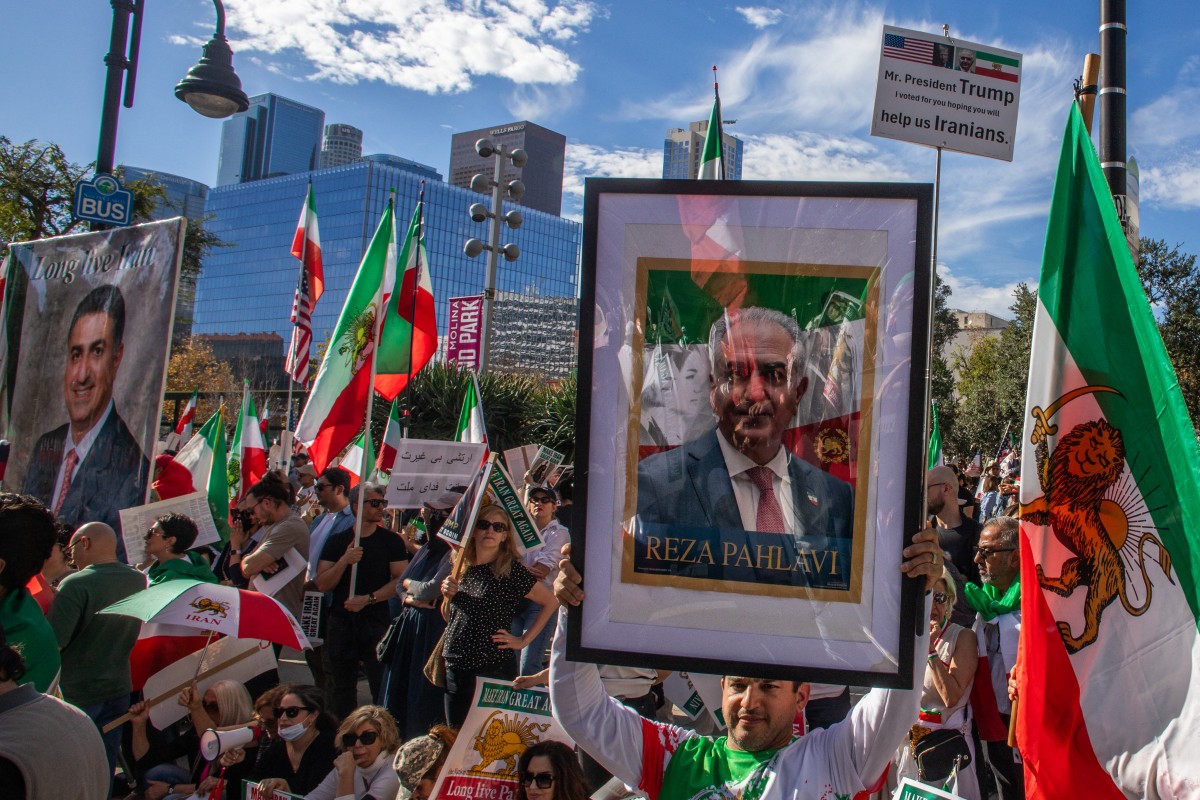
An unidentified man holds a picture of Reza Pahlavi while members of the Iranian community and supporters hold signs and pre-regime Iranian flags during a “Solidarity with the People of Iran” event in front of City Hall in Downtown on January 18, 2026 in Los Angeles, California.
(Photo by Apu Gomes / GETTY IMAGES NORTH AMERICA / Getty Images via AFP)
In an interview with Reuters, President Donald Trump remarked that Reza Pahlavi, the son of Iran’s deposed shah, “seems very nice, but I don’t know how he’d play within his own country.” Trump also expressed uncertainty over whether Iranians would accept Pahlavi as a political leader. That uncertainty stands in contrast to Pahlavi’s own public posture.
In recent months, Pahlavi has increasingly presented himself as the leading figure of what he terms a “national uprising” against the Islamic Regime. On more than one occasion, he has asserted that large-scale defections from Iran’s security forces were already underway.
The most recent wave of protests in Iran began on December 28 in Tehran’s Bazaar and rapidly spread to other cities. According to some reports, the crackdown that followed resulted in the deaths of at least 12,000 people, with estimates rising as high as 20,000; figures that remain difficult to independently verify. Regardless of the precise number, the scale of violence was extraordinary. And central to evaluating this episode is the role played by Pahlavi’s exiled leadership claims.
The Promise of Defection
Six months prior to the outbreak of the protests, on June 29, 2025, Reza Pahlavi released a video announcing the launch of a “National Cooperation Campaign.” The initiative sought to create secure communication channels for members of Iran’s military, law enforcement, and government institutions to defect and align themselves with him. The campaign relied heavily on symbolic signalling, including QR codes broadcast on satellite television. In July 2025, Pahlavi claimed in a telephone interview with Politico that “at least over 50,000” members of Iran’s military forces had joined this campaign. At the time, the claim attracted attention but little scrutiny. In hindsight, it became a cornerstone of his political narrative.
Escalation and Mobilization
Yet beyond this ambiguous declaration, no material or verifiable evidence emerged indicating large-scale defections, particularly among senior or operationally significant ranks
On January 5, 2026, Pahlavi reiterated his claims in an interview with The Wall Street Journal, stating that “the defection has begun” and that his movement had received “tens of thousands of people.” He emphasized that any successful political transition would require the tacit cooperation of Iran’s core military and paramilitary institutions.
One day later, on January 6, Pahlavi issued his first direct call for mass action, urging Iranians to take to the streets on January 18 and 19. On January 9, Iran’s Revolutionary Guard Corps (IRGC) Intelligence Organization announced that it was “dealing with possible acts of abandonment,” a statement that appeared, at least superficially, to lend credibility to Pahlavi’s claims. Yet beyond this ambiguous declaration, no material or verifiable evidence emerged indicating large-scale defections, particularly among senior or operationally significant ranks.
On January 10, Pahlavi further escalated his rhetoric, declaring in a recorded message that he was preparing to return to Iran so that he could stand beside the people “at the time of our national revolution’s victory.” He encouraged continued protests and suggested that assistance would arrive soon. No such assistance materialized.
On January 11, he announced what he called the second phase of the “national uprising,” urging protesters to seize and hold central streets and state institutions.
Responsibility and Consequence
the state’s repressive response intensified in a coordinated and disciplined manner.
Critics argue that Pahlavi’s calls for escalation were not accompanied by any concrete strategy, coordination, or protective measures capable of mitigating the risks faced by protesters. As CBS News anchor Norah O’Donnell asked in a televised interview: “is it responsible to be sending citizens in Iran to their deaths? Do you bear some responsibility?”
To date, there is no publicly verifiable evidence that defections occurred on anything approaching the scale promised. Instead, the state’s repressive response intensified in a coordinated and disciplined manner. Protesters were left exposed to overwhelming violence, reinforcing suspicions among critics that mobilization was driven by exaggerated claims rather than by demonstrable shifts in the balance of power. Alireza Nader, an independent analyst based in Washington, D.C., argued that “the campaign by Pahlavi and Iran International, in addition to comments by President Trump, may have provided Iranians with false hope that outside help was on the way.”
The IRGC is estimated to maintain approximately 150,000 active personnel, supported by a Basij network of roughly 600,000 members. A defection of 50,000 forces would represent a seismic shift, one that would almost certainly manifest in visible institutional weakness. As Alireza Nader and Nik Kowsar have asked pointedly: if 50,000 regime defectors truly existed, why did they not prevent, disrupt, or at least reduce the scale of violence?
Pahlavi’s supporters contend that the absence of visible defections does not necessarily disprove his claims. Defections, they argue, may be covert, fragmented, or intentionally concealed to protect defectors and their families. Moreover, heightened repression, including reports of foreign Shia militias assisting Iranian forces, could indicate regime anxiety rather than strength. From this perspective, Pahlavi’s rhetoric may reflect strategic ambiguity rather than deception, designed to accelerate elite fracture by projecting momentum.
Substantial defections numbering in the tens of thousands would be expected to produce observable effects: operational hesitation, jurisdictional breakdowns, localized restraint, or internal conflict within repressive institutions. None of these indicators materialized.
As Nader noted, “the Islamic Republic appears well organized, well-armed, and still unified. I have not seen evidence of major defections.” And the majority of atrocities, according to Nader, seems to be committed by the IRGC, which remains operationally cohesive and coordinated.
Structural Constraints on Defection
Established explicitly to prevent coups and internal fragmentation, the IRGC operates through overlapping chains of command, extensive counterintelligence mechanisms, and vertically personalized loyalty to the Supreme Leader rather than to abstract state institutions.
Understanding why large-scale defection is unlikely requires understanding the IRGC’s structural and ideological architecture and its deep social, political, and economic embedding within the Islamic Republic. Established explicitly to prevent coups and internal fragmentation, the IRGC operates through overlapping chains of command, extensive counterintelligence mechanisms, and vertically personalized loyalty to the Supreme Leader rather than to abstract state institutions. This environment renders coordinated dissent both morally stigmatized and operationally infeasible.
The costs of defection are severe, encompassing loss of livelihood, housing, social standing, and, often, direct punishment of family members. Moreover, the Guards’ deep economic entanglement incentivizes adaptation rather than exit, even as ideological commitment erodes. Despite broader budgetary deficits, the regime has increased military wages; for example, it allocated an estimated $6–9 billion, nearly double the budget of the regular army, to the IRGC in exchange for loyalty.
Crucially, no credible alternative authority or safe destination exists to absorb defectors or guarantee their security, making defection a form of strategic self-destruction. Dissatisfaction is therefore absorbed and disciplined within institutional boundaries, ensuring that loyalty remains the least risky option. The way things are unfolding does not require imputing malicious intent to Pahlavi. The central issue is not whether he deliberately misled protesters, but whether political mobilization based on unverified claims of elite defection is responsible in an authoritarian context where miscalculation carries lethal consequences.

Rojin Mukriyan
Rojin Mukriyan has PhD in the Department of Government and Politics at University College Cork, Ireland. Rojin’s main research areas are in political theory, feminist and decolonial theory, and Middle Eastern politics, especially Kurdish politics. She has published articles in the Journal of International Political Theory, Philosophy and Social Criticism, and Theoria. Her research has thus far focused on the areas of Kurdish liberty, Kurdish statehood, and Kurdish political friendship. She has published many think tank commentaries and reports on recent political developments in eastern Kurdistan (Rojhelat), or north-western Iran. She has also frequently appeared on a variety of Kurdish and Persian language news channels. X account: @RojinMukriyan