Rojava, Takfirism, and the Kurdish Place in the Ummah
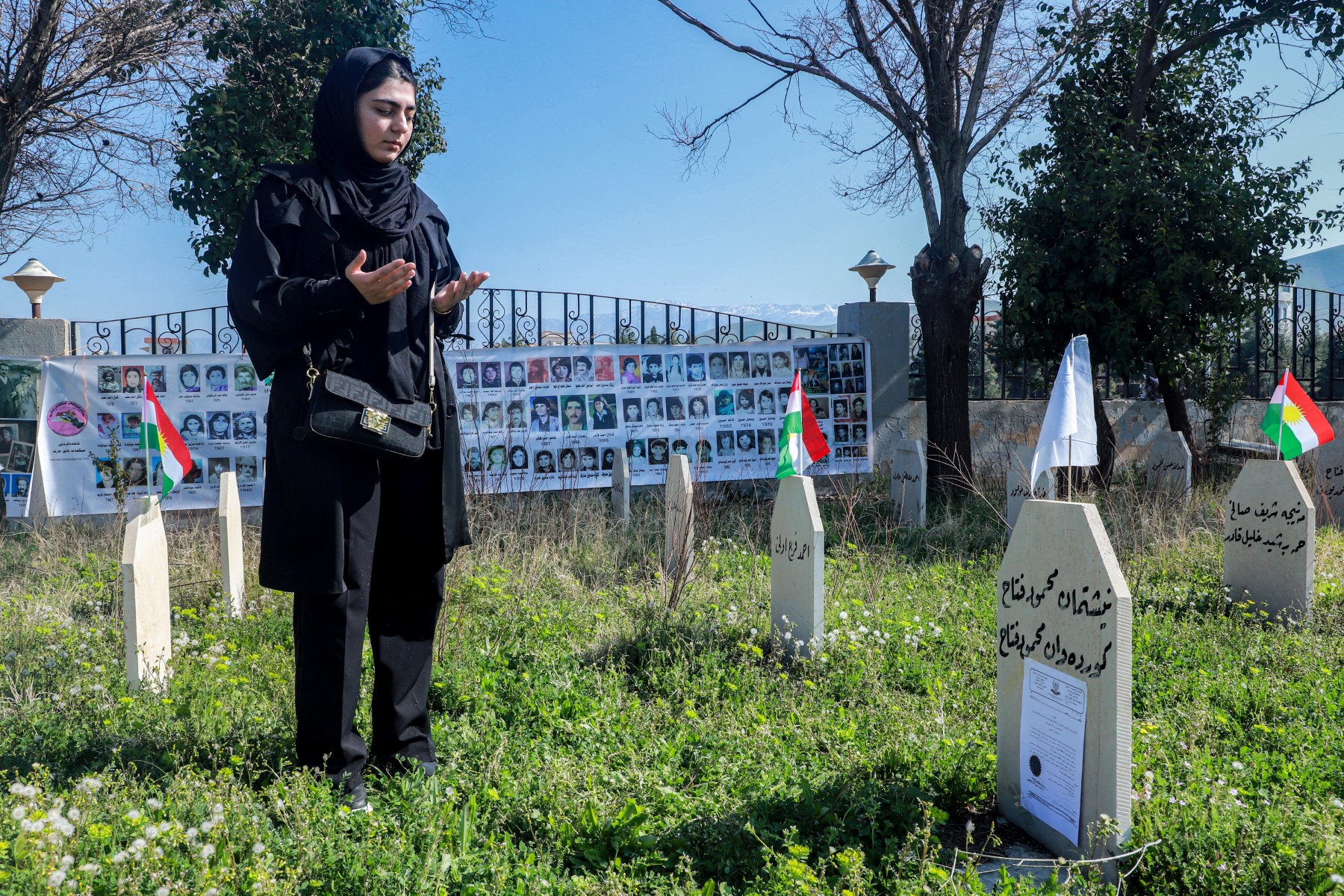
A woman prays by the grave of one of the victims of the 1988 Halabja chemical attack — March 16, 2025. (Photo by Shwan MOHAMMED / AFP)
The current situation in Rojava has once again exposed a deep rift in the Muslim Ummah’s moral compass. While Kurdish civilians are being displaced and subjected to military aggression, much of the Muslim Ummah has responded with indifference and even open hostility. This is neither accidental nor without precedent. It is rooted in long-standing ideological constructions that portray Kurds as inherently suspect of not being sufficiently Muslim, or even religiously deviant.
Kurds are often treated as not belonging to Islam unless otherwise proven
Given that the Kurdish people are predominantly Muslim, Islam has long shaped their cultural and historical life, much like a certain cultural Muslimness that shapes the lives of Arabs, Turks, and Iranians, even if they happen to be non-Muslim. However, while the latter are rarely disqualified as Muslims despite their ideological positions, Kurds are often treated as not belonging to Islam unless otherwise proven. Furthermore, Kurdish political mobilisation is frequently framed as anti-Ummatic and nationalist, and therefore non-Islamic. They are therefore often treated as anomalies within Ummatic frameworks and are viewed as a suspect community until they demonstrate ideological and political conformity. Such conformity invariably reinforces Pan-Arab and Turkish geostrategic objectives and ideological narratives. However, when Kurdish actors, regardless of their religious affiliation, mobilise around autonomous political goals, they are stigmatised as un-Islamic threats and existential aberrations for deviating from the dominant ambitions of Arabs and Turks.
Kurdish political projects are frequently dismissed not on the basis of their concrete actions or their ideals but through essentialised assumptions about their (lack of) Muslimness
I would argue that this exceptionalism is rooted in a long-standing, historically racialised form of takfir directed at Kurds – one that treats Kurdishness as an essentialised marker of religious suspicion. By ‘racist takfirism’, I refer to that involving the attribution of kufr or religious deviance to an entire ethnic group – not on theological grounds, but due to perceived political conduct, cultural differences, or resistance to dominant power structures. Within this framework, Kurds are not merely criticised for their political views, but are portrayed as unreliable Muslims. This is not always stated explicitly through accusations of kufr, but rather operates through insinuation. Kurds are described as “secular,” cast as “tools of the West” or accused of “always betraying the Ummah”. These claims produce a moral hierarchy in which Kurdish lives are treated as less worthy of solidarity or protection.
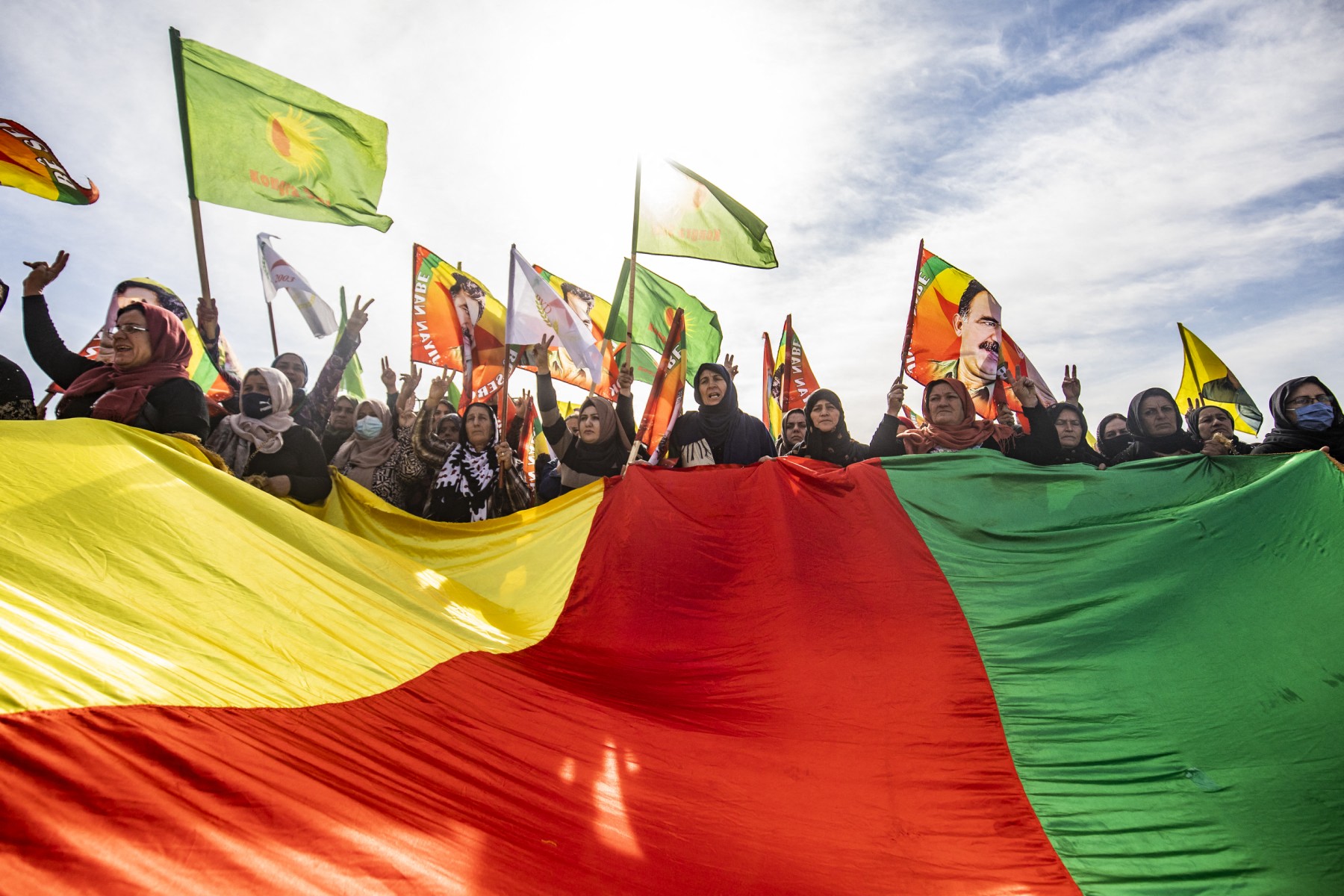
This is particularly evident in Rojava. Kurdish political projects are frequently dismissed not on the basis of their concrete actions or their ideals but through essentialised assumptions about their (lack of) Muslimness. This enables external actors, as well as Muslim audiences, to rationalise acts of violence against Kurdish populations as irrelevant to the Ummah. Kurdish political actors are frequently reduced to labels such as “communist” or “secular.” This simplification overlooks the reality that many Kurdish movements encompass a broad spectrum of both Islamic and non-Islamic elements, reflecting an ideological diversity similar to that found within Palestinian resistance movements. Rojava illustrates this complexity well. Images and videos from the region depict a diverse range of Kurdish actors – from women in hijab and imams declaring jihad in defence of Rojava to Marxist and libertarian groups, just to mention a few examples – coexisting within the same political space.
The historical kafirisation of the Kurdish people has deep and long-standing roots. This process has been perpetuated through the utilisation of various tropes and imaginaries, including the propagation of the notion that the Kurds are the descendants of jinn and that they inherently exhibit rebellious tendencies, thereby becoming adversaries of the Islamic cause. Despite being refuted by scholars, among them as-Suyuti (d. 911 AH/1505 CE) and al-Jawzi (d. 597 AH/1201 CE), who dismissed them as dangerous and jahil speech, the notion continues to resonate in popular imagination and political rhetoric. In contemporary contexts, the process of kafirisation manifests through the utilisation of novel expressions. These include accusations of atheism andof abandoning Islam for nationalism, and the portrayal of Kurdish self-defence as an act of aggression against the Ummah itself. This phenomenon is most explicitly illustrated in a statement issued by the Syrian Ministry of Endowments on 19 January. The ministry chose to utilise religious terminology in its campaign against the Kurds, drawing parallels between the campaign against Rojava and the Anfal campaign of Saddam Hussein of the 1980s, which is widely regarded as a genocidal act against the Kurdish population in Bashur (South Kurdistan). In this framing, the HTS-loyal groups are the Muslims, and the Kurds kuffar.
The process of kafirisation gives rise and lends legitimacy to narratives that encourage an Ummatic indifference towards Kurdish suffering. While the language of “Ummah” emphasises unity beyond ethnicity and nationality, its practical application often reveals selective compassion. Racist takfirism and kafirisation provide the moral infrastructure for this imbalance. However, this process also triggers a reflexive response from integrationist factions within the Ummah, who attempt to neutralise Kurdish political movements by emphasising religious brotherhood. This strategy operates as a form of “good cop, bad cop” policing, where the rhetoric of Islamic unity is deployed not to alleviate Kurdish suffering, but to diffuse Kurdish political demands. Within this framework, Kurdish Muslim identity becomes conditional: Kurds are recognised as Muslims only when submissive to Arab and Turkish dominance, but are cast as non-Muslim and divisive the moment they demand equality, rights, and dignity.
This moment presents an opportunity to develop theories grounded in Islamic knowledge regarding the management of diversity, reconciliation processes, and models of governance
As violence against Kurds persists in Rojava, alongside ongoing persecution and structural oppression in Turkey and Iran, ulama, activists, and duʿat bear a particular ethical responsibility to address the Kurdish condition and to articulate an Ummatic language capable of dismantling racist takfirism. With an estimated population of over forty million, Kurds remain in urgent need of solidarity, recognition, and meaningful processes of reconciliation. This moment presents an opportunity to develop theories grounded in Islamic knowledge regarding the management of diversity, reconciliation processes, and models of governance. Such efforts, however, can only bear fruit if the ulama collectively acknowledge and confront the dangers of racist takfirism directed at the Kurds.

Amanj Aziz
Amanj Aziz is a researcher and founder of the information- and educational platform INSAN - Institute for Social Analysis in Sweden. His work focuses mainly on racism and Islamophobia in a Swedish and European context.