Who Are the Bazaar Merchants Who Sparked Iran’s Protests?
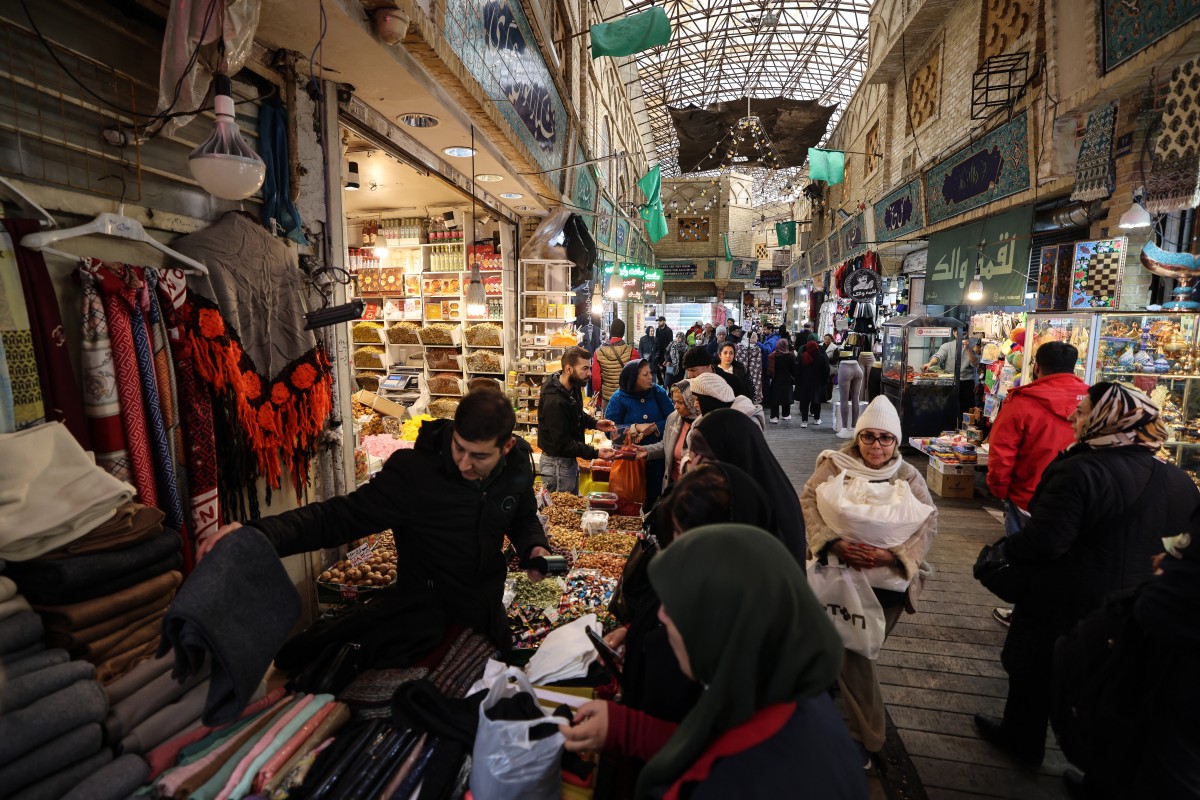
People shop at Tajrish Bazaar in the Iranian capital Tehran on 29 December 2025, at the time that the protests were just beginning (Photo by ATTA KENARE / AFP)
On January 3, 2026, Supreme Leader Ayatollah Ali Khamenei declared that no one can oppose the Islamic Republic “in the name of the bazaar and the bazaaris,” asserting that the bazaaris – Tehran’s commercial class – remain among the “most loyal segments” of the country. His remarks came just one week after a fresh wave of protests erupted in Tehran’s historic Grand Bazaar.
At the time of writing, the Iranian people are facing a brutal security crackdown. Authorities have imposed an internet blackout and severe communication restrictions for more than 100 hours, as protests continue to spread and casualties mount.
For Iran’s leadership, unrest in the bazaar rings major alarm bells – unlike protests elsewhere. It evokes the same commercial networks and social coalitions that once helped topple the Pahlavi monarchy. Yet the bazaar of 2026 is no longer the autonomous force that helped shape the country’s modern political history.
Over the past four decades, the Islamic Regime has systematically dismantled the economic foundations that once empowered the bazaar, replacing them with a fragmented system of elite-controlled political capitalism.
The Bazaar’s Long Shadow
For centuries, the bazaar was the multifunctional heart of Iranian cities. It was not merely a marketplace but a dense ecosystem of merchants, craftsmen, financiers, apprentices, and guilds bound together by credit networks, religious institutions, and social trust.
The alliance first emerged during the 1891 Tobacco Revolt, when Bazaaris joined the ulama (religious scholars and leaders) in challenging Naser al-Din Shah’s concession to a British company
Physically, it formed the spine of urban life: long corridors of covered streets connecting caravanserais, warehouses, mosques, and workshops. Bazaaris, the commercial class inhabiting this system, ranged from powerful merchants (‘tujjar’) at the top, to guild masters (‘asnaf’), workshop owners, and finally the mass of apprentices and labourers. While most possessed only modest capital, a wealthy minority controlled large shares of Iran’s handicraft production, retail trade, and wholesale commerce.
The Iranian bazaar has long been both a political and an economic institution. Given that it brought together merchants, artisans, and credit networks within a single spatial core, the bazaar could rapidly mobilize large segments of society and transmit information, grievances, and price signals. Its proximity to mosques and religious schools forged the enduring “bazaar–mosque alliance,” binding merchants and clerics into a formidable political coalition.
That alliance first emerged during the 1891 Tobacco Revolt, when Bazaaris joined the ulama (religious scholars and leaders) in challenging Naser al-Din Shah’s concession to a British company, which gave it a monopoly over the production, sale, and export of all Iranian tobacco. A leading Shi‘a cleric, Mirza Hasan Shirazi, issued a religious decree (fatwa) stating: The use of tobacco is tantamount to war against the 12th Imam. This built a form of alliance between the two groups that had far-reaching implications for modern Iranian politics.
Since then, their alliances have had at least two major successes: the 1905–11 Constitutional Revolution of Iran, which constrained the power of the Shah, and the 1979 Iranian Revolution, which toppled the Pahlavi monarchy and consolidated the rule of the Islamic Republic of Iran (IRI).
Despite the Shah’s hostility, the bazaar remained central to Iran’s economy. By the 1960s and 1970s, it had become a major financial force: in 1963, bazaar merchants supplied as much credit as the entire commercial banking sector, and by 1975 the Tehran Bazaar accounted for roughly 20% of official market transactions, handling about $3 billion in foreign exchange and $2.1 billion in outstanding loans.
The Shah’s efforts to suppress it – including forced party membership, mass arrests, anti-profiteering campaigns, and market demolitions – backfired, uniting bazaar factions and turning the bazaar into a core centre of opposition that helped bring down the Pahlavi monarchy in 1979.
However, the recent protests that started from the bazaar seem to challenge this historical alliance, and the question is when and how this rupture began.
How the Islamic Republic Reshaped the Bazaar
Once the new regime consolidated power, it pursued a quieter, more effective strategy to contain the bazaar’s political potential
A year after his fall, Mohammad Reza Shah said, ‘‘Moving against the bazaars was typical of the political and social risks I had to take in my drive for modernization.” Ayatollah Ruhollah Khomeini promised a different future:
“The Islamic Republic must preserve the bazaar with all its might,” he declared, “and the bazaar must preserve the government.” Yet once the new regime consolidated power, it pursued a quieter, more effective strategy to contain the bazaar’s political potential. The state sought to systematically reshape and constrain the bazaar’s autonomy to contain its political potential.
Rather than open confrontation, the Islamic Republic dismantled the bazaar’s autonomy through regulation. Foreign exchange controls, import licensing, trade restrictions, and currency surrender requirements forced merchants into dependence on state institutions. The bazaar’s dense cooperative networks, once the backbone of its collective power, eroded as commercial survival became tied to individual political connections rather than shared norms and credit relations.
The state’s expanding presence in retail and distribution further weakened traditional commerce. Semi-state foundations (‘bonyads’), military-linked firms, pension funds, and regime-connected conglomerates displaced bazaar merchants across key sectors. Over time, the bazaar became economically dependent, internally fragmented, and politically subordinated.
A New Political Economy
As the bazaar receded, new actors filled the vacuum. The Islamic Revolutionary Guard Corps (IRGC) evolved from a revolutionary militia into a sprawling political and economic force. A 2015 Reuters investigation described it as an “industrial empire” generating $10–12 billion annually outside military operations, spanning energy, construction, telecommunications, and tourism. By late 2024, reports indicated that the IRGC at times handled up to half of Iran’s oil export revenues, the country’s primary source of foreign currency.
Yet Iran’s economy is not dominated by any single institution, not even the IRGC. What has emerged is a highly fragmented system of patronage capitalism, often called a ‘subcontractor state,’ in which economic power is exercised through a decentralized network of elite-linked firms and foundations.
Why the Bazaar Matters Again
Today’s bazaar protesters are not wealthy merchants or political activists. They are mostly small and mid-level shop owners and traders who have been pushed to the edge by inflation, a collapsing currency, import controls, and unfair access to dollars. Many avoided politics for years. Their protest is not ideological—it is about survival. When these groups take to the streets, it signals a deep failure in how the state manages the economy.
In this corrupt ecosystem, the bazaar’s political power was meant to be neutralized, but its sudden re-emergence as a protest hub has unsettled the regime at a structural level. It recalls the historical moments of 1979 when the Iranian political order collapsed.
For a state whose survival depends on controlling foreign exchange, elite coalitions, and economic access, the bazaar’s return to the streets is not simply symbolic. It is a warning. However, the strong network of oligarchs, who prefer the status quo for economic gain, will do anything – as the recent violent crackdown on protests has shown – to prevent the regime’s collapse.

Rojin Mukriyan
Rojin Mukriyan has PhD in the Department of Government and Politics at University College Cork, Ireland. Rojin’s main research areas are in political theory, feminist and decolonial theory, and Middle Eastern politics, especially Kurdish politics. She has published articles in the Journal of International Political Theory, Philosophy and Social Criticism, and Theoria. Her research has thus far focused on the areas of Kurdish liberty, Kurdish statehood, and Kurdish political friendship. She has published many think tank commentaries and reports on recent political developments in eastern Kurdistan (Rojhelat), or north-western Iran. She has also frequently appeared on a variety of Kurdish and Persian language news channels. X account: @RojinMukriyan