Updated: A New Moment for Peace: Istanbul Conference Launches with Öcalan’s Message and DEM Party Appeal
Şilan Bingöl, Rengin Azizoğlu, Serap Gunes, Istanbul
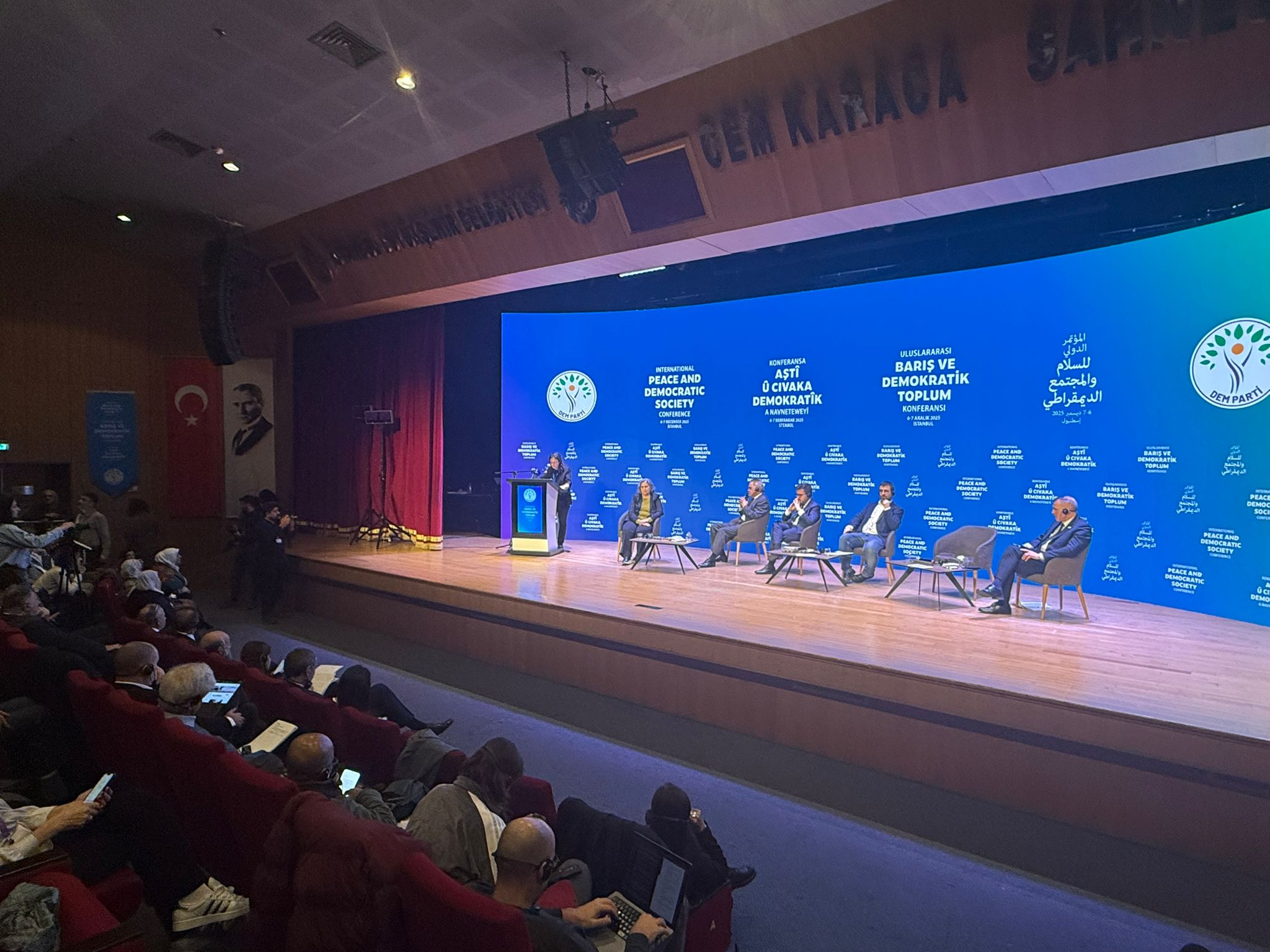
The International Conference on Peace and Democratic Society opened today in Istanbul with a message from Abdullah Öcalan and a forceful opening speech delivered by DEM Party Co-Chair Tülay Hatimoğulları.
Coming at a moment when political tensions in Turkey are shifting and new channels for dialogue are cautiously reopening, the event has quickly become one of the significant political gatherings of the year.
Hatimoğulları, speaking in both Arabic and Turkish, framed the urgent global context: “We have left behind a century full of wars,” she said. “Today, we stand on the brink of a third world war.” She warned that human life, all living beings, and the planet itself are under existential threat, calling for a renewed commitment to peace and democratic transformation.
The two-day meeting, attended by representatives from Kurdistan, Europe, the Americas and the Middle East, brings together political figures, academics, Nobel Peace Prize laureates, regional administrators and human rights defenders. The conference takes place at a historic turning point: a new round of dialogue with the Kurdish movement, led by the jailed leader Abdullah Öcalan on İmralı, has begun and continues with cautious optimism, while solid steps from the Turkish government are still awaited.
A Region in Turmoil: Hatimoğulları’s Call for Peace and Solidarity
In her remarks, Hatimoğulları condemned the escalating violence in Syria, particularly attacks targeting Druze, Alawite, and Christian communities. She warned that the democratic model built by Kurdish and local communities in northern Syria is being systematically dismantled by the Damascus administration.
“The construction of a democratic Syria—and the role of self-governance within it—must not be blocked; it must be supported,” she said.
She described the current political moment as a “critical stage,” where Turkey and the region face a choice between deepening conflict or embracing democratic solutions. Renewing past calls for negotiations, Hatimoğulları stressed that peace cannot move forward without acknowledging Abdullah Öcalan’s central role in any meaningful process.
Women at the Center of Peacebuilding
Throughout her speech, Hatimoğulları underscored that women must be the leading force in any democratic peace project.
“Women are the fundamental actors of peace. They are the founders, the subjects, the agents of transformation,” she said, arguing that confronting patriarchy is inseparable from confronting war.
She urged national and international solidarity between women’s movements, calling on women to “strengthen the will that extends the hand of peace.”
From İmralı Island: Öcalan Calls for a New Era of Democratic Society Socialism
In a politically significant written message sent from İmralı Island, where he has been held in isolation for 26 years, Abdullah Öcalan greeted the conference by announcing that a new dialogue process with the Turkish state has opened regarding a peaceful solution to the Kurdish question.
His message was read by Veysi Aktaş, who was imprisoned in İmralı Prison together with Öcalan and was released in recent days.
Addressing “all who still believe socialism is possible,” Öcalan declared that the Kurdish movement has entered a new phase. After 52 years of the PKK struggle, he argued, the fight for Kurdish existence and dignity has achieved its historical mission, creating the conditions for a democratic republic to be rebuilt.
Öcalan used the message to articulate his most comprehensive critique of 20th-century socialism in years. He argued that socialist movements failed not only because of capitalist repression, but also because they misunderstood the nature of the state.
“State-centered socialism seized the state, only to be defeated by it,” he wrote.
Instead, he put forward democratic society socialism, a model shaped by women’s liberation, ecological consciousness, and grassroots democracy. This paradigm, he insisted, provides the foundation for socialism to become “a living social force beating at the heart of the people.”
A Long View of History: Capitalism, Civilization, and Communal Origins
Öcalan placed modern capitalism within a 10,000-year historical arc, describing civilization as a “caste-based system of social murder” emerging with the domination of male hunter castes over women-centered communal life. He argued that this rupture — not merely the rise of capitalism in the 16th century — explains the roots of exploitation and domination in the modern world.
“Capitalism,” he wrote, “has become a disease threatening the very survival of humankind,” pointing to nuclear weapons, ecological destruction, and systematic plundering of nature.
He called on internationalist movements to reassess historical materialism and to understand history not solely as class struggle, but as a continuous conflict between communal and anti-communal social forces stretching back tens of thousands of years.
Peace Through Democratic Dialogue — Not Through the State Alone
Öcalan emphasized that meaningful socialism cannot be established through violent revolution or state seizure. Instead, he argued for a positive system of construction rooted in democratic dialogue, negotiation, and legal frameworks capable of transforming both the state and society.
He outlined a new concept, democratic integration law, built on three principles; Law of the free citizen, Law of peace and Laws of freedom and democratic society.
Such a framework, he said, would institutionalize democratic gains, protect societal freedoms, and provide the legal basis for lasting peace in Turkey.
“My relationship with the state,” Öcalan wrote, “is a relationship of democratization.”
He concluded his message by calling on the conference to foster new debates that can contribute to developing a renewed socialist program and political strategy for the 21st century.
Bakırhan: “This hall is where the will for peace takes form”
DEM Party Co-Chair Tuncer Bakırhan, speaking in Kurdish, described the conference as a site where “the will for peace becomes real”. “For more than a century, Kurds whose language and identity were denied continue to struggle for rights and justice. Including Kurds in the republic through law will bring stability not only to Turkey but to the region,” he said.
Bakırhan emphasized Abdullah Öcalan’s long-standing centrality to peace efforts:
“Since 1993, Öcalan has sought peace and its interlocutors. He transformed the logic of conflict into a language of justice. Even under isolation, he continues to produce ideas for peace.”
A Conference Marking a Political Shift
The opening day of the conference has signaled a shift in political tone in Turkey. Hatimoğulları’s remarks, combined with the breadth of Öcalan’s message, reflect a moment of renewed possibility — one in which peace, democracy, and a reimagined socialism are being articulated together.
Whether these ideas will shape the next phase of political developments remains uncertain. But today, in Istanbul, a new conversation has undeniably begun.
Set against decades of conflict, failed previous peace attempts, and region- and worldwide geopolitical crises, the conference aims to create a platform where political, intellectual, feminist and grassroots actors can openly discuss the prospects for peace and democratic coexistence, and provide a stimulus to the Turkish government and all actors to move forward with solid steps.
The Amargi will continue reporting from the conference with updates, interviews, and analysis.

The Amargi
Amargi Columnist