[Amargi Exclusive] In the Zagros Mountains, PJAK’s Co-chair Says Iran has “Already Collapsed” and Warns Against “Another Dictatorship”
![[Amargi Exclusive] In the Zagros Mountains, PJAK’s Co-chair Says Iran has “Already Collapsed” and Warns Against “Another Dictatorship”](https://cms.theamargi.com/wp-content/uploads/2026/01/ressize-Screenshot_2026-01-12_at_15.05.23-1.png)
Zagros mountains along the Iran-Iraq border – 12 January
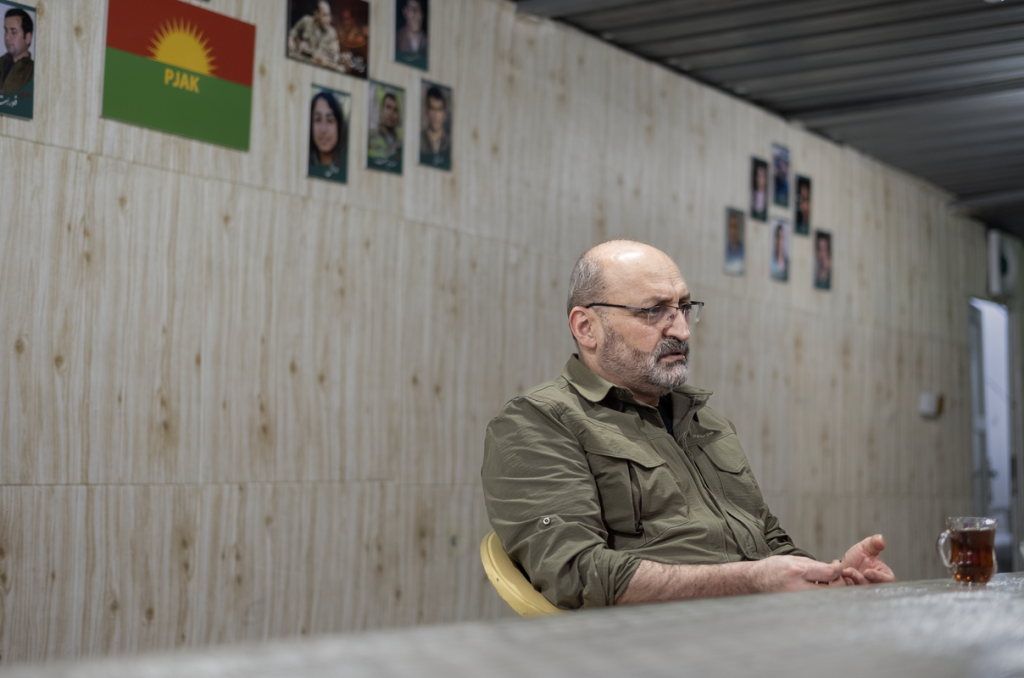
In a hideout headquarters deep in the Kurdish mountains along the Iran-Iraq frontier, Amir Karimi, the co-chair of the Kurdistan Free Life Party (PJAK), describes today’s Iran as a state still standing on paper but hollowed out in practice.
“The Islamic Republic of Iran has already collapsed,” he told Rebaz Majeed, a member of The Amargi’s editorial board, during a rare on-the-record conversation in the Zagros Mountains. “It still has a state, a bureaucracy, and a force. But… what is keeping the Islamic Republic standing now is only violence and force, nothing else.”
Karimi’s argument is not that Tehran has lost its coercive capacity, but that it has lost something more important: social legitimacy. He likens the Islamic Republic to “a human who is brain-dead; only their heart is beating.” In his telling, the current wave of unrest, intensified by severe communication blackouts, has forced Kurdish parties in Iran to rethink old rivalries and to prepare for a future in which the Kurdish question is either negotiated into a new political order or crushed by yet another centralised state.
What follows is PJAK’s view, in Karimi’s words, on the Iran protests, Kurdish unity, Reza Pahlavi, relations with Washington, Israel, PJAK’s connection to the PKK, and where the group claims to be strongest inside Iran, alongside what it says it wants from Tehran.
Rebaz: Since late 2023, and particularly following October 7th, the Middle East has been undergoing very rapid and serious changes. And Iran and Kurdistan are at the center of these changes. Currently, the streets of Iran are volatile, with protesters out demanding a change in the regime of the Islamic Republic of Iran. Despite the internet and communication lines being cut, the latest reports speak of dozens killed and thousands arrested. Recently, the Kurdish parties of Eastern Kurdistan (Iranian Kurdistan) released a joint statement, announcing their decision to take steps toward future stages within a shared political framework. I am currently sitting on the Kurdish mountains along the Iran-Iraq border with Mr. Amir Karimi, Co-Chair of the Kurdistan Free Life Party (PJAK), to discuss these questions. Mr. Karimi, thank you very much for this opportunity.
Karimi: Thank you, too.
Rebaz: Mr. Karimi, the Middle East is undergoing very rapid changes right now. From October 7th in Gaza to Lebanon, Syria, Iraq, and Iran, and to the fear that Turkey now harbors, which has led it to take steps toward a peace process with the PKK. And the changes currently occurring in Iran. All these changes indicate that the Middle East, even if its borders are not altered in the future, will be a very, very different Middle East. I want to know, are these changes occurring in the Middle East an opportunity for the Kurds to advance their cause and their political project in the region, or could they be a serious threat to the Kurdish political forces that are working for the Kurdish cause?
Karimi: Yes, from our perspective, both are possibilities. The fact that the rigid 20th-century system is collapsing—that is, the nation-state that is one-color, one-authority, one-language, and one-flag, where only one nation exists in all countries—like Turkey, or the Arab state of Iraq, Arab Syria, and Iran, a country where everything is defined within the framework of the Persian ethnicity. This was never an opportunity for the Kurds. In these countries, the nation-state is defined in a way that you are either part of the nation upon which the state is founded, or you are nothing. The Kurds have been placed outside the law, outside politics, and outside everything. They were either supposed to assimilate or perish. The Kurds resisted. They have resisted for a hundred years. All those Kurdish uprisings, all the wars the Kurds have fought, were all to survive. The Kurds have fought a war of existence and non-existence. They fought to be seen and heard. They have struggled for a hundred years for this. Now, as the structure of the nation-state is disintegrating, as that centralized, one-color, rigid, and severe system is vanishing, it is undoubtedly an opportunity for the Kurds. It is an opportunity for the Kurds to express their existence. For the Kurds to enter the field of politics and law, to enter the field of democratic political struggle. The Kurds must utilize this opportunity.
However, if the changes move in a direction that does not lead to democracy—if they lean toward dictatorship, despotism, a one-color identity, meaning a resurgence of nationalism or political Islam—it is certainly a danger to the Kurds. For example, we see this in Syria. The Kurds made all those efforts in Syria. It was not a global struggle; they were alone. The Kurds, who were not even given identity cards in Syria, established a system. They established good relations with the people. They developed democracy there. They accomplished all of that. Now, a central state is returning to power, which imposes its one-color, Arab element, and political Islam on the Kurds. And on all peoples, not just the Kurds. And because this is happening in the center, and because international law only recognizes the state, it creates a danger for the Kurds. What we see in Aleppo, we knew what its precedent was. But today, that state sees it as its right to attack the Kurds because the Kurds do not fit into its framework. So, that is dangerous. Therefore, we must see both sides. And part of this is not only related to how the international system or states behave, but it also relates to the struggle of the Kurds themselves. How does the Kurd define the system? How do they deal with that system? How should they struggle in place of that system? That also has an impact.
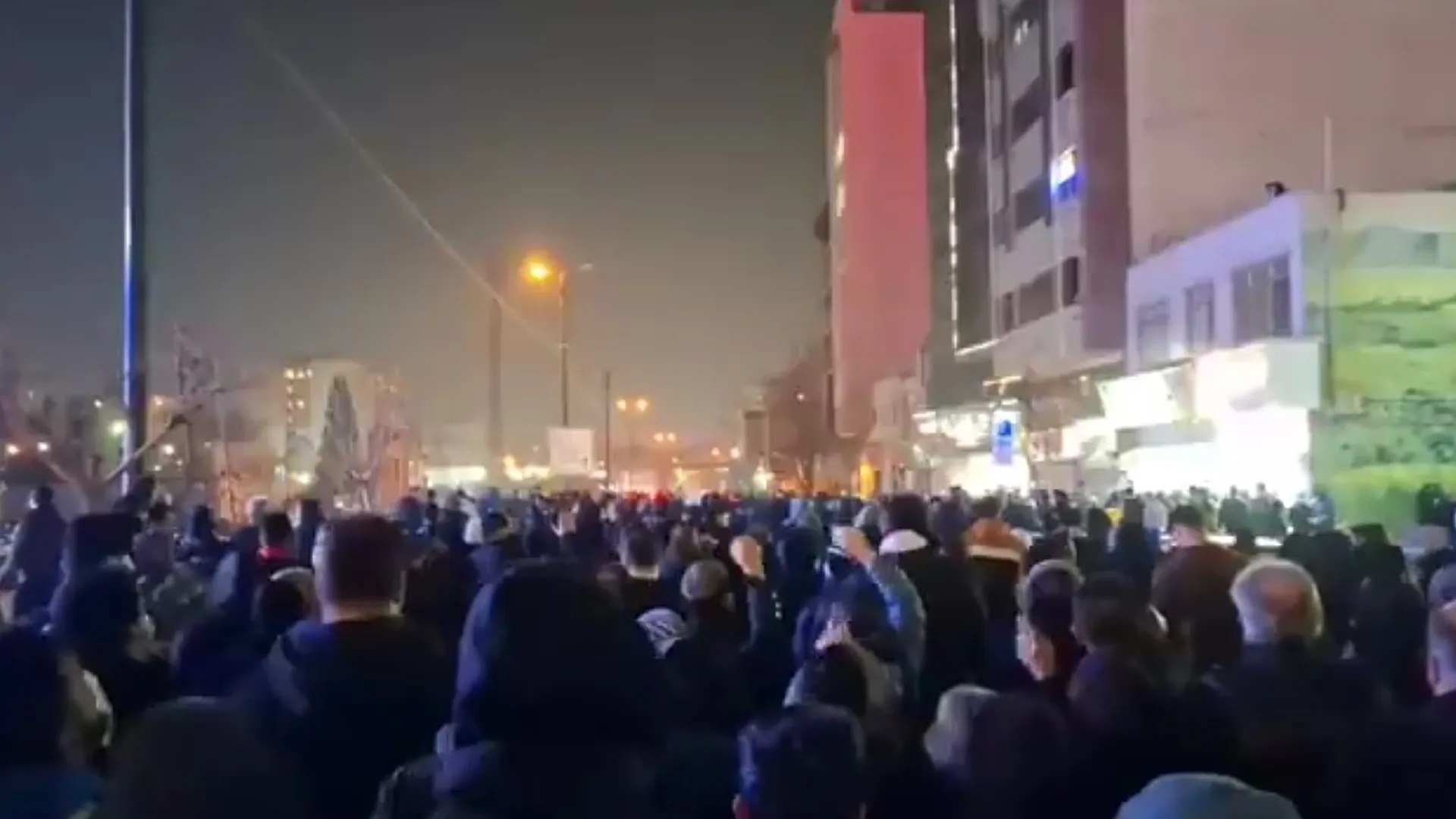
Rebaz: As we speak, the streets of Iran are highly volatile. In many cities and places across Iran, and especially in the Kurdish areas, particularly Kermanshah and Ilam, there are reports that in some places, the regime has lost its authority, and due to the communications blackout, we don’t know exactly what happened, but major world powers portray it as a dangerous threat to the lifespan of the Islamic Republic of Iran’s regime. And as the Kurdish political parties of Eastern Kurdistan, you have often been criticized for being severely disunited—calls for unity have constantly been directed at you. But in the past few days, we suddenly saw you issue a joint statement, published by the PDKI, where you together announced a joint framework, suggesting you have agreed to establish a common political framework to take steps together in the future stages of Iran. What suddenly prompted you to take this step? Do you genuinely believe that the lifespan of the Islamic Republic of Iran regime is over and it is collapsing?
Karimi: In reality, the Islamic Republic of Iran has already collapsed. What kind of collapse? It still has a state, a bureaucracy, and a force. But that alone is not enough. A state must have a foundation, a base within society, within the people. The legitimacy of the state and authority must be derived from the people. A state that lacks any legitimacy no longer exists. It is like a house whose foundation cracks and gives way—the roof and everything above will collapse. This is what is happening in Iran now. What is keeping the Islamic Republic standing now is only violence and force, nothing else. Previously, the Islamic Republic would use issues like religion, Iranian nationalism, or other colors to legitimize itself, drawing a segment of society to its side. We can now say that is also gone. That is why we can say that the state has collapsed. It is like a human who is brain-dead; only their heart is beating, and in the future, that heartbeat will stop. The picture is clear. For the Islamic Republic to remain standing, it has cut off all communication possibilities. Why? So it can comfortably massacre the people. We have serious doubts that it has carried out a major massacre. All of this in the cities far from the center, and in cities like Tehran. It is possible that it has collectively destroyed or purged people to remain in power. It is not clear; things will become apparent later. But the current appearance of the Islamic Republic is like a closed North Korea, and it is unknown what is happening. And what is very, very dangerous is that, as the Arabs say, someone who has fallen into the sewage will grab onto anything. It has reached that point; it grabs onto everything. And based on our understanding of the politics, mindset, and mentality of that state’s leaders and its ideological section, they will certainly commit massacres, absolutely. Because they say our legitimacy is from heaven, given to us by God, and therefore, the people are not meant to decide whether we remain or not. They do not grant this right to the people. And now the people do not want them. That is why they are heading toward non-existence. Now, a situation has emerged that requires a decision—it requires us to decide what we are doing.
In truth, for a while, we, the Kurdish political parties, for a while have made efforts to converge. Of course, some attempts happened before, but they were not very successful. This time, another attempt took place. We created a dialogue room, a center for dialogue, and a means of convergence. This is an effort; it is not something that has been fully created and where everyone has agreed on a single approach. Yes, it is the start of an effort. We want to have experience—the experience of dialogue. Dialogue is something that is not only not common among Kurdish forces but is generally not practiced in the Middle East. Force speaks; that is, in the Middle East, the language of force speaks. And relations are based on which force should submit to the other. There is no covenant among them; there is allegiance. One must become a follower of the other. Perspectives were based on that foundation. Now, the Kurdish political field in Eastern Kurdistan has reached the conviction that it can no longer be this way. No single force can impose itself on the others. The experiences of Southern Kurdistan (KRG), Rojava, and Northern Kurdistan have all shown us this.
Secondly, we all feel that we have a big problem, the Kurdish problem—that is, a big issue called the Kurdish question that must come to the fore in the Middle East generally. Currently, this issue exists at one level in Southern Kurdistan, at one level in Rojava with international impact. In Northern Kurdistan, it has a significant impact on the entire region, on the changes, on the change in the state’s politics and perspective towards politics and democracy, and so on. All these things have made Eastern Kurdistan also find its place within this great national issue. And secondly, it is a necessity now. We feel a necessity. Something has emerged among us: the Kurds must become a force that can raise their issue and solve it. But to raise their issue, they must be able to do so in a democratic atmosphere. Otherwise, there is no place for them. In a place where there is no democracy, you are forced to fight and clash only; otherwise, there is no place for you to raise your issue, or you must remain silent. That is why a democratic issue must be created. A democratic environment must be created, and in Iran, the Kurdish force must become the main force creating that democracy. And we see danger in that point for the future of Iran. In fact, besides believing that it is necessary and that we must first look at our own political issue and not neglect the Kurdish question, it is both a necessity and a danger. We have the experience of the beginning of the revolution in Iran in 1979 (the Iranian year 57), where the Shah was gone, and everyone was happy. The dictatorship was gone. But after that, a much more dangerous dictatorial system came. Will such a thing not happen this time? Is there a guarantee? There is no guarantee at all. We see the experience of a country like Syria. And the Kurds must create that guarantee. This is a matter of life for the Kurds. To create that guarantee, we are trying to converge, trying to become a force, trying to be influential.
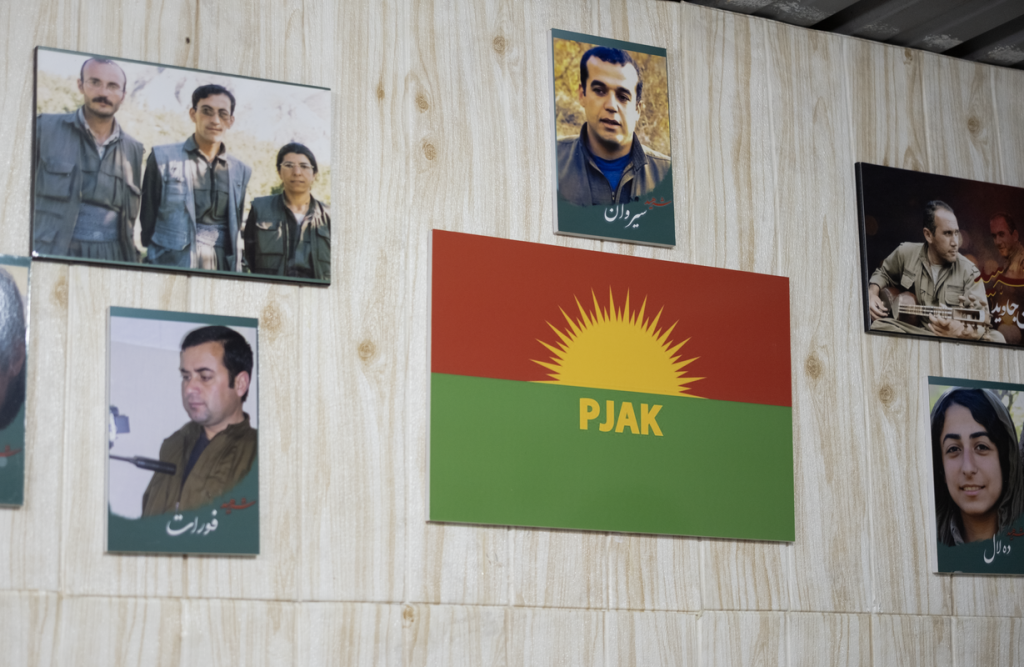
Rebaz: I will move on to the question of Iran’s future and what the scenarios might be. But you just mentioned that the regime is very violent against protesters, and there is no information because all communication lines are down. But it might have committed a massacre. My question here is: You, as PJAK, are known as a political party and a political force that does political work based on the self-organization of the people. Can you tell us, within the borders of the Islamic Republic of Iran, within the borders of Iran, what is the extent of your force in terms of geography? And do you have a specific number you can share, such as how many guerrillas you have? And how much of the public is sympathetic to and supportive of you among the people and on the streets?
Karimi: It is difficult to state a number. It is not something that we can go and take statistics on—who supports me, who doesn’t, and how much support there is. But PJAK is an influential force. In some places where the Kurdish political movement did not go before, it never went, or went very little. For example, the Krmanj, Mac regions, and so on, the classic Kurdish political movements of Eastern Kurdistan, especially after the Shah’s era, in the era of the Islamic Republic, were not very active there. We are strong there, truly. In the Mukryan region, in the Sanandaj and Ardalan region, Hawraman, we have been active in all those regions for years; we are present. We are present both as a guerrilla force and as an organizational force. And in those regions that were previously somewhat separated from classic Kurdish politics and were not given much attention or status meaning the regions of Kermanshah, Ilam, Lakestan, Lorestan, Khorramabad—they were not given much importance. Due to dialect differences, due to language differences, and due to a somewhat different historical trajectory, we have organizations in those places as well. We have a force in those places as well. It is true that we do not have guerrillas everywhere. That is also partly due to the situation. But we have an organizational force. In fact, we feel more like a political organizing force than an armed force.
But we know that the media and so on prefer to highlight the issue of the armed struggle. And the Middle East is known for weapons, war, and so on. Therefore, even for the guerrillas, we do not emphasize numbers, truly. We emphasize on quality. That is, the modern military style and approach also focus on quality. Now, that is about technology; it is about expertise. We work on that. And because we also do not believe that the problem is a military problem. And we do not believe that opposition should be solved only by military means. Therefore, armed action for us is a means of protection, not a means to go and use as a key to open the lock and solve the problem. As you said, Iran is a country where the main language is violence. Especially regarding the Iranian issue, especially regarding the Kurdish issue. Its perspective regarding the Kurdish issue is entirely a security perspective. As I said, any movement is defined as a threat to the state’s existence, to the country’s integrity. That is how they have defined it. Therefore, only the security and military sections deal with the Kurdish issue. And that means oppression, that means violence. Their politics are also for that purpose. Either assimilation, or them performing their ritual of resistance, meaning the Kurd becomes the state’s Kurd and is assimilated, or we have to resist, and when you resist, you become a dangerous Kurd and must be killed. From that perspective.
Of course, the Islamic Republic deals with all freedoms—for women, for nations, for those issues—very harshly, especially the Kurdish issue. For example, even now, a very high percentage of those being executed and arrested are Kurds. It is very significant. Therefore, in the actions of the Islamic Republic, we are always forced to protect ourselves. And we are forced to protect our people. Now that there is violence, we believe that the people must be able to protect themselves. Of course, the Kurdish people have some experience in this area. We also have a philosophy in this area called Legitimate Self-Defense. Every society must protect itself. It is not right that all means of violence should be in the hands of the state, and society should expect a solution from that very state. That is a legal problem in the nation-state issue. The right to violence belongs entirely to the nation-state, but what about society? Society can only complain to that state. What is it complaining about? Therefore, society must have the force to defend itself. To set a limit on state violence. And that is a universal right, a global right—the right to Legitimate Self-Defense. Within that framework, it is part of our organizational philosophy, part of what we do in society—what is called a democratic society—part of it is that this society must know that it must protect itself. It is its duty to protect itself. And self-protection is a natural thing. And it should not expect a force from outside, nor should it even expect the guerrilla force.
Rebaz: But if that’s the case, then what is the role of political parties, or for example, the political parties of Eastern Kurdistan? What is the role of a party like PJAK, if all responsibility is placed on the people to protect themselves?
Karimi: Well, is that party not part of that people? It is the party’s duty to establish that philosophy. Why? The party should not be separate from the people. That party should not be above the people. That era is over, where the party is the leader and the masses are followers of the party. On the contrary, the party must be a part of society. The party must gather the force and energy of society that the state has dispersed. If you look at the modern era, it should be like this. The state system works based on the state and the citizen. The state is not society; the state is the citizen. The state and the individual. The individual is important. The individual must be free. The individual must have a will. But in the modern system, in the state system, that is only talk. The individual is not that [free]; there is this issue that Max Weber calls the “Iron Cage” they have imprisoned us in. Man is helpless against the state. Isn’t that right? But a person who is part of a community, whose social relationships are strong, who has an identity in society, can protect themselves based on that identity. They are protected by their relationships. Isn’t that right? They have force, they have support. We want society to be revived, those relationships to be revived. We work for that. The work of the party, in our philosophy and PJAK’s, is society. The work of the party is not to make itself the ruler of society and dictate decisions to society.
Rebaz: Let’s return to the events currently happening on the streets of Iran and Kurdistan. Iran is a country that holds a very, very important geopolitical position in the Middle East, and many Western countries, major powers, Europe, and the US look at it with importance and speak about it, and it is important to them which direction it takes. Currently, in this void, various major powers are sending different messages. And they are closely monitoring the events. According to a Jamestown Foundation report published in 2009, it was mentioned that in 2006 in Kirkuk, the Americans met with PJAK and asked PJAK at that time to cooperate with the Americans to put pressure on the Islamic Republic of Iran. According to my information, PJAK rejected the request at that time because it did not want to become part of the politics of non-state actors under the shadow of a major power. Now that the situation in Iran is so sensitive and everyone is watching cautiously—whether in the 12-day war or now—have the US and European countries directly or indirectly contacted you and asked for cooperation or help?
Karimi: Yes, if you are a prominent political force and have weight, definitely. PJAK has a set of relationships, dialogues, and discussions with forces. Only the extent to which we cooperate with which force and to what level, those are very, very different. We have a covenant. Our covenant is that we strive for the rights of our people. And we strive for democracy. That is, a democratic system must be established. The Kurd must become a fundamental element. They must lead the way for democracy. The issues of the peoples must be resolved in that democratic system. If a force, a state, supports that and works toward that, we can cooperate with them. We do not believe that an external force should come and solve everything in Iran and everyone submits. No, nothing like that. These are natural things. States look after their own interests. But do their interests truly serve democracy and a progressive life in that country? And secondly, what is our policy and strategy regarding the Kurds and the Kurdish issue? Cooperation is never unconditional. If you cooperate unconditionally, it is only on the basis that that country is a major power, and you must belong to it. It is nothing more than that. Many times, the Kurds have cooperated with world powers, but they have been harmed. And our history is full of such things. Therefore, these things are not done simply like that.
Secondly, we have a line. Our line is what we call the Third Way. One, we are truly against that dictatorial state. And in this opposition to dictatorship, we are the most serious because we believe in a very deep democracy. We believe that all colors in that society must have rights. The dictatorial system is very afraid of that. I don’t mean just changing the authority. The state prefers a force to come to power, but when it wants society to become a force, the state is very afraid of it. And we are that force, the force that looks toward society. That is why we are against dictatorship. But we also do not believe that an external force will come and be an angel for us and come to save us and become our Messiah, and so on. We do not believe in that either. We read their interests. That is why we believe that the one who must decide, the one who must determine the destiny, the one who must create a democratic Iran and a free Kurdistan through their own struggle, is the struggle of the people. The people themselves. The people must rely on their own strength and energy. That does not mean there should be no flexibility in politics. No diplomacy. Not seeing the changes in strategic situations. Not working on those things. We do all of those things. And we have relationships. And we also keep in mind to what extent it is, and to what extent the interests of ourselves and our people are considered in the outcomes. It is not unconditional. We know their weight. The world powers and the existence of the region have created a change in the region. We also read that. In that regard, there are relations. But to the extent that we put ourselves in the service of someone, or become someone’s soldier.
Rebaz: And you said there are relations. There are diplomatic relations. With other countries and perhaps a country in the region that is currently looking at Iran and the future of Iran with attention and importance and sees its interests there is Israel. And a large part of the changes that have happened in the Middle East since October 7th until now, in reality, the main actor is Israel. So, currently, both now and during the 12-day war, do you have relations, diplomatic relations, with the US, with European countries? Is Israel one of those countries where any direct or indirect channel of communication has been established?
Karimi: The US, especially the US issue, is somewhat different. The US is an international force and has certain programs and things. It has importance. For Israel, the issue is somewhat different. We honestly do not know exactly what program Israel has, especially regarding the Kurdish issue. We have not had any contact. But the contact has not been at the level where we truly know what they want. Therefore, we do not have an open relationship with Israel now. We also do not have cooperation. But we say that if any force supports democratic change and the rights of the peoples, we are open to that. But we must know what their program is, and we must be certain that they do not look at the Kurdish people, at the force of struggle, at that democratic struggle with the eyes of a tool or a very, very pragmatic view. And we must know that in the end, they will not impose something on us.
For example, something concerning for the Kurdish people and for all democracy in Iran is Israel’s support for Reza Pahlavi. They have met several times. Of course, Reza Pahlavi’s propaganda machine exaggerates the issue greatly. But to the extent that we see it, Israel is tacitly supporting him. The people, the peoples of Iran, and the Kurdish people within them, do not want to fall into another dictatorship. The past experiences told us that. In Iran, the Shahists should be parties, or other political parties, but not that [one]. But when you see a leader being created from outside and something being imposed, if that person becomes the leader and rules in Iran, it will certainly make things worse. Especially the mindset we see in him—that denial, undemocratic approach, and refusal to accept democracy and the rights of the peoples—creates some issues. It creates doubt and suspicion toward them. I believe Israel should address those concerns. Address those concerns that it does not have a project to create such a leader for Iran. And secondly, that it should become a tool close to the power of the peoples and democracy. Israel’s elements are a reality; it is a state. The Jewish people are a very ancient people. They have an existence here. They have lived with the Kurds for years. They are in Iran. And all of them live in consideration.
Rebaz: Besides that, do you have any relations, as PJAK, with the other nations inside Iran—the Persian opposition, Azeris, Baloch, Arabs, and others? Do you have any coordination or connection to work together for the future stages, if something happens in Iran, to take steps together?
Karimi: Yes, we have relations. Especially with the struggle of the peoples. There is a level of cooperation too. But there is a problem. And that is, how much force does the opposition that has gone abroad truly have inside? That is not clear, honestly. The problem with those peoples and that opposition that is stuck abroad is that their political perspective and political mindset are stuck in the past, as if they are disconnected from Iran. For example, we have spoken with a segment of the opposition. For example, they still think it is the year 1979. They still think it is the beginning of the revolution. They still think the balance of forces is still the same. They still think society is still the same, stuck. Most of them are like that. While there are very, very large and serious changes internally.
For example, PJAK is different in this regard because PJAK has never been disconnected. We have force in organization, and it is young. That is, those who support PJAK are not the traditional part of society but the youth part that wants change. Therefore, we deal more with the changes in society. And we see how far disconnected [the external opposition] is. Therefore, this gives us some concern. That is, how much can they manage with that external influence? We do not reject them. They have had difficulties; they have struggled. They have supporters; that is another thing. But they do not have force internally. They are not a distinct force within the framework of that opposition.
That is, internally, there is an unorganized kind of opposition, a kind of opposition whose structure has not been fully defined yet. That is, those intellectual and political currents are circulating inside Iran. And because the ruling system does not allow them the opportunity to organize, they cannot organize themselves. But in the future, all of them will emerge. If an open political atmosphere is created, dozens of political and intellectual groups and social and civil organizations will emerge that have not had the opportunity so far. And the volume and number of these will surpass all the old opposition, the opposition that is abroad. And we make that prediction. We see that future. And we work more on those. Our allies—that is, those we consider allies as PJAK—are those forces that will become the foundation of a democratic society in the future of Iran. The force of women, the force of environmentalists, the force of oppressed peoples, the force of religious groups, and the minorities who have been denied. All those who have remained outside the authority and are in opposition to the authority. All of them are considered our allies, and in practice, you will see. For example, they are drawing closer to PJAK. For example, the force of women who seek democracy—they work in parallel with PJAK. As I said, because they have not yet taken on a very clear and obvious structure within the framework of that political reality, but in the future, all of this will happen. And one clear thing is that they had a fundamental role in the “Woman, Life, Freedom” revolution. And the “Woman, Life, Freedom” revolution, is their’s and PJAK’s, It is essentially revolving around that relationship. And that is something we rely on.
Rebaz: What do you mean by the “Woman, Life, Freedom” revolution belonges to them and PJAK?
Karimi: The “Woman, Life, Freedom” revolution is a social revolution. It is the revolution of those forces that exist within society but do not have an opportunity to express themselves. Political parties exist in the “Woman, Life, Freedom” revolution—parties and groups—but they are not the main force of “Woman, Life, Freedom.” They cannot digest that too. Why? Because the discourse of partisanship, generally speaking—I’m not just talking about Kurdistan—is in some way an attempt to seize power. The competition is over power, isn’t it? And in some kind of system and structure, there is a kind of patriarchy, a kind of authority, a patriarchal authority. A kind of system where “we determine” and they rule over society. They see society as a mass, don’t they? In English, they call it the “mass.” That is, they see it as something they can shape. That is, impose their will on society. All of these are against the philosophy of “Woman, Life, Freedom.” But the force within society that does not want anyone to determine its fate and wants to determine its fate based on its own specific characteristics, to work with other parts of society—that is the force. The “Woman, Life, Freedom” revolution is the revolution of intersectional identities, isn’t it? That is, those identities, that intersectionality, must live. The revolution is the revolution of those colorful identities that are mixed with each other. And that greatly surpasses the framework and mold of 20th-century political and party struggles. And PJAK’s struggle is fundamentally of that nature. Our philosophy is of that nature. That is why we consider this revolution our own.
Rebaz: Mr. Karimi, given PJAK’s proximity to the theses of Abdullah Öcalan and its proximity, and given that one of your political projects is Democratic Confederalism, which is a thesis by Abdullah Öcalan, the criticism has constantly been repeated and spread that you are essentially just a branch of the PKK and do not possess any of your own decisions or sovereignty. You, as those ideologically close to Abdullah Öcalan and his theses, how can you preserve your sovereignty? How can you have your own decisions?
Karimi: Of course, those discussions no longer exist. Let’s say that too. That was a period of propaganda that they launched against us. There were some parties that were afraid of us organizing ourselves and becoming a force. They felt a sense of rivalry. Some parties were afraid of our thought, meaning afraid of Leader Apo’s thought and that philosophy. For example, there is a party that is afraid of society being aware. Some parties talk about freedom and so on, but in the end, they want to rule over those people. Ruling over ignorant people is very easy. You cannot easily rule over an aware people. You, knowing the systems of democratic countries, you know that. The authority must always be accountable to the people. In the Middle East, that is not the case. No one can hold the authority accountable, can they? They are against that that too. The state of Turkey is afraid of it there. The state of Iran is afraid of it there. An aware people, an aware society, a society that governs itself. It is the owner of its own force. It restricts the state’s space. It expands its own space. It makes decisions for itself; The state can no longer intervene in all of their affairs. That is a threat to them. They oppose it. And in that opposition, they then reject it. That you do not have a will. While we are a movement of will. We talk about society itself having a will. PJAK does not take instructions from anywhere. We have said this before. This entire ideology, for example, are socialist movements only connected to one thing, or are they connected to one center that gives them one decision? There is the Socialist Party, the Social Democratic Party, for example, in Sweden. Those are all Social Democrats. Who makes decision for them? Don’t they make their own independent decisions? Being of the same thought does not mean there is a decision-making center.
We have a kind of coordination with them. The coordination is at the level that we have one issue: the Kurdish issue. Unfortunately, in the last century, that necessary coordination did not exist in the struggle of the parts of Kurdistan. That largely harmed us. For example, in Southern Kurdistan, they were fighting against Iran, and at the same time, they needed relations with Iran. Isn’t that right? When they went to Iran And Iran’s condition was for them to do some things against the Kurds in Eastern Kurdistan (Iran). Isn’t that right? It was also done; you see it. The ones in Eastern Kurdistan did the same with Iraq. They also have some conditions. You know. Those things become a reason for you to be forced to work against another part for the sake of your own part’s struggle. That is not the case. We want that not to happen. For that, we want to coordinate more with the struggle of the other part rather than with the state that is invader there. And we have that thing. We also have some dialogue. That does not mean that we give instructions to each other. There is a kind of coordination involved. There is a kind of coordination involved where we talk about not doing anything that is political or works against that part. There could also be flaws and mistakes. That thing must come out. And that is the world of politics, but we have the right to criticize each other, the right to account for each other. That exists. Because we must keep that in mind. The movements are also forced to be with the states. For example, Should not the PKK have relations with the state of Iraq? Of course, the PKK no longer exists. That discussion is not relevant. But for example, that force, let’s call it the force of freedom, the force of the Kurdish people’s freedom in Northern Kurdistan. Mustn’t they have relations with the state of Iraq? They must, but that relationship must not be at the expense of the Kurds of Southern Kurdistan. Mustn’t they have relations with the state of Syria. They can have it. But it must not be against the interests of the other peoples. They can also have relations with Iran, and they do have it. But it must be a relationship that is not only not against the Kurds of Eastern Kurdistan. Rather, all those states that we have relations with. It is a shared interest. But you must do that thing. You must consider the rights of the Kurdish people. And those parties that have adopted Leader Apo’s thought have that thing. For example, let me give an example. I remember a time when Mr. Salih Muslim came to Iran. They asked him what their policy was regarding the Iranian state. He answered that he did not come here for that. Then he said, “They must only grant the rights of the Kurdish people.” For example, we see that he does it less comparing to KRG or the movements of Southern Kurdistan. They only say Iran is goof for the Kurds. They do not say that steps must be taken; that the solution to the issue that steps must be taken. That is the minimum expectation that we believe the Apoist movement in Northern Kurdistan is doing. If we have a relationship with a state like the state of Turkey, that relationship must certainly be based on the principle that it should not do anything against the Kurds of Northern Kurdistan. It must be based on the principle, that it advances a solution for that part. Therefore, we emphasize again. That is propaganda; it is not true. And now that the PKK has dissolved itself, has separated itself, they cannot even do that anymore. If it were true, with the dissolution of the PKK, we should have ceased to exist, but we are stronger than before.
Rebaz: You mentioned the dissolution of the PKK. Now that Turkey and the PKK are in dialogue and seeking to resolve the issues peacefully, is there a scenario where, if the Islamic Republic of Iran’s regime does not fall or is under heavy pressure now, would you have any intention to present your political project for the future of Iran and Kurdistan through dialogue and peace instead of war and violence, and resolve the issues through dialogue?
Karimi: We have made efforts from the beginning. We have even released proposals and declarations to the public several times on how the democratic resolution of the Kurdish issue should happen and what steps must be taken to establish democracy in Iran. All of those have been presented. But the ground is not there; the ground for change, the ground for listening, the ground for dialogue. The Islamic Republic is in no way prepared to create change within itself. Also regarding the Kurdish issue and removing the security perspective on the Kurdish issue, also regarding the issue of freedoms, regarding those issues. It insists on its politics and extremism, which it has done until now. The Kurdish dialogue with the Islamic Republic has also not been very fruitful until now. Other parties have experience. We have not had a direct dialogue with the Islamic Republic so far, but we have always said this. We are ready for a democratic resolution of the Kurdish question. Because this issue must eventually reach that point. The Kurdish issue must reach that point. Whether that state remains or not, the Kurdish issue is not only with one regime. The Kurdish issue is with a system that has been in place for 100 years. Since the time of Reza Shah, since 1925, that issue has been in place. This year was also the 100th anniversary of the nation-state. PJAK has also had much dialogue and discussion on this. Some intellectuals and other parties have also made efforts in this regard to draw attention to the issue of how the nation-state is a deadly phenomenon for the Kurdish question, for the Kurdish identity, and for the issue of democracy. And we are against that phenomenon.
Now we want to know this. After 100 years, is there an opportunity to work in a system in a system that we call “State plus Democracy”? To work in such system. That is, a system where issues are not viewed from a military, security, or armed perspective. They are viewed from a political perspective. A political field where we can go and talk about the issues. Where we can struggle. A field that is legal. Where there is a parliament. A place where you carry out your work. Where you struggle. Where the society can organize itself. Society becomes one that holds accountability. It sets limits for the state. It expands itself. According to us, field for democracy is society, and the state is the field for authority and society should be able to impose democracy on the state. That is what we work for. Will that be created for us in the future of Iran? That is our issue. Therefore, our problem with the intellectual system of the Islamic Republic is partly that very nation-state perspective, and to a very large extent, they have added the official religious system and Wilayat al-Faqih (Guardianship of the Jurist), and they have centralized their authority much more and made it much more sacred. And they have significantly deepened the problem. That is, now they say, if you can work with the Iranian state in some way, you must have belief in their faith. To become a part of their belief system. We are not a part of their belief system. The Kurdish people reject that. If that is the case, it does not allow for dialogue. They view us as an enemy, as an infidel, and as an enemy of God and the system. They look at you and attack you. That ground does not exist in the Islamic Republic. And we do not believe that it can create that ground anymore. So far, there is no sign, no pulse, no indication that this system is even thinking about resolving the issues. Thinking about giving an opportunity for resolution and for democracy.
Rebaz: We also talked in the previous question about the possibility of past Kurdish parties’ relations with the region’s countries. You mentioned the possibility of PJAK’s relationship with Turkey as well. Are you open to establishing a diplomatic relationship with Turkey in the future?
Karimi: Yes, why not? It is Turkey that has Kurdish phobia. Turkey wants the Kurds to be weak. It especially fears a Kurd whose ideas originate from Leader Apo, Mr. Abdullah Öcalan. It is afraid of that; it has a phobia. While if Turkey breaks that phobia, if it deals democratically with the Kurdish issue, In fact, Turkey itself will become a power. We do not have enmity toward Turkey. We have not carried out any activities against Turkey so far, nor do we have enmity. Turkey attacks us. So far, several of our comrades have been martyred by Turkey. While we are facing Iran, our focus is on the Iranian issue, not Turkey. We have not interfered in the Turkish system. Therefore, if Turkey changes its political behavior and is open to dialogue, why not? Turkey is a force in the region, and we can have dialogue. We can have diplomatic relations with it, why not?
Rebaz: Mr. Karimi, my final question. With everything we have discussed, due to the situation and developments in the Middle East and what is happening now in Iran and Kurdistan, what is your political project for the future of Iran? What is your political project for the future of Kurdistan?
Karimi: For the future of Iran and Kurdistan, we have an idea. That is, we talk about Democratic Confederalism. We talk about the Democratic Nation. We talk about the convergence of identities. Look, the Kurdish issue is not only the issue of being under pressure from a system which exists. But the issue is how Kurdish society organizes itself internally. How it expresses itself. How it creates its institutions. How it strengthens democracy internally. These are two sides. Our politics for the Kurdish issue are not only politics of liberation. it is also the politics of life. How does the Kurd live? What is the Kurd, essentially? What is the phenomenon of the Kurd? How should it be defined? Those are questions for us. We have something called the Free Kurd. What is the Free Kurd? That is the Kurd who is free as an individual, free as a society. For example, what are the diverse identities within the Kurds? Is the Kurd just one identity, and that’s it? What about the differences within the Kurds? How do those differences live with each other? How do they accept each other? How will the issue of women be resolved in Kurdish society? The issue of the environment, the issues—all those issues that a human society faces, Kurdish society also faces. That is one.
And secondly, the Kurd must have status in terms of liberation, and Kurdistan must have status. The Kurd must have status. And no legal or political obstacles should remain against them. The Kurd must be able to govern themselves. That is the solution we see for the Kurdish issue. But there is something else here. Kurds must remain a force. For solving their own issue. Kurds must be powerful inside Iran. They must be at the center. They must not isolate themselves. Look at today’s world, whoever enters their borders becomes weak. Now all of the efforts of America and Israel is to limit Iran into its borders. They want to cut off its external reach. Everyone who becomes force, surpasses its borders.
According to us, the Kurdish issue must surpass ethnic limits. Kurds must have a program for all Iran. If Kurds are not in the center, the ones who are in the center will decide for the Kurds. The Kurds should be there to decide for themselves and also for everyone. That is why we have a program for Iran called the Democratic Republic of Iran. It is a state, but a decentralized system transcending the nation-state. There is self-governance for the peoples. There is a solution for the women’s issue. There is a change in the political mindset. It becomes a force without dominant nationalism. There is room for radical community democracy. The community elects its own representatives. Where the communities can influence on the political decisions. The decisions that concern them. We know that it is a very different system, and it requires struggle. We are ready for that struggle. And there is another thing here in Iran that is very important. That is the relationship between the peoples. Because tomorrow it will become a layer of problems. Now in Iran, there are Kurds, there are Azeri Turks, there are Arabs. There are Baloch, there are Lur-Bakhtiari. There are all kinds of peoples and nations, some of which are very mixed, some less mixed. If, from the perspective of the nationalism of the peoples, the issue of geographical borders becomes a fundamental situation, it will become a problem. That is, if they also think like a nation-state—that one geography belongs only to one nation, and only one nation can dominate it—it will become a problem. Therefore, the political perspectives of these nations must change. A formula for common life must be found. We cannot, and we do not have the right, to expel any nation from any geography. To dismiss any nation. They also do not have that right against us. Therefore, in some places, we must be able to live together, govern together. And have a shared country in some places. That is, some places should be my country and someone else’s. Some places should also be Kurdistan. No one can deny that. But it can also be a country for others too, But together.
How should the governance system be? If the governance system is like a nation-state—where only one nation speaks there, only one nation has rights, everyone must be subject to the laws of one center—it will become a problem. Therefore, perspectives in terms of democracy and so on are very different from the perspective we think about. That time a democratic republic, a democratic life of the peoples, a life of freedom of the peoples with each other, along with that a system of advanced democratic nationality inside inside the Kurds that for itself means it sees the internal differences and solves them, That is the general formula that we accept for Iran. We accept for Kurdistan. And we work for it.
I want to also point out, that many sides, accuse us that [our care for] Kurdish national issue is weak. On the contrary. PJAK is a national movement. A very strong national movement. But a democratic national movement. Kurdish national issue within PJAK is based on a deep foundation of patriotism. Not on a kind of hollow nationalism and on the basis of hatred for the other nation and denial of the other. It is based on coexistence and on the basis of common life and on the basis of a democratic formulation. We are looking for alternatives. Therefore, we want to have a positive role. Not a negative role. What is a negative role? For example, an enemy comes, and you say that enemy must be destroyed. Those things are also our right. The enemy, dictatorship, oppression—those must be destroyed. But that is not just something you don’t want. We want something, and we must formulate it. That is what is somewhat weak among the Kurds. We have a formula for that. Therefore, we want to play a positive, constructive role. The Kurds must have a role in the construction of future Iran. They must have a main role. And the Kurds must not only look at their issues from a national and ethnic perspective. They must look at it from a broader perspective. Because that is what makes the Kurds a force. For example, look, no people are as ready as the Kurds for democracy now, to struggle. Because the ruling and oppressive system must be broken. Its chains must be broken. In the issue of women, Kurdish society, the Kurd is a pioneer. We saw that in the “Woman, Life, Freedom” revolution. A political experience and a struggle of Kurdish women have been created that can lead the way in every field. We have an ancient history. They have a strong culture. We are in the field where the Kurd must work with self-confidence. The Kurd must not limit themselves and restrict themselves to the existing formulas. The Kurd must advance solutions. Advance formulas. That is a self-confident and strong democratic nationalism. And we work on that. And in the end, democracy will emerge from it for all peoples, freedom will emerge from it, common life will emerge from it. A strong and democratic Iran will emerge from it. And a free, proud, self-governing Kurdish people can emerge from it.
Rebaz: Mr. Karimi, thank you very much for the opportunity you gave us.
Karimi: We thank you too.
Rebaz: Thank you very much to you, the viewers, and until next time.

Rebaz Majeed
Rebaz Majeed is a Kurdish journalist, researcher, and photographer based in Berlin whose work bridges conflict reporting, academic inquiry, and digital fact-checking. He has covered politics, migration, and security in Iraq and the Kurdistan Region for Voice of America, and later worked with Lead Stories as TikTok’s fact-checking partner for the MENA region, specializing in misinformation and digital verification. His research has explored gender, violence, and political dynamics in Iraq. A polyglot journalist, Rebaz holds a BA in International Studies from AUIS and an MA in Interdisciplinary Studies of the Middle East from Freie Universität Berlin.