Erdoğan’s Nationalist Ally Sets Syria Roadmap, Targets Kurdish Autonomy
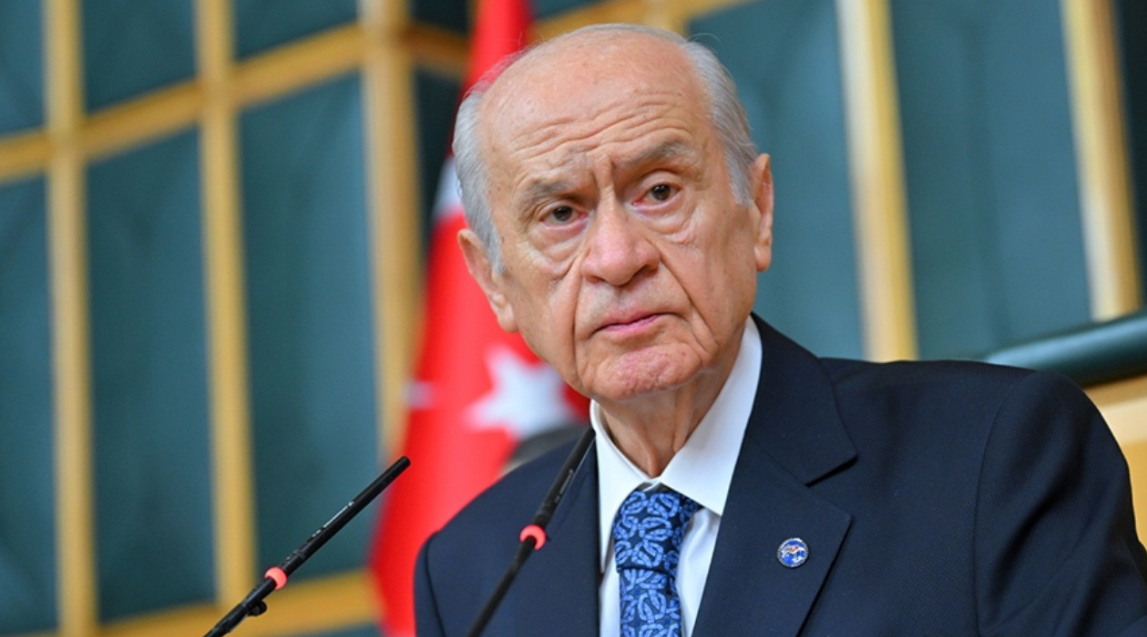
Photo Credits: Mezopotamya Ajansı
Nationalist Movement Party (MHP) leader Devlet Bahçeli released a written statement on January 18, 2026, addressing recent developments in Syria. Bahçeli’s statement targeted the Syrian Democratic Forces (SDF) and laid out an eight-point “road map” for Syria’s future, which severely restricts Kurdish political and cultural rights.
The statement came after the Damascus administration launched a siege and attacks on the Kurdish-majority neighborhoods of Sheikh Maqsoud and Ashrafiyeh in Aleppo on January 6, immediately following a Syrian-Israeli agreement in Paris.
More than a foreign policy assessment, Bahçeli’s road map reads like a projection of Turkey’s security-focused anti-Kurdish paradigm onto Syria: it emphasizes Syria’s “territorial integrity” and the “strengthening of central authority,” takes aim at Kurdish political agency, and on the issue of mother-tongue rights falls short of even the interim administration in Damascus.
What Did Bahçeli Say?
Under the heading of education, Bahçeli proposed that Kurdish be included in the curriculum only as an “elective course.”
In his statement, Bahçeli argued that the SDF has established “de facto zones of control” in Syria and claimed that this structure is one of the main obstacles to the country’s reconstruction and stability. Drawing a distinction by saying “Kurds are one thing, the SDF is another,” Bahçeli asserted that the SDF does not represent the Kurdish people and called for the complete dismantling of the group.
The following points stood out in Bahçeli’s eight-point road map:
- Full implementation of the March 10, 2025 agreement;
- dissolution of the SDF and similar structures;
- complete removal of debates on federation and autonomy from the agenda;
- and the establishment of central government authority across the entire country.
Under the heading of education, Bahçeli proposed that Kurdish be included in the curriculum only as an “elective course,” while strongly emphasizing the preservation of the principle of a single official language.
By limiting Kurdish to an elective subject, Bahçeli’s position reveals that Ankara’s approach lags behind even that of the transitional administration in Damascus, which issued a decree recognizing Kurdish – not as an official language, but as a “national language” – and allowing its use as the language of instruction in Kurdish regions in the aftermath of the January attacks on Kurds in Aleppo.
Bahçeli’s distinction between “Kurds” and the “SDF,” while superficially inclusive, does not constitute a genuine discussion of representation; rather, it operates as a strategy of delegitimization. Within this framework, Kurds are treated as an abstract, depoliticized, and passive community, while all structures through which they organize and emerge as political actors are framed as threats to be dismantled. This reflects a long-standing approach in Turkish domestic politics – accepting Kurdish existence, while rejecting any form of Kurdish political organization or self-representation – now projected onto Syria.
Territorial Integrity: Applied to Kurds, Not Israel
A selective use of the concept of “territorial integrity”: tacit acceptance of a foreign power’s military occupation on the one hand, and the targeting of Syria’s own citizens for exercising non-hostile forms of self-rule on the other.
Although Bahçeli’s road map places Syria’s “territorial integrity” at its center, it falls short of addressing a real occupation in the country’s south. Despite the fact that the Golan Heights and the Quneitra region – recognized under international law as Syrian territory – remain under Israel’s de facto military and administrative control, Bahçeli’s statement offers no assessment of this reality.
The same silence came from Ankara regarding the Sharaa administration’s agreement with Israel in Paris on intelligence sharing and a de-escalation mechanism. The January 6 agreement reached under U.S. mediation implicitly acknowledges Israel’s de facto presence in southern Syria, given its omission of or non-challenge to the Israeli control over the Golan Heights.
Taken together, this suggests a selective use of the concept of “territorial integrity”: tacit acceptance of a foreign power’s military occupation on the one hand, and the targeting of Syria’s own citizens for exercising non-hostile forms of self-rule on the other.
A Shared Anti-Kurdish Narrative in Turkish Media
The editorial line that emerged in the Turkish media during the attacks on Aleppo was also notable. Across a broad spectrum from pro-government Islamist outlets to opposition Kemalist media, the assaults were legitimized under headlines such as “counterterrorism operations,” while civilian casualties and mass displacement were largely ignored and the SDF was equated with “terrorism,” showing that when it comes to the Kurdish issue in Turkey, ideological differences between political camps are often suspended in favor of the official anti-Kurdish narrative.
According to Kurdish political actors, Ankara’s Syria policy directly undermines the prospects for resolution and peace in Turkey.
Speaking on this issue, DEM Party Co-Chair Tuncer Bakırhan criticized the media’s language around the conflict, arguing that the way the situation was being discussed did not reflect a commitment to peace and instead helped normalize violence and exclusion rather than truthfully reporting on the human impact of the attacks.
Implications for the Peace Process in Turkey
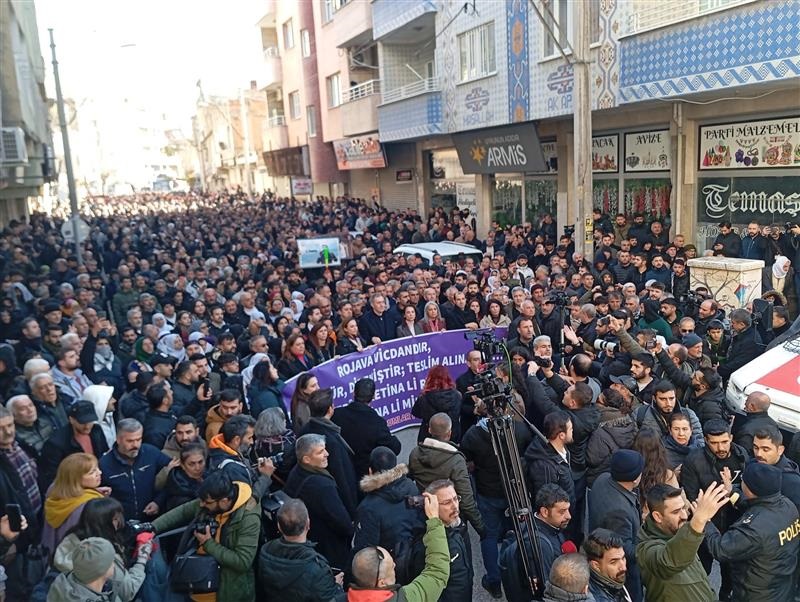
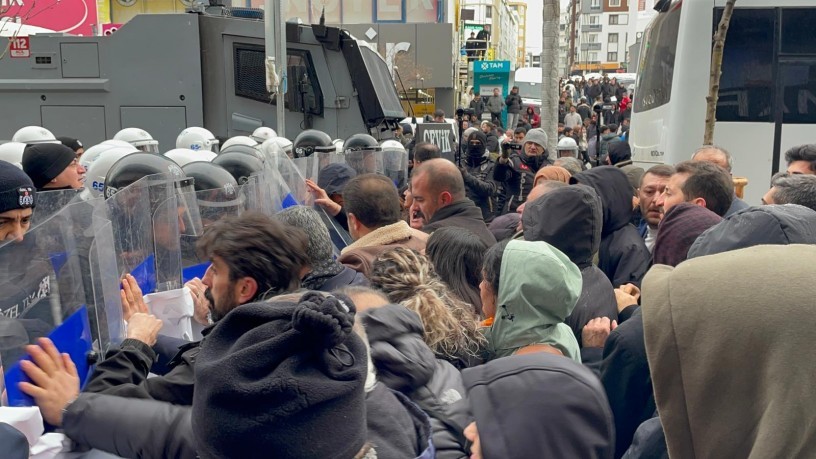
Statements by DEM Party leaders and protests held in many cities make clear that developments in Syria cannot be treated merely as a matter of Turkey’s foreign policy. According to Kurdish political actors, Ankara’s Syria policy directly undermines the prospects for resolution and peace in Turkey.
Responding to remarks Bahçeli made during his most recent parliamentary group meeting, where he referred to SDF Commander Mazloum Abdi as an “Israeli proxy”, DEM Party Co-Chair Tülay Hatimoğulları said that “the Israel–Kurdish relationship narrative constructed through Mazloum Abdi is entirely imaginary and a deliberate attempt to manufacture public perception.”
Hatimoğulları blamed the HTS-led Damascus authorities for failing to implement the March 10 agreement and for presenting a constitution draft two days later that ignored women, Alevis, Christians, Druze, Armenians, and secular Sunni Arabs. Referring to al-Sharaa’s 8-point decree, she stressed that such measures cannot resolve Syria’s deep-rooted problems, which require guaranteeing political, administrative, and cultural rights in a democratic constitution.
Hatimoğulları also said that the activities of the parliamentary commission on the Kurdish peace process have slowed due to Syrian developments. She emphasized that Turkey’s internal peace process should be guided by Ankara, not Damascus, and noted that the DEM Party’s İmralı delegation had requested a meeting with President Erdoğan but had not yet received a response.
As SDF General Commander Mazloum Abdi travels to Damascus today, January 19, to discuss the details of the ceasefire and “full integration” agreement announced by Interim President Ahmed al-Sharaa, Kurds are reaffirming their determination – not only in Syria and Turkey, but across all parts of Kurdistan – to preserve their hard-won gains and to defend their existence in democracy and peace, despite harsh geopolitical realities.

Serap Gunes
Serap Güneş is a freelance translator and writer based in Istanbul. She holds a PhD in International Relations and European Politics from Masaryk University, where her research focused on minority rights and EU–Turkey relations. Her work has appeared in both academic journals and independent media outlets.