No More Women’s Rights in Raqqa
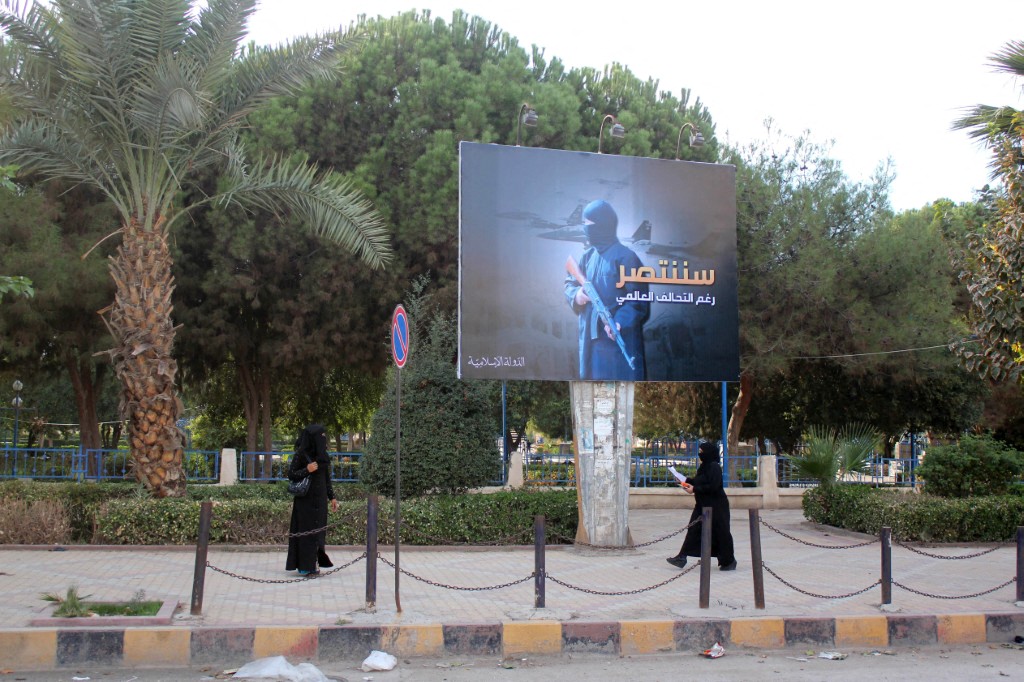
Women wearing a niqab, a type of full veil, walk under a billboard erected by the Islamic State (IS) group as part of a campaign in the IS controlled Syrian city of Raqqa on November 1, 2014. Arabic writting on billboard “We shall be triumphant, in spite of the global coalition”. AFP PHOTO/RMC/STR (Photo by Raqa Media Center / AFP)
After Raqqa, the capital of ISIS, was liberated by the Syrian Democratic Forces (SDF), Emel and her colleagues founded the Arab women’s organization Zenobia with the dream of eradicating the misogynistic ISIS ideology in the city. However, those dreams disappeared on January 20, when the Syrian Arab Army took over the city.
Since the takeover of Raqqa in northern Syria by militias affiliated with the Syrian Transitional Government (STG) have been spreading fear by producing disturbing images and videos targeting women. These videos circulating online have re-traumatized women fighting for women’s liberation.
Raqqa, the self-proclaimed capital of the Islamic State until 2017, was a place where public beheadings were routine, women were stoned, sold in slave markets, chained inside their homes, and subjected to total male domination and violence. After the liberation of Raqqa at the end of 2017 by the SDF, Emel and other women began to organize collectively against this deeply rooted mentality. ISIS had left not only profound trauma, but also lasting social and psychological damage.
“The invasion of areas under the Autonomous Administration [of North and East Syria] by the al-Amshat and Hamzat factions … represents a dangerous regression in women’s right to work, participate, and have a voice
Emel*, who managed to escape to Qamishli just in time, now follows developments in Raqqa with deep fear. For women like her – and for anyone associated with them – the danger is immense. Out of concern for her family members who remain in the city, she has chosen to remain anonymous.
While many women publicly tore off and burned their niqabs and black abayas during the liberation, the deeper consequences could not be discarded as easily. Together, they founded the Arab women’s organization Zenobia, which advocates for women’s liberation through women’s houses, cooperatives, and educational initiatives.
Today, everything these women built is once again at risk of being erased.
“The invasion of areas under the Autonomous Administration [of North and East Syria] by the al-Amshat and Hamzat factions, and the resulting deprivation of women’s rights, is not merely a military or administrative shift,” Emel explains. “It represents a dangerous regression in women’s right to work, participate, and have a voice.”
Within Zenobia, Emel worked in regional coordination and diplomatic efforts. When armed factions aligned with the Damascus government entered Raqqa, she was forced to flee.
“We left Raqqa after tribal militias attacked us. The situation is extremely bad, Arab militias are attacking Kurds,” she says. “We fled with the last convoy, and along the way we were attacked three times.”
She recounts that civilians were targeted at the last checkpoint in Raqqa. In Sabah al-Khair, cars were attacked, resulting in a massacre and severe harm to the civilian population. In the village of Umm Madfa, civilians were again attacked from the south. “The situation was catastrophic – there were dead and wounded. An entire family was hit, and three ambulances belonging to the Kurdish Red Crescent were attacked. Another family was targeted at a checkpoint 20 kilometers from Khirbet al-Tamr.”
Emel reports that in Tabqa and Raqqa, they have already began handing out “modest” clothes for women: “People in Tabqa have already begun wearing religious clothing in accordance with Sharia law.” She adds that once the Kurdish-led forces withdrew, “the region came under the banner of ISIS.”
The restriction of women’s rights is accompanied by increasing reports of targeted attacks against the Kurdish population and individuals who work with the Autonomous Administration.
“Families are being threatened and ordered to hand over their cars and personal weapons,” Emel says. “People say there is no longer any safety. They keep their doors locked and do not open them.” Adding to the urgency and deteriorating situation, there is also a shortage of food, according to Emel. Others, who have worked with the Autonomous Administration, fear retaliation, with many now looking to escape to Damascus, “fearing attacks on their homes or being exposed by informants.”
Among those she knows, one of her colleagues was recently forced to leave her home in Tabqa and “sought refuge with her uncle in Raqqa, where no one knows her.” She also reports that mercenary groups destroyed and looted Zenobia centers.
Emel fears that women will once again be confined exclusively to their homes.
Despite being in relative safety in Qamishli, Emel has not escaped the fear, as her family remains in Raqqa, some of whom have been threatened: “Yesterday, they went to my brother’s house and ordered him to leave. They threatened my niece and her husband as well.”
While the concrete impact on women’s rights in Raqqa, Tabqa, Deir ez-Zor, and Manbij – where Zenobia was previously active – remains unclear, Emel fears that women will once again be confined exclusively to their homes.
According to the new Raqqa Governor Abdul Rahman Salama, the Syrian government wants to bring back stability and security into the region and rebuild the infrastructure of the city. However, the new authorities have yet to address the documented attacks on civilians in this region by Islamist forces. Instead, they have accused SDF of similar crimes.
For now, the work of the women’s organization Zenobia has been suspended in the region. For Emel, though, this is not a reason to give up. She issues an appeal to the international community to see women not only as victims but as partners for peace and stability:
“We are not asking for privileges, but for fundamental rights: the right to be present, active, and safe in our communities. Excluding women means returning to the logic of violence instead of justice, and silence instead of voice.” *Names have been changed for the safety of interviewees.

Isabel Krokat
Isabel Krokat is a freelance journalist whose work focuses on women's rights, the Middle East, and migration. She holds a degree in Arabic and Islamic studies and is currently based in Qamishlo, North and East Syria.
![[The Amargi Exclusive] Investigating the Syrian Army’s Abuses](https://cms.theamargi.com/wp-content/uploads/2026/02/AFP__20260118__934D2KE__v1__MidRes__SyriaConflictKurds.jpg)