There Are No Terrorists Until The System Needs One
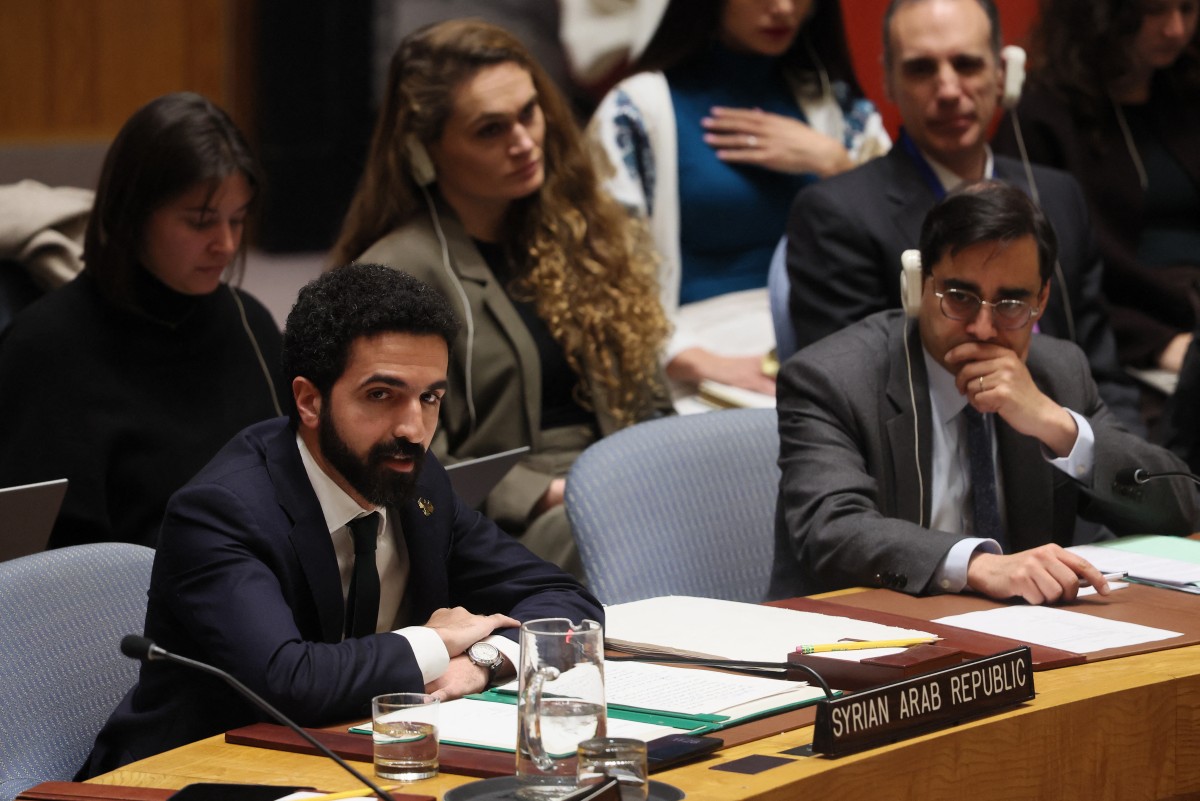
NEW YORK, NEW YORK – JANUARY 22: Ibrahim Abdulmalik Olabi, Syria’s Permanent Representative to the UN, speaks during a United Nations Security Council meeting on the situation on the Middle East at the United Nations headquarters on January 22, 2026 in New York City. (Photo by Michael M. Santiago / GETTY IMAGES NORTH AMERICA / Getty Images via AFP)
The fact that the United Nations only held a meeting about Syria after several weeks of widespread killing of civilians does not point to a procedural lapse; it is rather a clear indication of how the political process works.
When the recent UN meeting took place, the drawing up of the framework for a post-Assad Syrian order had already begun elsewhere. The UN was not a latecomer to the crisis; it entered the scene precisely on time to legitimize the actual “solution” package.
Syria’s interim government is being judged today not on its actions, but on what it accomplishes. The expectations are clear: first, to bring “stability” to the region and manage Syria’s borders; and second, to integrate into a regional architecture compatible with Turkey’s security priorities, the Gulf capital’s appetite for restructuring, and the West’s containment design. Once an actor assumes this function, the cost of opposing it increases. In such a geopolitical situation, condemnation becomes a “destructive” intervention, and silence becomes a “productive” tool.
Only one delegation explicitly described the violence as “brutal.” The others, instead of confronting the facts, simply refused to address them in a politically significant manner.
Almost all participants in this meeting, supposedly representing diverse national positions, remarkably found common ground in their vocabulary: stability, transition, moderation, sovereignty, and de-escalation. The striking nature of this repetition is significant not because it was “coordinated,” but because it reveals a shared intuition about what was being protected.
Only one delegation explicitly described the violence as “brutal.” The others, instead of confronting the facts, simply refused to address them in a politically significant manner. In international politics, silence is not always neutrality; it often indicates that violence has already been incorporated into an “acceptable” political course.
What truly betrayed the meeting wasn’t a statement made explicitly in the room; rather, it was the acceptance, before the meeting even started, that figures officially classified as terrorists until yesterday are to be treated as indispensable interlocutors in the reconstruction of Syria. This silent reclassification, presented under the label of “pragmatism,” is purely the product of political self-interest; moreover, it reveals the malleability of the principles of international law under realigning strategic interests.
Evidently, actors are labelled terrorists not only for the actions they commit, but also for when and against whom they commit them.
International law does not allow for the selective justification of political violence solely through its ’recognition.’ But in practice, this is precisely what happened. The ’promotion’ from terrorist to statesman cannot be explained by legal processes. The basis of this transformation is utilitarianism.
Evidently, actors are labelled terrorists not only for the actions they commit, but also for when and against whom they commit them. The international response, therefore, can look very different when similar methods are used by different actors at different times.
The UN meeting made this starkly visible: while violence perpetrated by an actor without legal backing is considered “never tolerable,” the same violence, when embedded within a state-building project, can be reduced to a “manageable” cost. Civilian deaths are treated as a background condition: tragic, yes, but a kind of “cost” that shouldn’t undermine the goal of establishing order.
A particular intervention during the meeting was particularly illustrative: the Syrian ambassador to the UN stated that the recent military operations against the SDF in Aleppo were conducted “with humanitarian considerations in mind.” This sentence was phrased unhurriedly, as if providing a technical detail; there was no irony.
The concept of humanitarian assessment did not collapse under the weight of the evidence, because it wasn’t created to describe reality in the first place.
However, public records of the same operations reveal a completely different picture. Images showing fighters being thrown from the tops of buildings, the cutting of the braid of a captured female fighter, the dragging of females by their hair through the streets, and their branding as “pigs”, the subjecting of civilians to collective punishment; all of this calls the Ambassador’s statement into question. Accounts and evidence of some settlements, including Kobane, being deprived of water, electricity, and internet serve a similar purpose.
What made the ambassador’s statement truly striking was how ’useful’ the delegations found it. The concept of humanitarian assessment did not collapse under the weight of the evidence, because it wasn’t created to describe reality in the first place. Its function, in fact, was to inject legitimacy into the political order.
When violence is embedded within a project of establishing a “recognizable” state, even the most blatant excesses can be rendered harmless at the rhetorical level. Abuse is reduced to an “unfortunate detail.” Collective punishment is renamed a “security measure.” Dehumanization is presented under the guise of “discipline.”
No one in the room interjected to ask under what humanitarian norm throwing prisoners from buildings could be compatible, or questioned whether cutting off civilians’ access to water and electricity constitutes collective punishment under international law.
Legitimacy is thus reinforced in practice: not by denying violence, but by re-categorizing it. When an actor is considered a “stabilizing force,” the burden of proof is reversed. It is not assumed that brutality is unacceptable; on the contrary, it is required to prove that brutality is an exception.
This meeting did more than simply tolerate a lie. It exposed how humanitarian rhetoric can be instrumentalized to ‘tame’ violence, and how actions that would normally provoke outrage can be reduced to a “manageable” matter.
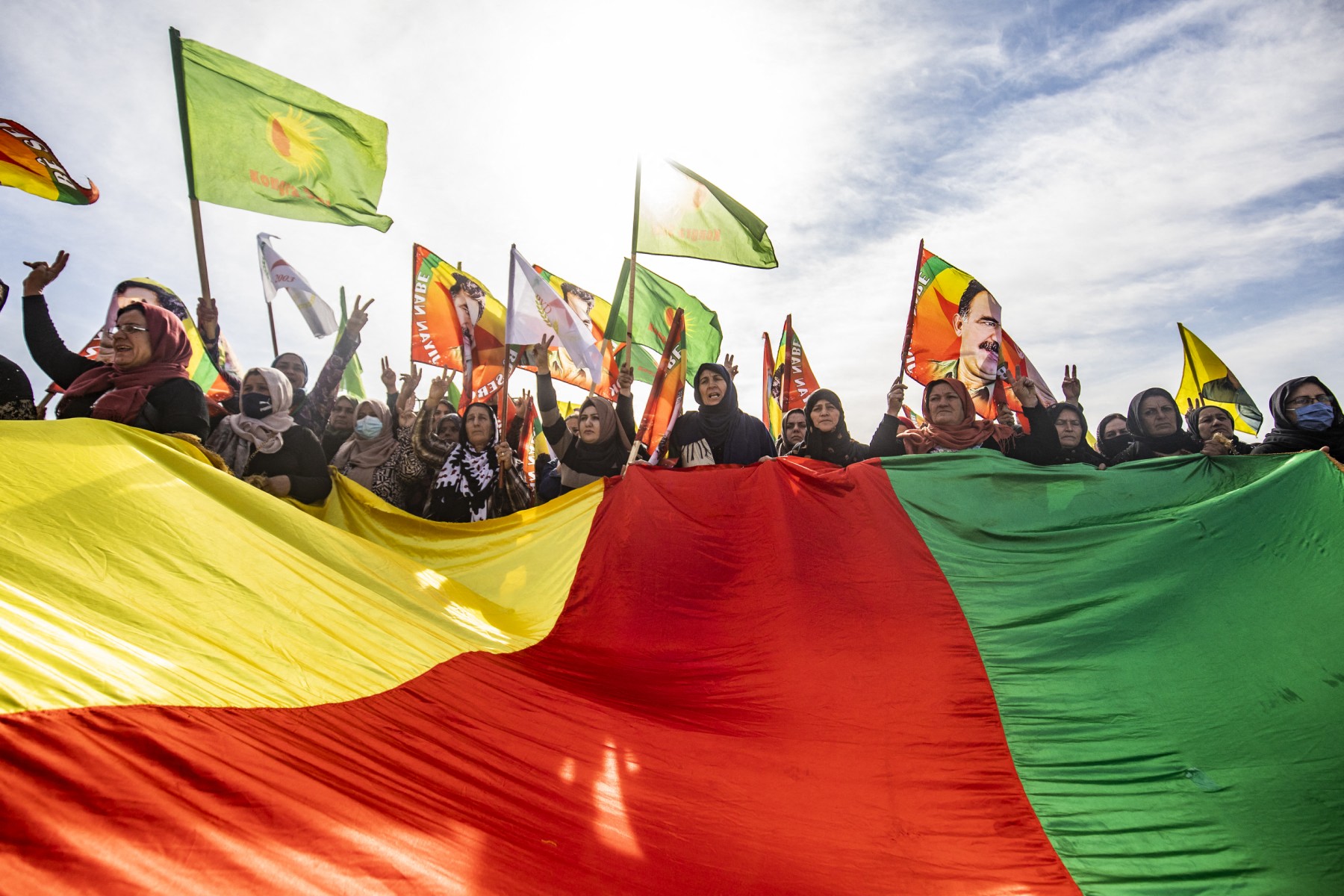
This is not a situation that can be reduced to the Kurdish issue. The Kurds are merely making the mechanism more naked, more lucid.
Communities that are politically organized but lack a recognized state are condemned to structural fragility within international politics. When they are useful, they are instrumentalized; when they are superfluous, they are rendered invisible; and when their existence hinders territorial consolidation, they can become targets of violence.
The UN’s stance also reveals a deeper truth about the nature of the “state-building” currently underway in Syria. What is being built is not a nation-state project based on social consent or political participation but a project of state-building driven by external interests.
Within this framework, historical realities, including pluralism, local governance practices, unresolved grievances, and entrenched exclusions, are treated not as foundations upon which to build, but as “discomforts to be managed.” The language of history is selectively employed, as if Syria were merely returning to a “natural” course interrupted by war. Yet what is happening is not restoration; it is restructuring. This distinction is critical. Building a state without a nation produces a short-term order at the expense of robust legitimacy. It prioritizes limitation over compromise and predictability over justice.
It is important to avoid confusion: this reading does not mean that all actors bear equal responsibility, and it certainly does not mean that violations by one side legitimize those by the other. The issue is that international institutions exhibit systematic selectivity in which violations they categorize as ‘to be combated’ and which they formally incorporate into the ‘reconciliation’ regime.
Today, Syria is being rebuilt. It is being reassembled according to a logic that rewards utility and punishes friction. In this system, the concepts of terrorism, legality, and legitimacy are increasingly ceasing to be principle-based boundaries and becoming conditional instruments governed by interests.
Once this is understood, the UN meeting no longer appears delayed or uncertain. It appears abundantly clear.

Dilek Çelebi
Dr Dilek Çelebi is an Islamic historian and interdisciplinary researcher working at the intersection of nationalism, religion, security studies, and development in the Middle East. She holds a PhD from the University of Manchester, where she examined Iranian national security narratives and their effects on political minorities. Her research explores how religious idioms, state security frameworks, and development governance shape legitimacy, exclusion, and minority politics across Iran and the wider region. Using qualitative, discourse-informed methods, she contributes to academic and public debates and develops research with practical relevance to governance, rights, and conflict prevention.