Turkey Puts Journalists’ Payments on Trial Amid Kurdish Peace Talks
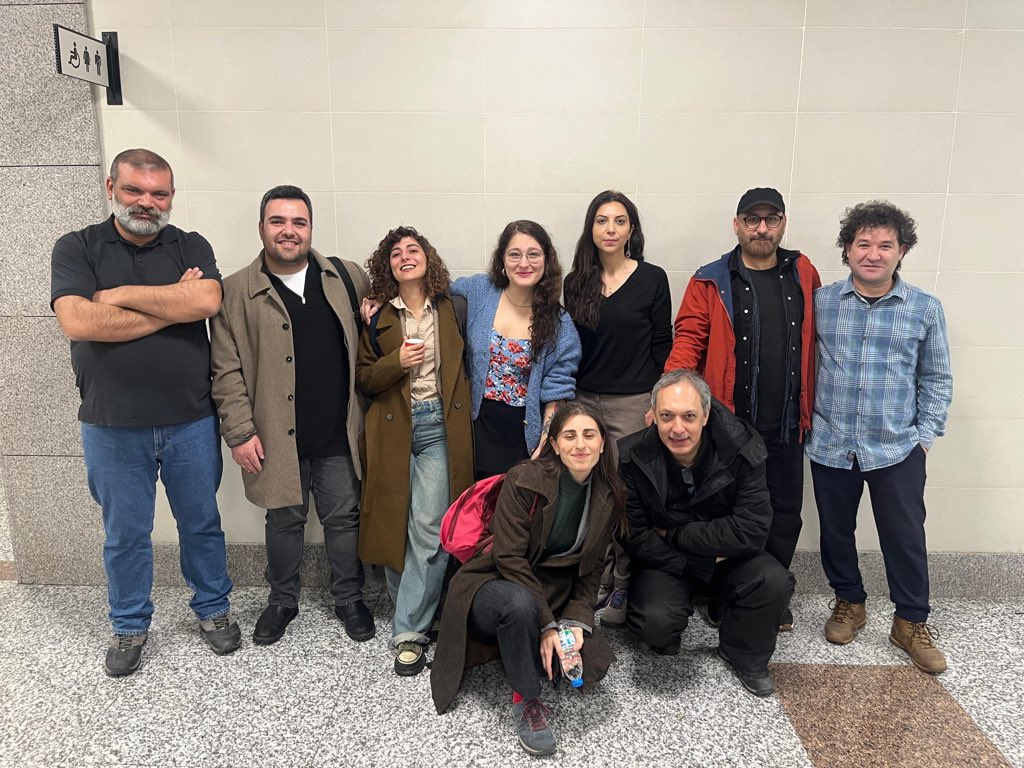
The group of journalists on trial in a group picture. Photo credit: DİSK Basın-İş X account
The first hearing in the trial of five journalists, a translator, and a sociologist took place on Tuesday, December 9, at the Istanbul 13th High Criminal Court. The defendants are accused of “aiding a terrorist organization”, but lawyers say the case is baseless.
Journalists Erdoğan Alayumat, Tuğçe Yılmaz, Suzan Demir, Gülcan Dereli, Kemal Taylan Abatan; translator Serap Güneş; and sociologist Berfin Atlı are accused of “aiding a terrorist organization” under Article 220/7 of Turkey’s Penal Code for producing news and translations for the outlet Yeni Özgür Politika and its supplement PolitikArt, both of which operate legally in Germany.
Defense lawyers who talked to The Amargi stated that the case has no legal basis under Turkish law, Constitutional Court (AYM), and European Court of Human Rights (ECtHR) rulings. The defendants emphasized a shared point in their statements: “We are being prosecuted for doing journalism.”
Money at the Center
Reacting to the MASAK (Financial Crimes Investigation Board) report, which frames honorarium payments as “organizational funds,” the journalists explained that all of their work was done under their real names and through Turkey’s national banking system.
One of the defendants, sociologist Berfin Atlı, said, “I am being prosecuted for receiving an amount that doesn’t even cover a young woman’s rent in Istanbul, let alone her living expenses.”
“Defense lawyers who talked to The Amargi stated that the case has no legal basis under Turkish law, Constitutional Court (AYM), and European Court of Human Rights (ECtHR) rulings. The defendants emphasized a shared point in their statements: “We are being prosecuted for doing journalism.””
Journalist Erdoğan Alayumat argued that he was being prosecuted over a single news story for which he received a routine honorarium payment, and noted that even his social-media posts were included as evidence. His lawyer added that Turkey’s new “cyber-patrol” monitoring had reviewed Alayumat’s timelines during the same period and found nothing suspicious.
“If reporting news and receiving payment for it are crimes, then nobody can do journalism,” Alayumat said.
Tuğçe Yılmaz, who described receiving ill-treatment during detention, said the case seems designed to pressure journalists to distance themselves from the Kurdish press, adding a broader critique to the indictment’s implications: “This file essentially tells us: ‘You can only work for [the state-run] Anadolu Agency.’ It criminalizes cultural journalism and tries to dictate where we can and cannot work.” She also noted the continuing impact of judicial harassment on her ability to travel, work, and report.
Gülcan Dereli, a freelance journalist, stressed that journalism is not volunteer work: “Producing news and receiving payment for it is not a crime. This is my profession, and I cannot make a living if I am not getting paid for my work.”
Kemal Taylan Abatan emphasized that his entire livelihood depends on his writing: “I write articles and reports, and I am paid in return. This is how I sustain my life. There is no crime here, and I demand my acquittal.”
Serap Güneş, a translator for 20 years, explained that the prosecution had reduced her professional work to a criminal allegation: “I translate texts and get paid for it. That is all. I reject both the witness statement and the accusations in the indictment.”
Suzan Demir, a film critic and journalist since 2008, similarly pointed out the absurdity of the accusations: “I wrote two film-related pieces for a publicly accessible outlet. I have been a journalist for years. Nothing I’ve done constitutes a crime.”
Indictment Built on an Invalid Ruling
Yeni Özgür Politika’s predecessor, Özgür Politika, was banned in Turkey during the 1990s. After its exile to Europe, the outlet was also closed down in Germany in 2005 for alleged ties to the Kurdistan Workers’ Party and publishing pieces focused on the Kurdish question and Turkey’s war on Kurds.
The decision, which came during a period when others Kurdish outlets in Europe were likewise banned, has been seen as a political move caused by Turkish pressure. However, since its foundation, Yeni Özgür Politika has operated legally and without issue in Germany.
This background makes up part of the indictment, but the lawyers explained that the “banned publication” document cited in the indictment has nothing to do with Yeni Özgür Politika, that it dates back to the 1990s, and that it was issued about a different newspaper published in those years.
“Would a terrorist organization send money through Ziraat Bank?”
Attorney Batıkan Erkoç highlighted the logical premise in the case, which he believes is flawed:
“Terrorist organizations operate secretly. Would they transfer money through Ziraat Bank [a Turkish bank]? And if this money was really from an organizational fund, then the bank should also be a defendant, because it would have taken a commission on the transfer.”
Erkoç also pointed out that the indictment does not include any of the articles, reports, or translations that are supposed to be the basis of the charges: “So, where is the crime?”
Another attorney, Deniz Yazgan, said “Right now, journalist Murat Aksoy has been acquitted in the retrial of a similar case – one that actually had more evidence – after the AYM sent it back. They [the prosecutors] probably expect the 13th High Criminal Court to quietly clean up their faulty indictment, but we refuse to accept that.”
The indictment relies only on MASAK records, but the defense has argued that to assist an organization you give money to it, not receive money from it. And, as Erkoç has claimed, the prosecution has not built its case on any of the articles, interviews, or translations that it has alleged to be criminal propaganda, making the case questionable.
“This case will be overturned”
The lawyers presented established case law from the AYM and the ECtHR, explaining that producing paid journalistic work cannot be treated as “assisting a terrorist organization.”
They reminded the court that the ECtHR has overturned similar convictions for years, especially those brought under Article 220/7 of Turkey’s Penal Code. The ECtHR considers it “overbroad and arbitrary” to treat visible, peaceful, and public activities by people who are not part of an organization’s hierarchy as terrorism offenses.
No steps have yet been taken to return the indictment, dismiss the case, or lift the restrictions on the defendants. Only the weekly check-in requirement – either by signature or fingerprint – was removed. The travel ban preventing the defendants from leaving the country remains in place.
The file has been sent to the prosecutor’s office. The next hearing will be held on February 17, 2026.
Justice on Hold for the Political Calendar
Some observers argue that cases like this are kept alive by the government as political leverage or bargaining chips in the ongoing peace process. Legal experts point out that no new laws are needed to close them; existing legislation and high-court rulings already provide grounds to throw out the indictment.
Lawyers describe the ongoing restrictions – mandatory check-ins and a travel ban – as a form of judicial harassment that could end immediately if current law were applied.
A case built entirely on paid reporting and translation work again raises the broader question of how tightly the justice system in Turkey is tied to political priorities: Is the law waiting on politics to move first?

The Amargi
Amargi Columnist