Why Iranian Feminists Are Concerned About the Fate of Rojava
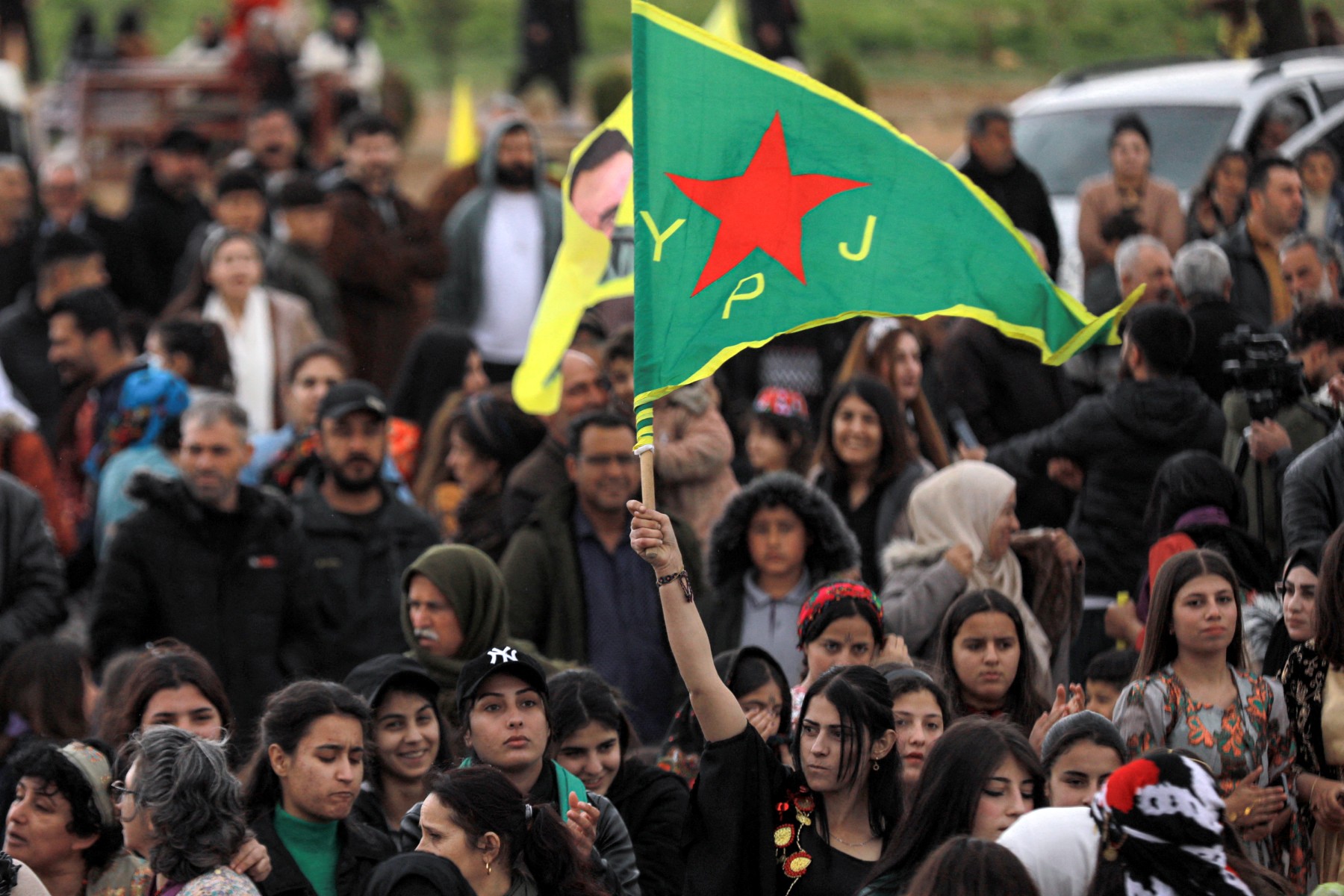
A woman holds a pennant of the Syrian-Kurdish Women’s Protection Units (YPJ) all-female militia during an event organised by NGOs and women’s action groups to commemorate International Women’s Day in Syria’s northeastern city of Qamishli on March 8, 2025. (Photo by Delil SOULEIMAN / AFP)
As the Syrian Arab Army presses deeper into Kurdish-held northern Syria, threatening the autonomy and women-led institutions of Rojava, a group of Iranian feminists is watching with alarm. They fear that the destruction of one of the Middle East’s most ambitious feminist experiments would extinguish a rare, hard-won vision of liberation that helped inspire their own struggle.
Inspiring Woman, Life, Freedom Uprising in Iran
The slogan “Jin, Jîyan, Azadî”, born from the decades-long struggle of the Kurdish women’s movement and the Kurdish liberation movement, resonated deeply in Iran and became the rallying cry of the Woman, Life, Freedom movement – which was sparked by the murder of 22-year-old Kurdish woman Jina (Mahsa) Amini by the Islamic Republic’s morality police on September 16, 2022.
Women’s bodies and hair, long sites of political resistance, took center stage in this struggle: in Rojhelat (Kurdish parts of Iran) and across Iran, women famously cut their hair and burned hijabs as acts of mourning and protest, defiantly rejecting forced hijab laws.
While haircutting is a traditional Kurdish mourning ritual, here it became a powerful political statement against state violence and gender oppression. On September 26, 2022, women in Rojava also cut their hair in support of the uprisings, with some removing their headscarves permanently and issuing a statement of solidarity.
Female bodies and women’s resistance in Rojava have been among the first targets of government forces in Syria. On January 10, 2026, a verified video showed a soldier of the Syrian Arab Army throwing a female Kurdish fighter off a tall building in Aleppo. Days later, footage from Tabqa showed residents dismantling a statue of a YPJ fighter (Kurdish Women’s Protection Units), once a proud monument commemorating the defeat of ISIS.
Another video has been circulating, which shows a Syrian militant brandishing the severed braid of a fallen fighter, and the militant brags, “This is the hair of a ‘heval’,” – “heval” meaning “comrade” in Kurdish, and commonly used as a term of endearment. In response, women have been braiding their own hair in protest and solidarity, signaling the same message: state power is attempting to erase all that women have achieved in Rojava.
Iranian women are familiar with this reality. Since 1979, their bodies have been battlegrounds: state authorities have restricted their freedoms, curtailed their participation in public life, and sought to erase their agency. The attacks on women in Rojava follow a similar strategy, making the struggle there not only a regional issue but a deeply resonant one for women across Iran.
Transnational Feminist Solidarity
As many states turn a blind eye to the situation in Rojava, some Iranian feminists and activists have tried increase its visibility online. Ever since 2014, when Kobani’s Kurdish YPG and YPJ forces defeated ISIS, the images of Kurdish fighters resisting some of the most barbarous forces in the region entered the political imagination of many Iranian activists and observers. Books on Rojava were translated into Persian, and Rojava was perceived as a society that represents a feminist, democratic alternative.
In response to attacks from the Turkish government’s proxy fundamentalist forces back in 2024, the Tanideh Collective issued a statement of solidarity with Rojava. They framed defending Rojava as both ethical and strategic, emphasizing that the region’s defense is inseparable from the defense of feminist, egalitarian, and progressive movements across the Middle East. Solidarity with Rojava, they argued, is therefore not symbolic charity but a political responsibility that links struggles across borders.
“Women in Rojava voiced Woman, Life, Freedom before we did – we declare solidarity with their struggle, which is not parallel to ours but part of the same battle.”
Similarly, in January 2026, the Feminists4Jina network emphasized that attacks on Rojava are not only military but also attempts to destroy a living feminist-social experiment:
“This is not merely a military attack but an organized assault on an alternative political-social project – one that represents the possibility of a liberatory future based on self-governance, gender and ethnic equality, and bottom-up organization. Defending Rojava is defending that possibility. Women in Rojava voiced Woman, Life, Freedom before we did – we declare solidarity with their struggle, which is not parallel to ours but part of the same battle.”
For many feminists and activists, Rojava – surviving sanctions, oppression, war, and state violence – remains a site of imagination for envisioning feminist futures. As Batool, a queer feminist activist and scholar, put it, “Within the terrain of political thinking and leftist feminist praxis emerging from the political geography of Iran, Rojava means imagination – and the possibility of imagining – toward the realization of a feminist and democratic future, a future that has already materialized in the present.”
Sally, a Gilak queer feminist based in the U.S., emphasized the strategic and intellectual connections forged between Iranian and Kurdish women, “between the philosophies of women’s struggle in Rojava and feminist activism among Kurdish, Gilak, and other women belonging to national/ethnic minoritized populations in Iran. This connection went beyond symbolic solidarity, resting on shared experiences, concepts, and methods of resistance.”
Sally emphasized that Rojava’s model has been able to link anti-authoritarian struggle with women’s liberation: “Its continued existence, alongside the preservation of relative autonomy and security, demonstrates that alternative forms of political and social organization outside centralized, patriarchal nation-states are possible.” Sally’s point underlines that solidarity with Rojava is grounded in the shared experience of oppression and modes of resistance by subaltern women – or women whose voice and agency have been stripped from them.
Yet, even with the seas of disagreements that exist between them, these powers always find a way to work together, “to suppress Kurdish uprisings
Arash, an Iranian activist in Stockholm, situated his concern with Rojava’s fate within the broader regional struggle, where hegemonic regional powers impose their “fascist, dictatorial, and patriarchal” power on minoritized groups. Yet, even with the seas of disagreements that exist between them, these powers always find a way to work together, “to suppress Kurdish uprisings – because Kurdish resistance targets the roots of all patriarchal archetypes with the slogan Jin, Jiyan, Azadi.”
The attacks on women, local councils, and social institutions threaten not only Kurdish autonomy but also the tangible possibility of imagining and enacting feminist alternatives to authoritarian and patriarchal governance. Solidarity with Rojava, therefore, as the activists said, is strategic learning, shared defense, and political alignment. As the Feminists4Jina network underscores, the struggle is ongoing: Iranian feminists must engage not only in symbolic support but also in concrete political and ethical accountability.

Mahtab Mahboub
Mahtab Mahboub is an Iranian feminist activist and PhD candidate in the Department of Sociology at the University of Duisburg-Essen, Germany. Her research focuses on the intersection of gender and migration within the Iranian diaspora in Germany, with particular interest in narrative research, intersectionality, identity, and decolonial feminist theory. She also writes on social movements and political developments in Iran.