Why Iraqi Kurdistan’s Political Deadlock Is a Structural Crisis
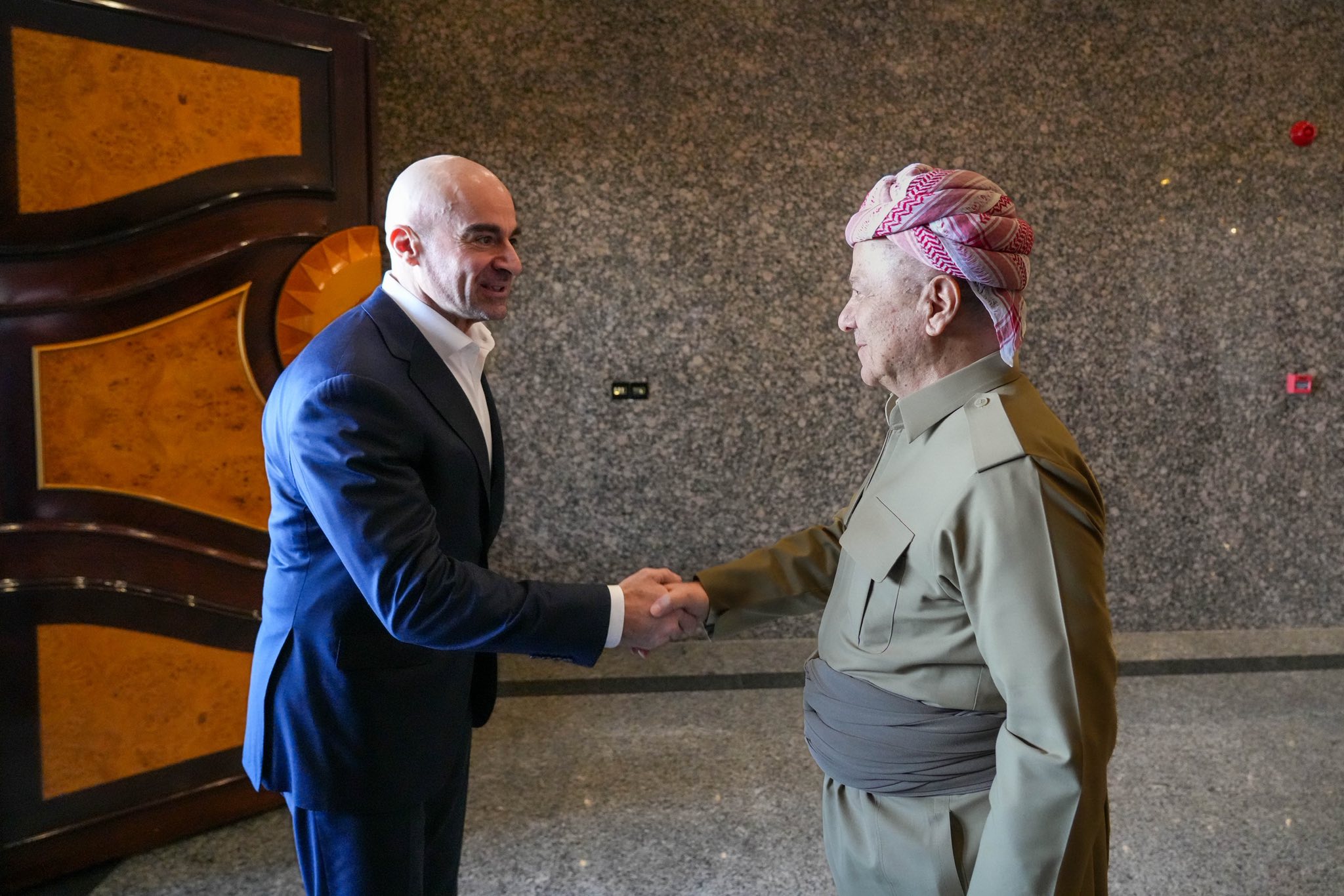
Masoud Barzani, KDP President (Right) and Bafel Talabani, PUK President (left) shake hands | Picture credits: Bafel Talabani’s Facebook page.
The Kurdistan Regional Government (KRG) held elections in September 2024; however, the Kurdish parties are yet to agree on a new cabinet to form the government. The Kurdistan Democratic Party (KDP) emerged as the largest bloc with 39 of 100 seats, and the Patriotic Union of Kurdistan (PUK), the second largest, secured 23 seats.
Why the Delay?
The arithmetic has recently shifted. In January 2026, the New Generation Movement (NGM), which holds 15 seats and is headquartered in Slemani, announced a strategic alliance with the PUK. With 23 seats from the PUK and 15 from the NGM, the new bloc commands 38 seats – just one seat short of the KDP’s 39. The PUK now argues that negotiations should no longer be conducted on the basis of a 39-versus-23 imbalance, but rather 39 versus 38. And based on that logic, power-sharing should reflect near-parity, potentially even a 50–50 distribution of executive authority, echoing the early post-2005 cabinets.
The KDP rejects this interpretation. It maintains that government formation negotiations should be based on formal party results, not post-electoral alliances. For the KDP, the PUK remains a 23-seat party. The New Generation Movement’s alignment does not, in the KDP’s view, alter the constitutional weight of this newly-formed largest coalition. The disagreement over how to interpret parliamentary strength has added a new layer of complexity to an already entrenched stalemate.
Another dimension of the political dispute relates to the Iraqi national elections held in November 2025. The Iraqi federal model has divided the country’s top offices among Kurds, Shias, and Sunnis. The Iraqi presidency is for Kurds, the Iraqi speaker of parliament is for Sunnis, and the Iraqi prime minister’s office is for Shias.
Since 2005, the PUK has traditionally held the Iraqi presidency, but with the latest federal elections, the KDP has contended that the office belongs to Iraqi Kurds as a collective rather than being automatically given to the PUK.
Majority Rule or Dual Legitimacy?
The KDP frames the dispute in electoral terms. As the largest party, it argues that it has the democratic mandate to form the government, retain the prime minister’s office, hold the presidency of the Kurdistan Region, and keep control of key sovereign ministries such as the Interior Ministry. It further argues that proportionality should be determined by the ballot box, not by political alliances formed after elections.
From the KDP’s perspective, conceding parity despite holding the largest bloc would undermine electoral legitimacy and institutional coherence. Party leaders also contend that the PUK’s demands exceed its parliamentary weight. Some within the KDP argue that the PUK is being influenced by regional actors seeking to destabilize the KRG.
Others suggest that resistance to Prime Minister Masrour Barzani reflects political rivalry rather than structural grievance, particularly as his government has pursued modernization efforts: 24-hour electricity, infrastructure expansion, agricultural investment, dam construction, digital governance initiatives, and anti-corruption measures.
The PUK, however, operates within a different logic – one shaped by the KRG’s post–civil war power-sharing architecture: Since the Kurdish civil war of the early 1990s, governance in the Kurdistan Region has functioned less as majority rule and more as negotiated balance between the KDP’s “Yellow Zone” (Erbil and Duhok, dominated by the KDP) and the PUK’s “Green Zone” (Slemani and Halabja, under PUK influence).
With the addition of the NGM, the PUK now argues that Kurdish politics reflects two nearly-equal parliamentary blocs. In its view, near-equal seat distribution justifies near-equal executive power. The Iraqi presidency, traditionally held by the PUK, symbolizes that balance. For the PUK, surrendering it while also losing out on the prime minister’s office and regional presidency would mark a structural marginalization.
The dispute, therefore, reflects two incompatible models: KDP majoritarianism versus PUK-led parity politics reinforced by new alliances. Without redefining the governing framework, coalition formation becomes zero-sum.
Institutional Power?
The breakdown of trust has intensified since 2019, when Masrour Barzani became prime minister. Under his predecessor, Nechirvan Barzani, coalition management relied heavily on informal flexibility and interpersonal accommodation. Governance functioned through elite coordination rather than codified institutional guarantees.
The current administration has adopted a more centralized executive style. PUK officials argue that decision-making has narrowed and that coalition participation has not translated into meaningful authority. They contend that even when formally inside the cabinet, their ministers and general directors lack genuineoperational autonomy. In their view, entering another cabinet without structural reform would amount to symbolic participation rather than true partnership.
The KDP counters that executive authority is constitutionally vested in the prime minister’s office and that effective governance requires clarity, not diffusion of command. It also argues that participating in government while simultaneously criticizing it in the media creates instability and undermines collective responsibility.
If previous governments were sustained by personal trust, the current stalemate reveals the fragility of that arrangement. The KRG never institutionalized mechanisms to manage structural rivalry once interpersonal flexibility diminished.
The “Government Within a Government”
One of the PUK’s central grievances concerns what it describes as a parallel administrative structure: senior advisors and security-linked offices that dilute ministerial authority. According to PUK leaders, such arrangements render formal portfolios ineffective and prevent their ministers from exercising the full powers granted by law.
The PUK insists that any new cabinet must dismantle what it characterizes as a “deep government” and restore full authority to ministers and the deputy prime minister. It also demands equitable recruitment practices and balanced geographicallocation of development projects, arguing that their constituencies perceive systematic marginalization.
The KDP rejects the accusation of parallel governance and maintains that centralized coordination is necessary for modernization and policy coherence. It frames its development record – particularly in infrastructure, water management, and electricity reform – as evidence of effective leadership rather than partisan favoritism.
Economic geography compounds the crisis. Large-scale infrastructure projects in recent years have concentrated heavily in Erbil and Duhok. The PUK and its allies argue that Sulaymaniyah and Halabja have received disproportionately fewer investments. They contend that this imbalance reinforces political alienation and justifies demands for stronger executive safeguards.
The KDP disputes the framing, pointing to development initiatives across the region and emphasizing fiscal constraints, federal budget disputes, and broader economic pressures.
In divided systems, however, institutional design matters as much as performance metrics. Perceptions of exclusion can destabilize even high-performing administrations. Regardless of intent, the more governance appears geographically skewed, the more parity becomes a political necessity rather than a symbolic demand.
Baghdad and the Battle for Symbolism
The Iraqi presidency dispute adds to the stakes. Since 2005, the position has functioned as the Kurdish share of Iraq’s tripartite power structure, alongside a Shia prime minister and a Sunni speaker of parliament.
Recent high-level meetings between KDP and PUK leadership have signaled a possible breakthrough. Although no formal statement was issued, political observers suggest that there may be a tentative consensus on allowing the Iraqi presidency to remain with the PUK.
At the same time, discussions reportedly included the creation of a Kurdish “Political Council,” modeled loosely on Iraq’s Shi’a Coordination Framework. The idea would be to establish a structured platform through which major Kurdish parties coordinate strategic decisions concerning federal negotiations and national interests.
Yet such a council would face significant challenges. First, enforcement: without binding mechanisms, decisions risk remaining advisory. Second, credibility: Kurdish parties have historically struggled to maintain unified positions. Unlike the Shia Coordination Framework, which has demonstrated a degree of internal discipline, Kurdish politics has been marked by fragmentation. A political council without enforcement authority may simply reproduce existing disagreements in a new forum.
What Is at Stake?
The immediate risk is not institutional collapse but cumulative erosion. Over a year without government formation undermines parliamentary credibility. Continued caretaker governance blursaccountability. Economic uncertainty compounds political fatigue.
For the PUK, entering government without structural guarantees risks legitimizing what it views as a one-party system. For the KDP, conceding parity despite electoral plurality risks weakening executive coherence and reform momentum.
Both sides believe they are defending institutional principles. Both risk entrenching paralysis.
An Unfinished Project
The present crisis is not simply a rivalry between the KDP and PUK, nor merely a contest over Baghdad’s presidency. It is the manifestation of an unfinished state-building project. Until executive authority, fiscal distribution, security control, and inter-party coordination are anchored in transparent and enforceable rules, each election will reopen the same structural dispute.
What appears to be a familiar coalition impasse is, in fact, something deeper: a structural crisis rooted in the Kurdistan Region’s incomplete transition from party-based dual authority to unified institutional governance. The deadlock is not merely about ministries, personalities, or protocol. It is about whether the KRG functions as a majoritarian parliamentary system or as a parity-based condominium between competing political poles.
The question is no longer who holds which ministry. It is whether the Kurdistan Region can move beyond negotiated dualism toward a coherent, institutionalized parliamentary order. The answer will shape not only Kurdish governance but also Iraq’s federal equilibrium in an increasingly volatile Middle East.

Sangar Rasul
Sangar Rasul holds an M.A. in International Political Communication from the University of Sheffield. He has taught courses on Good Governance, Human Rights, and Principles of Democracy at the Catholic University in Erbil and has been active as an independent writer and researcher since 2005. He has represented Iraq internationally, including during observation of the 2018 U.S. midterm elections and at an advanced academic training on rural economic development at Zhejiang University in 2025. In addition to his academic and writing work, he has served on the boards of several NGOs and media organizations.