Why Poland’s (Political) Culture Has Failed to Embrace the Kurdish Cause
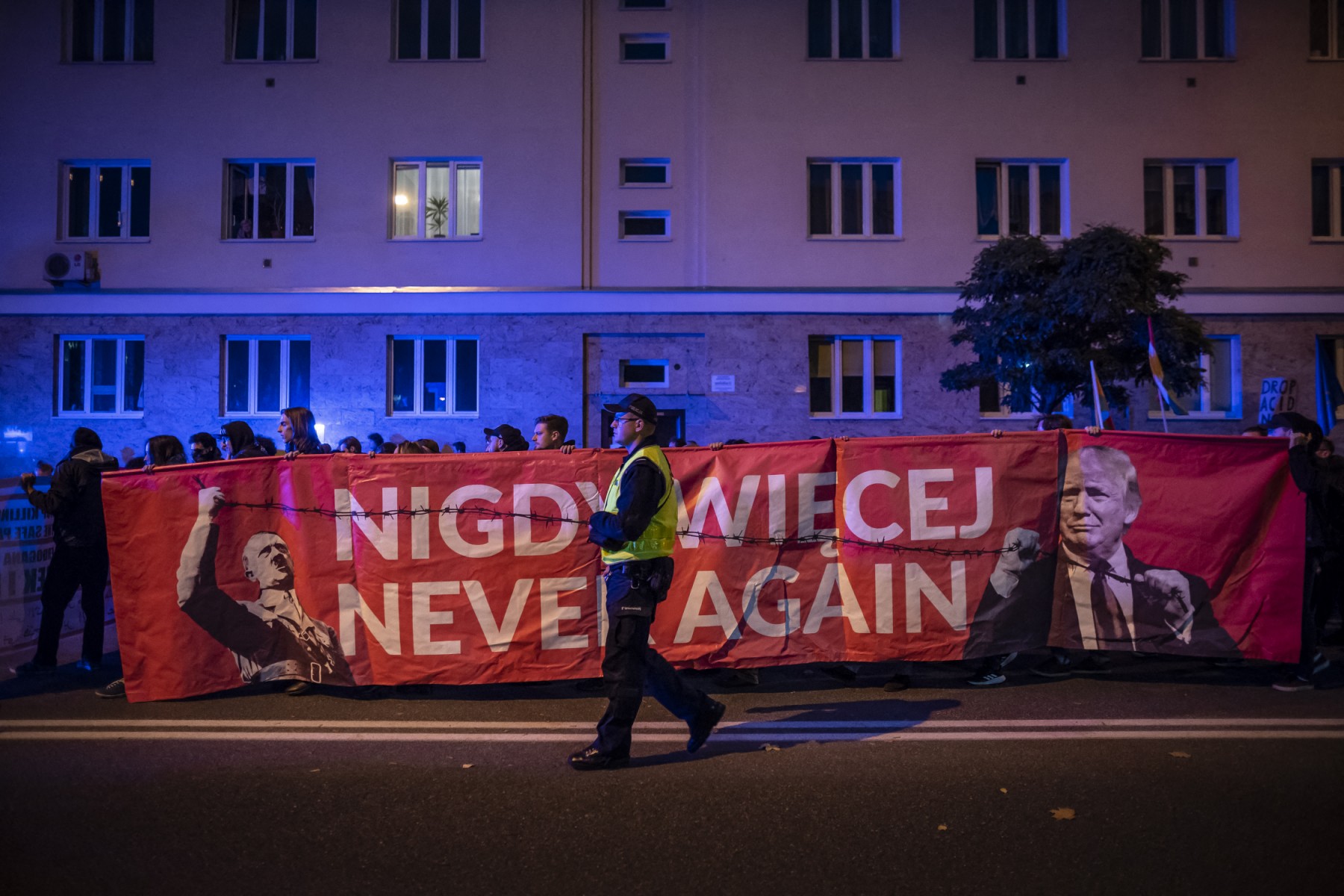
Demonstrators hold a banner depicting Adolf Hitler and US President Donald Trump and reading “Never Again” as they take part in a demonstration against the Turkish military operation on Kurdish-held border towns in northeastern Syria, in front of Turkish embassy, Warsaw, on October 11, 2019. (Photo by Wojtek RADWANSKI / AFP)
Despite parallels in history and culture, many Poles remain unaware of Kurdistan and the plight of its people. Owing to selective education, a geopolitical alignment with NATO and the EU, and state nationalism, support for the Kurdish struggle remains marginal in Polish political and public discourse. This ignorance not only overlooks the ongoing suffering of those threatened with erasure but also betrays the values the powstańcy1 fought and died for.
The Kurdish Present is the Polish Past
Although originating in different regions and periods, Polish and Kurdish aspirations for independence share many similarities.
Recently, an Instagram post by a Polish activist named Karina, in which she explains how she came to know the Kurdish struggle, went viral among Kurdish accounts. “I listened to thousands of Kurdish songs, and something woke up in me- a sense of solidarity with people fighting for their homeland, perhaps the same feeling rooted deeply in Polish history as well, where countless guerrilla movements once fought for a country that had been erased from the map.”
Although originating in different regions and periods, Polish and Kurdish aspirations for independence share many similarities. Both cultures are marked by stories of uprisings, massacres, and charismatic leaders. Both nations have endured centuries of division, repression, and betrayal at the hands of foreign powers. Much like the Kurds, the Polish nation disappeared from the maps. From the 18th century, the Slavic country endured 123 years of occupation by Prussia, Russia, and Austria. In 1918, while Poland gained its autonomy, the Kurds experienced a similar fate: their lands were divided between Turkey, Syria, Iran, and Iraq.
Now, the Kurdish people remain halfway between limited autonomy and the unfulfilled dream of their own state. This one difference is what sets the two nations’ worlds apart. Kurds, divided among four states, face threats every day, many of them existential, that vary by the regimes in power, while Poles enjoy the status that their country’s borders grant.
The Nation That Would Not Disappear
The trauma inflicted on the people during the Second World War – and how it altered the composition of communities– is still visible in many families.
Both nations’ histories show that the struggle for independence is not solely about political borders. It is, above all, a fight for survival, identity, and the right to live according to one’s own traditions and values. Polish culture is marked by recurring tension between East and West. Under Russian and Prussian occupation, Poles endured cultural suppression, discrimination, and political persecution aimed at eradicating national identity and control. In the 20th century, Poles, along with other Slavs, Jews, and Roma, were designated as Untermensch (“sub-humans”) by Germany’s Nazis, while at the same time being massacred by the Red Army in the hundreds of thousands. The trauma inflicted on the people during the Second World War – and how it altered the composition of communities– is still visible in many families.
The majority of Polish children have been raised on their grandparents’ stories of surviving the war and their parents’ lives under communist rule. In schools, they are encouraged to read the memoirs of Holocaust survivors and of those sent to the gułags2. They study the rise of German fascism and the Soviet Union’s regime, and are repeatedly told by survivors to respect one another, take care of people in need, and never let anything like that happen again. Therefore, why does this empathy not translate into political or popular support for Kurds?
Poland’s Historic Blind Spots Repeated in Public Discourse
Education in Poland today follows a nationalist agenda centred on the former glory of the Roman Empire and the questionable superiority of the West today, paying little attention to other nations’ ongoing struggles. Many historical events are presented as if they happened in almost a vacuum, painting the Polish case as unique. It encourages children to learn the tales of Poland’s past successes, wealth, and bravery, while memorising dates of lost battles and the grim details of what occurred at the hands of the oppressors, as if the struggle for independence were an exclusively Polish experience . This view of the world later shapes politics and mainstream media coverage of geopolitics.
The news focuses mainly on Poland and its closest neighbours, with special attention to the USA and the European Union as a moral compass. Patriotic sentiments, once necessary to preserve identity, now serve to maintain the status quo, and “never again” essentially applies only to those whom Western hegemonic powers deem desirable. While several Polish politicians have recently brought the Palestinian cause to the government’s attention, many elected officials have simply echoed arguments found in the Western mainstream media. Similarly, the Kurdish question has remained absent, even as attacks on communities in Western and Eastern Kurdistan have intensified.
Current Polish Politics Betrays Human Values
Given the imminent Russian threat, Poland clings to NATO’s weapons and influence for protection; the same NATO that is actively causing destruction across the SWANA region. Still, the privileges that come with being a nation-state and belonging to major Western-led economic and military groups have enabled the government to become the bully that the Polish people once fought against.
Since abolishing the communist regime in 1989 and regaining sovereignty, Poland has embraced a capitalist lifestyle and actively contributes to the ‘new world order’ vision promoted by the Western powers. For decades, the country has ignored the abuses and war crimes committed by nations such as Turkey, a fellow NATO member state, against the Kurdish people. When mainstream media reports on the incidents, they repeat the narrative of “terrorists in the mountains”, framing the Kurdish question as a matter of security rather than the dignity of the Kurdish people.
The Polish army, once created to protect its people and to fight the occupiers, today participates in so-called peace missions, maintains collaboration with countries accused of committing genocidal acts, and with its soldiers accused of committing war crimes in regions where they should not be in the first place. Fortunately, where governments fail, the Poles do not disappoint.
Building The Bridges
Social centres, such as “Postój”, organise meetings and protests in support of Kurdish rights, while Kurdystan.info, a news service on Facebook, keeps followers updated and regularly supports cultural events
Although the network between Kurdish and Polish institutions and groups remains modest, many people care about the safety and dreams of Kurds. Karina is not the only individual who works tirelessly to spread awareness and keep the public informed. Other groups educate the Polish public about Kurdistan and build connections. Social centres, such as “Postój”, organise meetings and protests in support of Kurdish rights, while Kurdystan.info, a news service on Facebook, keeps followers updated and regularly supports cultural events. A few weeks ago, Kobani University and the University of Szczecin signed a Memorandum of Understanding to boost academic collaboration.
These grassroots initiatives show that although politicians often follow the hegemonic path, ordinary people keep the spirit of solidarity alive. The similarities between the two nations create a bridge of understanding and hold the potential to build strong unity. Understanding how Kurds nurture their patriotism and culture offers Poles the opportunity to reflect more deeply on their Polish identity and its confused, fragmented position. Both nations can learn from each other, and cooperation can grow stronger and larger if given the chance.

Aleksandra Kalisz
Aleksandra Kalisz is a visual artist and researcher with a PhD in Fine Arts from the University of Porto, working at the intersection of art, research, and journalism. Her work examines how gender, identity, power, and social structures are represented and negotiated within contemporary globalised culture. She uses visual and research-based approaches to make complex social questions visible, relatable, and accessible to wider audiences.