A Deeper Look into Why Sectarian Violence is Escalating in Syria
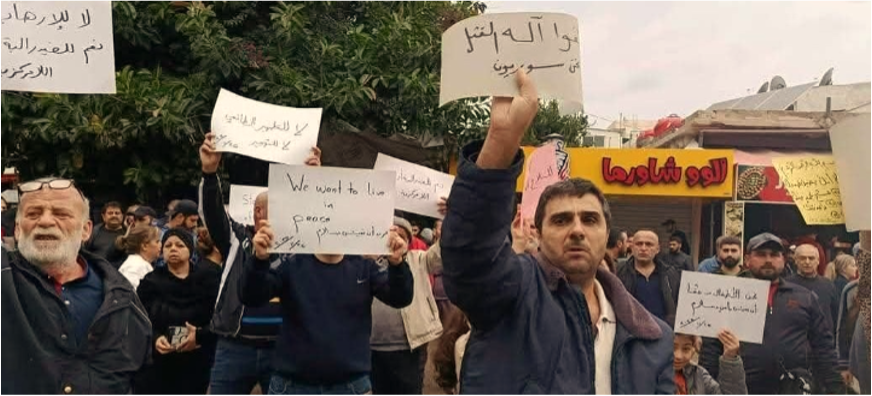
Peaceful protesters gathering during demonstrations in Homs, Syria
On Sunday, November 23, 2025, residents of Homs in central Syria woke up to the news that a married couple from the Bani Khalid tribe had been murdered. The news triggered reactions from the tribe, who targeted Alawite communities, prompting security forces to intervene, evacuate civilians, and impose a curfew that ended the next day.
The unrest follows a string of sectarian massacres and violent events that erupted in a number of villages on the Syrian coast and in rural areas and neighborhoods in Homs and Hama in early March 2025. In these previous conflicts, over 2000 people were executed and killed during security “mop-up” operations. Many people in these areas have since become victims of personal vendettas and violence on the basis of their religious identities.
Background
According to international reports and official testimonies from the area, unknown assailants broke into the home of a Sunni married couple from the Bani Khalid Bedouin tribe, on the outskirts of Zaidal in Homs province. They beat the man to death and killed the woman, then burned her corpse. The perpetrators had also left a message on the walls that framed the murders as sectarian violence.
The crime caused widespread anger among the tribe, and some members attacked Alawite-majority neighborhoods in the Muhajireen and al-Basil districts of Homs. They fired shots into the air and at houses and shops, burned several cars, and injured two people before security forces arrived to restore order.
In a statement published by the Syrian news agency SANA, the commander of the Homs Internal Security Brigadier General Morhaf al-Naasan said, “The town of Zaidal, south of Homs, witnessed a horrific murder on Sunday morning, where a man and his wife were found dead inside their home, and the wife’s body had been burned.” He added that sectarian slogans were found at the crime scene, indicating an attempt to sow discord among the residents. Al-Naasan confirmed that “a comprehensive investigation has been launched to uncover the circumstances of the crime, identify the perpetrators, and bring them to justice.”
The news of the murder spread on social media just a day after the death of two Alawite youths was reported in the western countryside of Homs.
The two Alawite young men, cousins from Abu Hakfa in Homs, were killed under mysterious circumstances on November 21, 2025. They had been waiting for a tractor to transport rubble near the al-Zahra neighborhood when they disappeared. Two hours after they failed to meet with the tractor driver, they were reported as kidnapped. Their bodies were found in Al-Wa’er neighborhood hospital with apparent gunshot wounds and possible signs of a public execution.
The murder of Abdullah al-Aboud and his wife
On Monday, November 24, the Syrian Interior Ministry confirmed that preliminary investigations into the murder indicate criminal intent, rather than sectarian; though, some have tried to suggest otherwise by writing sectarian slogans at the crime scene. At a press conference in Homs, Ministry Spokesman Nour al-Din al-Baba said that those who wrote the slogans wanted to cover up their crime and turn it into sectarian strife. He stressed that there is no material evidence pointing to the incident being of sectarian nature. Al-Baba added that the slogans found at the scene were placed there to mislead the public.
On November 24, Sheikh Ghazal Ghazal, head of the Supreme Islamic Alawite Council in Syria and the diaspora, released a video statement addressing the recent armed attacks on Alawite-majority neighborhoods in Homs. He emphasized that Syria has become “a battleground for sectarian score-settling,” and warned that these practices will push the country toward further division and possible partition in the future.
He noted that the Alawites had previously surrendered their weapons “out of belief in the legitimacy of the state alone,” but later found themselves under “a de facto terrorist, factionalist, and exclusionary authority.” And he accused the transitional government of usurping the Sunni community’s political will, to use them “as a tool in its policy”. He also highlighted that the government has been making inflammatory statements – such as “beware of minorities” – in response to voices calling for justice or denouncing oppression.
This statement came amid escalating tensions in areas and neighborhoods inhabited by Alawites in multiple regions of Syria, including the coast, Hama, Homs, and some Damascus neighborhoods.
The Rise of Peaceful Protests
Following Sheikh Ghazal’s statement on Tuesday, November 24, the Alawite community held peaceful marches in Homs and several coastal cities. Thousands of protesters demanded justice, dignity, and accountability, emphasizing the need to stop arbitrary killings, the abduction of women and children, and the release of Alawite detainees who have been held on due to their religious identity.
In Latakia, hundreds gathered at al-Azhari, al-Zira’a, and al-Thawra roundabouts. In Jableh, demonstrators filled al-Omara Square, waving Syrian flags and chanting slogans demanding an end to oppression and protection for Alawite lives. Protesters carried banners proclaiming “Dignity!”, demanding reform and recognition of their grievances. But the protests faced heavy security cordons and violent obstructions from the General Security Service (GSS).
According to the Syrian Observatory for Human Rights (SOHR), some of the demonstrations began and ended peacefully. However, others quickly escalated when the GSS tried to restrict the protests from expanding, and armed individuals attempted to confront the protesters.
The GSS deployed in areas such as al-Azhari, al-Zira’a, and al-Thawra. They closed major roads, including the Jableh Bridge and the surrounding ring roads, in an attempt to contain the protests.
Witnesses have said the GSS used tear gas; they also cordoned off Alawite-majority neighborhoods and aggressively patrolled some Alawite-majority neighborhoods. During a protest in Jableh, one man was struck in the head and initially thought to be dead. Fortunately, he later received treatment and survived. Due to the chaos, however, the identity of the perpetrator was unclear.
What’s next?
Following the demonstrations, Sheikh Ghazal Ghazal issued another statement confirming that the protesters’ message had been received. Taking the courage of protesters from different backgrounds and age groups as a sign that people will not remain silent about their suffering; they will rise up again.
These demonstrations are the first of their kind within the Alawite community. There is a significant shift in public sentiment: communities are now more inclined to express themselves and their demands with new awareness during a sensitive transitional time in Syria – despite facing pressure and direct threats from government authorities and local elders, who aimed to force Alawites in the provinces of Latakia, Tartus, Homs, and Hama to participate in pro-government marches.
According to residents, the threats followed the peaceful demonstrations. The Syrian authorities in the mentioned provinces ordered most school principals in Alawite-majority villages, neighborhoods, and towns to require students and teachers to participate in pro-Ahmad al-Sharaa marches on Liberation Day. And those who refused were threatened that they would be fired from their jobs. This is what the Assad regime used to do.

Soha Ezzi
A filmmaker, civil activist, and independent journalist based in Damascus, Syria