American-Kurdish relationship: Tactical vs. Moral
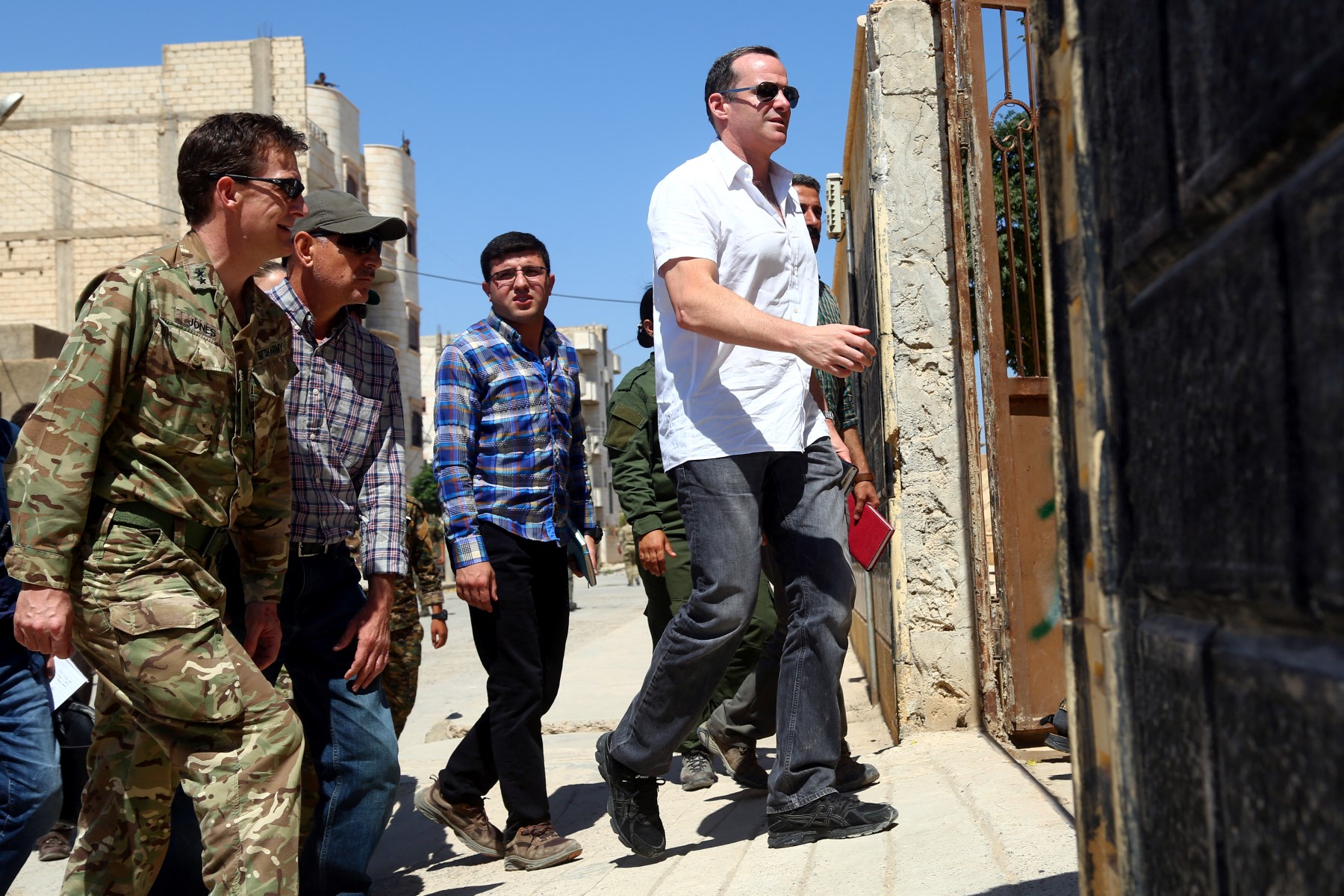
Brett McGurk (R), US special Presidential Envoy for the Global Coalition to Counter IS, and Rupert Jones (L), deputy commander of Combined Joint Task Force Operation Inherent Resolve (CJTF-OIR), arrive for a meeting with the Tabqa Civil Council in the town of Tabqa, about 55 kilometres (35 miles) west of Raqa city, on June 29, 2017. (Photo by DELIL SOULEIMAN / AFP)
The American-Kurdish relationship in Syria has entered a challenging and complex phase. To grasp it better, it can be understood as a struggle between moral and tactical diplomatic approaches, which have increasingly come into conflict.
James Jeffrey, former United States Ambassador and Special Envoy to the Global Coalition to Defeat Da’esh (ISIS), openly acknowledges that Washington’s partnership with the Kurdish-led Syrian Democratic Forces (SDF) has been “tactical”. However, Ambassador Tom Barrack, US Ambassador to Turkey and Special Envoy for Syria, recently took this to a new level.
“Today, the situation has fundamentally changed,” Barrack said on January 20th. Noting that Ahmed al-Sharaa’s Syrian Transitional Government has joined the Global Coalition, he stated, “The original purpose of the SDF as the primary anti-ISIS force on the ground has largely expired.”
Barrack’s statement illustrates the defining features of a tactical relationship. First, it is temporal. Second, it is situational. Third, it is narrowly goal-oriented. Fourth, it reflects a transactional view of alliances, as per Trumpian parlance. Together, these features set the stage for abandonment and betrayal. In the Syrian Kurdish context, where abandonment has a long and painful history, this distinction is not merely theoretical.
These features reveal the tactical relationship to be essentially immoral. Abandonment, betrayal, and, above all, indifference to the fate of the other, are evident in both US language and actions. The problem is that the consequences are borne by people on the ground in Syria.
The tactical approach prepares the ground for dehumanisation, as it is based on exploitation and inevitable abandonment. This, in turn, enables perpetrators to inflict violence, since those who are abandoned appear vulnerable and easy to demonise.
Abandonment is not unique to the current administration. However, Ambassador Barrack has argued that the Middle East is composed of tribal communities unable to adapt to Western values, describing the region as a “tribal aggravation.” Such a view is likely to facilitate the latest international abandonment of the Kurds in Syria.
This view is not merely orientalist, reducing complex cultures, histories, societies, and a century of modern state-building in the region to caricatures. It constructs a distorted reality that reinforces an oppositional Western worldview. Reducing the situation to “tribal aggravation” further demeans the region and its people, casting them as static, irrelevant, and never changing, as critiqued by Edward Said, the American-Palestinian scholar of Levantine Christian origin.
Orientalism, Said argued, was a system of thought tied to imperialism and power, rather than real knowledge production: “Here develops a kind of image of the timeless Orient, as if the Orient, unlike the West, doesn’t develop, it stays the same. And that’s one of the problems with Orientalism, it creates an image outside of history, of something that is placid and still and eternal. Which is simply contradicted by the fact of history. In one sense, it’s a creation of you might say, an ideal Other for Europe.”
Viewing a society as tribal justifies violence, short-termism, and exploitation. Tribalism is often associated with tactical alliances driven by power and resources, but this framing distorts a far more complex reality. There is no doubt that tribalism is prominent in Syria, but by no means is the country entirely tribal. In fact, urban middle-class Syrians, who historically constituted a significant segment of the population, are today among the most marginalised.
The Kurds in Syria and the US bonded together on moral grounds over the Yazidi Genocide in Shengal (Sinjar) in August 2014.
The American political scientist Joseph Nye effectively contrasts the tactical approach and the moral approach. “According to this [tactical] line of thinking, international relations are anarchic and there is no world government to provide order,” he said. “States must provide for their own defence, and when survival is at stake, the ends justify the means. Where there is no meaningful choice there can be no ethics. Thus, in judging a president’s foreign policy, we should simply ask whether it worked, not whether it was moral. However, in my experience as a scholar and sometime practitioner of foreign policy, morals do matter.”
The Kurds in Syria and the US bonded together on moral grounds over the Yazidi Genocide in Shengal (Sinjar) in August 2014. Gayle Tzemach Lemmon notes in her book Daughters of Kobani how US diplomat Brett McGurk first took note of the Syrian Kurds and the People’s Protection Units (YPG), the backbone of the SDF, when they broke the ISIS siege of Mount Sinjar and rescued stranded Yazidis.
McGurk, an architect of the Global Coalition to Defeat ISIS, worked closely with US Special Operations forces in northern Syria. ISIS went on to siege the Syrian Kurdish-majority city of Kobani in September that same year.
“[McGurk] argued to senior leaders in the US that if Kobani fell, the entire border with Turkey would land in ISIS hands,” Lemmon said. “And if ISIS controlled that border, then the US would never be able to keep ISIS out of Iraq and support the government in Baghdad. Iraqi and US interests in a stable Iraq would be harmed because ISIS would operate unimpeded just across the border.”
So, the US pursued multiple objectives in Syria and Iraq, namely fighting ISIS, stabilising Iraq (and, de facto, Syria), and preventing ISIS from holding territory, particularly along the Turkish border. During a genocide, an outside force cannot remain neutral. As Samantha Power writes in A Problem from Hell: America and the Age of Genocide, such a force must “either forfeit its neutrality or shirk it and confront and take sides.” The US intervention gained not only military success but also significant moral recognition.
Given that the US-Kurdish military partnership in Syria emerged in response to genocide, it cannot be allowed to lead to another. In the complex sociopolitical landscape of the Middle East, US relationships, especially combat partnerships, are unlike development projects or environmental initiatives; they involve death, victory, loss, and consequently leave lasting political memory and narratives.
Conflicts between religious groups and secular groups result in the act of takfir, Arabic for the practice of creating “otherness” where difference is treated as a basis for discrimination. It defines others as a kāfir (unbeliever) or murtad (apostate), thereby normalising their persecution or killing. Diplomats who promote a tactical approach clearly do not consider its fatal consequences.
Consider how an American can walk freely around Erbil, the capital of the Kurdistan Region, and yet it is impossible in most other Iraqi cities. This shows how acts of recognition and abandonment affect everyone.
A moralistic stance aligns with the Save the Kurds Act introduced in January by US Senators Lindsey Graham and Richard Blumenthal. The bill includes a provision to formally recognise the SDF for its role in cooperating with the US to eliminate ISIS. Such recognition stands as the polar opposite of abandonment.
Without getting too philosophical, recognition is a means of valuing or respecting another person or group and is essential to any meaningful relationship, trust, or stability. During a period when traditional soft power has weakened, foreign policy is increasingly driven by short-term tactical interest rather than ethical considerations.
Consider how an American can walk freely around Erbil, the capital of the Kurdistan Region, and yet it is impossible in most other Iraqi cities. This shows how acts of recognition and abandonment affect everyone. Recognition brings protection, and protection is the most effective means of preventing war and mass atrocities.
People in the Middle East have had enough of seeing their lives handled by the state or cold bureaucrats. They are, after all, human, with value and dignity. This was the core demand of the Arab Spring before it got hijacked by Islamists with the backing of anti-democratic forces in the region.
In the words of political scientist Henry J. Barkey, when a victory comes with a powerful sense of betrayal, it will prove empty if further steps are not taken to address Kurdish political aspirations.

Sardar Aziz
Sardar Aziz is a researcher, columnist, and international advisor. Worked as senior adviser, Kurdistan Parliament, Iraq. writes in Kurdish and English. He focuses on Kurdish politics and economy, Iraqi politics, and China-Kurdistan and Iraq relationship. He has published with numerous think tanks in the US, Europe, and the Middle East. Author of a number of books in Kurdish in the areas of governing, institutions, and political economy. He has a PhD on the State in the Arab Middle East from University College Cork (UCC) Ireland. He teaches annually at the Asian Study UCC.