Can Rojava’s Kurdish Project Survive Middle Eastern Fascism?
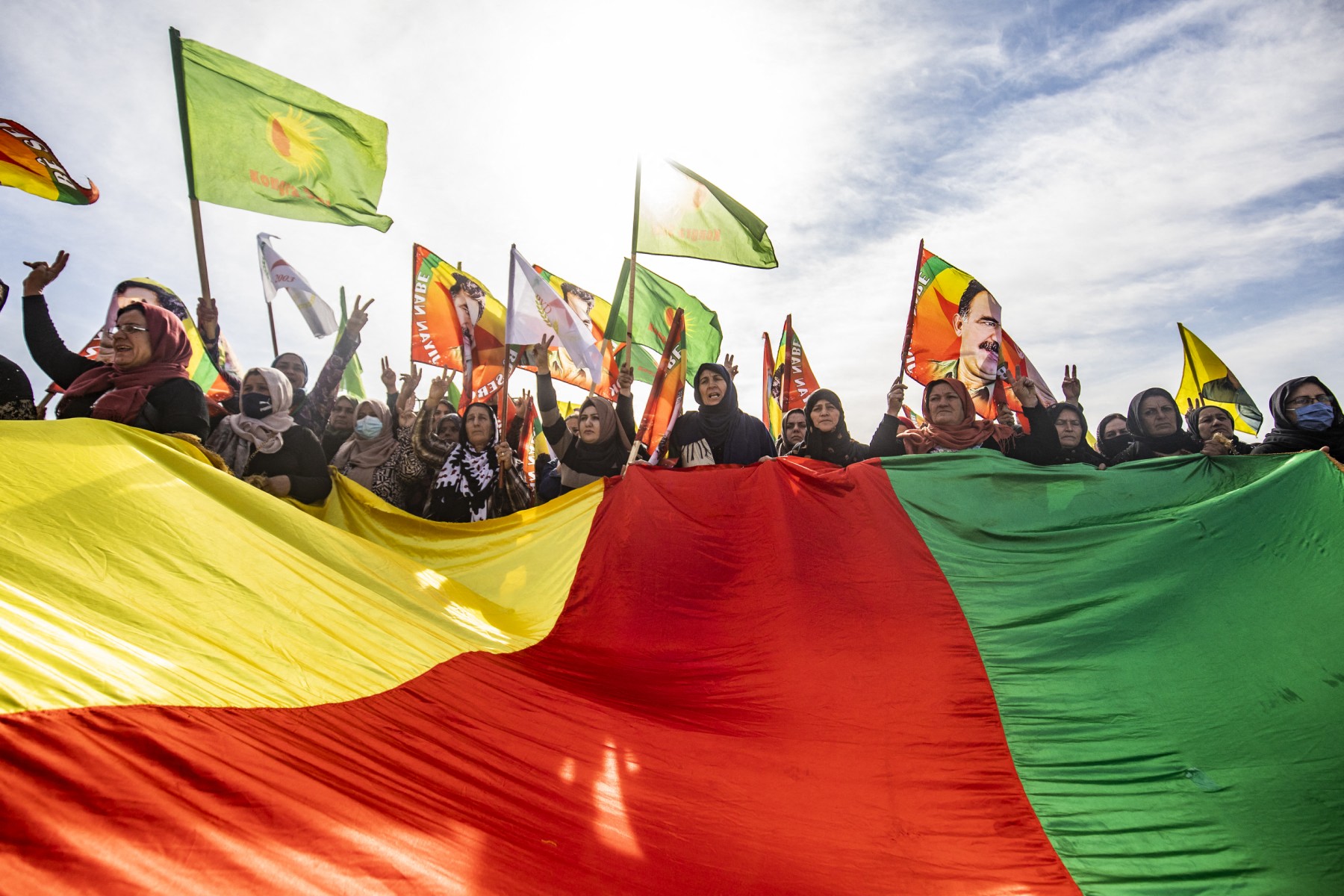
Kurdish Syrians protest the death of victims reportedly killed in a Turkish drone bombing on November 10, 2021 in the Syrian Kurdish-majority city of Qamishli. (Photo by Delil souleiman / AFP)
The territorial shrinkage of Kurdish-led governance in northeast Syria in January 2026 has been widely described as a military reverse or regress. That framing is too narrow. What has unfolded is a political calculation that forces a harder question: whether a project built explicitly to prevent fascism can survive in a region whose dominant states were forged through it.
Since January 6, Syrian government forces have advanced into areas long administered by the Syrian Democratic Forces (SDF), particularly Arab-majority regions once presented as proof that Kurdish self-rule could transcend ethnic boundaries. The collapse of detention camps and prisons holding ISIS members, followed by renewed militant activity, has darkened the picture. The Kurdish project, which is rooted in democratic autonomy and the principle of brotherhood between peoples, now finds itself territorially reduced, politically constrained, and strategically unprotected.
Many observers have rushed to declare the experiment a failure; that verdict misunderstands both the intent and context.
The Kurdish political project in Syria was never conceived as a nationalist enterprise. On the contrary, it emerged from a historical refusal of the nation-state itself. Abdullah Ocalan’s theory of Democratic Confederalism and praxis of democratic autonomy in Rojava rejected the form of sovereignty, ethnic supremacy, and centralized authority that have been structural causes of violence in Middle East. Instead, it proposed local autonomy, gender equality, and coexistence among Kurds, Arabs, Assyrians, Armenians, and others. This was not rhetorical cosmopolitanism; it was a response to lived history.
For Kurds, nationalism has not been an abstract ideology but an instrument of erasure. The Turkish Republic’s century-long project of Turkification criminalised the Kurdish language and identity in the name of unity. Iranian state nationalism subordinated Kurdish plurality to a Persian-centred political order enforced by militarisation and surveillance. Both systems followed a familiar pattern: homogenisation framed as security; repression justified as cohesion. Democratic Confederalism emerged as a deliberate refusal of this pattern.
Brotherhood as Political Strategy
The Kurdish insistence on brotherhood between nations was not sentimental idealism. It functioned as a political safeguard against fascism. The movement understood that once politics is organised around ethnic supremacy, violence becomes self-legitimating. Pluralism, therefore, was not a concession to others but a line drawn against becoming what the region had already endured too many times.
This choice, however, carried structural risks. By rejecting the nation-state, the Kurdish administration also rejected the only form of political organisation fully recognized by the international system. Rojava governed territory, enforced law, collected revenue, conscripted fighters, and ran prisons, yet without sovereignty, recognition, or binding guarantees.
This contradiction was temporarily masked by the war against ISIS. Like the Spanish anarchists in 1936, Kurdish forces built revolutionary institutions under the assumption that wartime legitimacy would translate into postwar protection. History offered little reason for confidence.
Arab Regions and the Limits of Inclusion
The SDF’s expansion into Arab-majority areas was often cited as evidence that Rojava’s concept of democratic autonomy could transcend ethnic boundaries. Arabs participated in councils and military units; local governance structures functioned unevenly but visibly. Yet participation did not always translate into ownership.
Decision-making power remained concentrated within a disciplined, ideologically trained Kurdish leadership. Complaints, over land, conscription, oil revenues, and security practices were acknowledged but rarely allowed to reshape the structure itself. Brotherhood, in practice, proved more fragile than brotherhood in principle.
When Syrian state forces returned in January 2026, many Arab-majority areas fell with minimal resistance. This was not necessarily an endorsement of Damascus, but it was a verdict on the limits of Kurdish-led governance under conditions of demographic imbalance and prolonged insecurity. Pluralism cannot survive on declarations alone; it must be continuously renegotiated when power shifts.
ISIS and the Burden of Abandonment
The collapse of ISIS detention infrastructure has become the most damaging accusation of Kurdish self-rule. This, too, misidentifies the source of failure.
For years, the Kurdish administration guarded tens of thousands of ISIS fighters and family members on behalf of a global coalition unwilling to assume responsibility. Western governments praised Kurdish stability while refusing to repatriate ISIS members, funding detention camps, or working on legal frameworks that could permanently solve the problem of ISIS detainees. Thus, when territorial control weakened, the system experienced a degree of collapse – as any system would under such conditions.
ISIS did not return because Rojava’s Autonomous Administration was naïve. It returned because containment without political settlement is not a strategy. The Kurds managed a global security problem without global backing and were blamed when abandonment produced chaos.
Regional Power and the Fear of Example
Turkey and Iran did not oppose the Kurdish project simply because it was Kurdish. They opposed it because it threatened the ideological foundations of their states.
Both regimes are products of 20th-century nationalist consolidation. Both equate decentralisation with disintegration. Both have treated pluralism not as a strength but as a security risk. The Kurdish insistence on coexistence, especially one that empowered women, minorities, and local councils, modelled a quiet but profound challenge.
What unfolded in 2026 was not merely a Syrian reconquest. It was a regional modification. A consensus emerged that this experiment had gone far enough. The rollback of Kurdish autonomy in Syria reflects a broader regional correction. Damascus regained territory; Ankara and Tehran accepted the outcome. All three share a common interest in preventing decentralisation from becoming normalised. This convergence reveals less about Kurdish weakness than about regional insecurity.
Internal Calculation Without Abandonment
At the same time, the Kurdish movement also bears responsibility for its strategic misjudgements: democratic autonomy hardened into a doctrine, internal dissent was constrained, and alternatives such as federalism, trusteeship, and territorial consolidation were insufficiently explored. Moral clarity was mistaken for political protection.
Yet one fact remains striking. Despite reverse, retreat, and betrayal, the Kurdish movement has not turned toward ethnic revenge, religious exclusion, or ultra-nationalism. It has not embraced the fascisms that surround it. This restraint is not accidental; it is the project’s core achievement.
The Kurdish experiment in Syria may not survive in its original institutional form. Its autonomy is diminished; its future uncertain. But its central claim, that the Middle East does not need to choose between state repression and sectarian collapse, remains intact.
In a region where nationalism has repeatedly produced catastrophe, the Kurdish insistence on brotherhood between nations is not naïve. It is historical knowledge. What is at stake now is not only Kurdish self-rule, but whether pluralism itself is allowed to exist within the political space.
If the answer is no, then the tragedy of Rojava lies not in Kurdish failure, but in the region’s continued loyalty to systems that have already failed too many times.

Seevan Saeed
Seevan Saeed is an Associate Professor in Area Studies at Shaanxi Normal University, China and Lecturer at Rojava University, Syria. He received his BA degree in Sociology and MA in Social Policy at the University of Wolverhampton,UK. He gained a PhD in Middle East Politics at the University of Exeter in 2015. He has delivered lecturers in domestic and international universities since 2015. He published articles and papers in six languages on social and political issues in the Middle East and beyond.