Syria’s Unity Is Not Inevitable: The History of a Modern State and a Crisis That Force Cannot Resolve
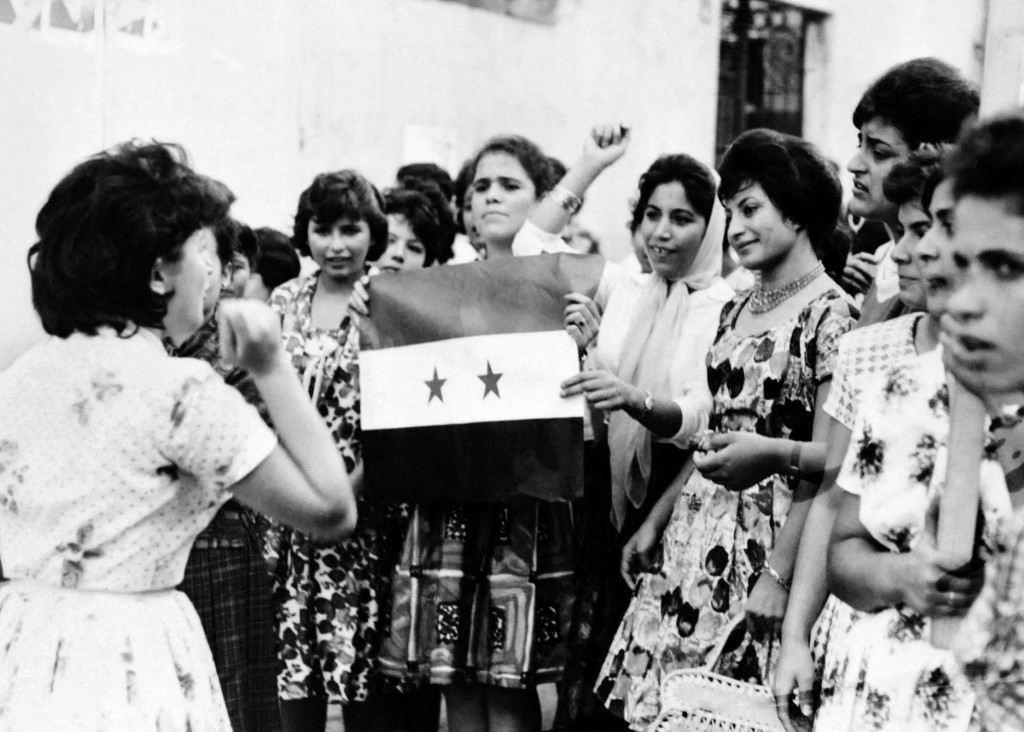
Picture released on October 5, 1961 in Beyrouth of Syrian women demonstrating their suppport to Nasser as Syria withdraw from the UAR (United Arab Republic), the political union between Egypt and Syria from 1958 to 1961.
(Photo by AFP)
Much of the discussion surrounding Syria’s current condition centers on restoring state unity, sovereignty, and the monopoly over violence. Implicit in this is the assumption that Syria has always been a unified state with centralized authority, and that what is unfolding today is merely a temporary deviation from a fixed historical trajectory. This assumption, despite its prevalence, does not withstand close scrutiny of the history of the Syrian state’s formation. Syrian unity is neither an ancient reality nor a historical destiny, but a recent political construction, shaped under European mandate and imposed by force rather than grounded in a pluralistic social contract. From this perspective, the current crisis is not about reunifying the state, but about its failure, since its inception, to resolve questions of diversity, political participation, citizenship, and democracy.
Before Syria emerged as a modern state, this territory did not exist as a political entity in its own right; rather, it was part of the Ottoman administrative structure. What was known as Bilad al-Sham was a loosely defined space encompassing several provinces – most notably Damascus, Aleppo, Palestine, and Mount Lebanon. The authority of the Ottoman governor (wali) in Damascus did not extend across the entire geography now known as Syria; it remained largely confined to southern and central areas, while other provinces functioned as separate administrative units, linked directly to the imperial center.
Within this administrative framework, late Ottoman societies were organized through the millet system, which managed religious and sectarian diversity by recognizing legally constituted communities with authority over personal status, education, and religious practice. The system did not establish legal equality, but rested on a clear hierarchy in which Sunni Muslims held a privileged position, while non-Sunni and non-Muslim communities faced varying forms of discrimination in taxation, access to office, and relations with the state.
Following the collapse of Ottoman rule in 1918, an attempt was made to establish a unified Syrian entity through the Syrian General Congress and the proclamation of the Arab Kingdom of Syria
With the outbreak of World War I, this territory entered a phase of political reordering shaped by the victorious European powers. The 1916 Sykes–Picot Agreement delineated spheres of influence between Britain and France, placing the geography that would later be known as Syria within the French zone. This included Damascus, Aleppo, the coastal regions, and Lebanon. The region was treated as an administrative space open to reorganization, with existing urban, regional, and sectarian structures taken into account and later managed through the mandate system.
Following the collapse of Ottoman rule in 1918, an attempt was made to establish a unified Syrian entity through the Syrian General Congress and the proclamation of the Arab Kingdom of Syria under Emir Faisal, son of Sharif Hussein of Mecca. The project envisioned an independent, sovereign state encompassing Damascus, Aleppo, the coast, Jabal al-Druze, and Palestine, with a constitution and a parliament.
This phase ended with the formal establishment of the French mandate in July 1920, which placed Syria on a different political and administrative path. France created several political entities within this zone: Damascus and Aleppo, the Alawite State, the State of Jabal al-Druze, and the Sanjak of Alexandretta, each serving as a distinct administrative framework for governing regions with differing social and historical characteristics under the mandate’s overarching authority.
Beginning in the late 1930s, political negotiations led by elites in Damascus and Aleppo initiated the reassembly of fragmented entities into a single state, following the Druze-led Great Syrian Revolt (1925–1927), which reshaped nationalist discourse and French policy. Damascus and Aleppo were merged first, followed by Jabal al-Druze and the coastal region. In 1939, the Sanjak of Alexandretta was separated from the French Mandate for Syria and incorporated into Turkey.
However, independence did not bring a redefined state–society relationship; instead, the state inherited a centralized structure reinforced by military and administrative institutions
With the withdrawal of French forces in 1946, Syria became an independent state with internationally recognized sovereignty. Only then did a unified Syrian state emerge in legal and political terms. However, independence did not bring a redefined state–society relationship; instead, the state inherited a centralized structure reinforced by military and administrative institutions, making centralization a permanent feature of governance.
In 1958, Syria entered a brief political union with Egypt as the United Arab Republic under Gamal Abdel Nasser. The union imposed sweeping centralization, dissolved Syria’s parliamentary institutions, and shifted authority to Cairo. Though it ended in 1961, it left a lasting imprint by reinforcing centralized rule and further weakening fragile traditions of political pluralism.
With the Arab Socialist Ba’ath Party’s seizure of power in 1963, the Syrian state entered a phase of rigid centralized rule. The security and military apparatus expanded, political space was sharply curtailed, and state institutions were bound to the ruling party. Arab nationalist ideology became the organizing principle of public identity, marginalizing cultural, religious, and regional diversity and consolidating the center as the primary site of political and administrative decision-making. Governance from Damascus rested on an interlocking structure of security control and ideological mobilization, rather than political representation of local communities.
With Hafez al-Assad’s rise to power in 1970, this authoritarian model was consolidated into a more durable form. Power was concentrated in the presidency, the army and security services were directly subordinated to it, and any prospect of genuine institutional balance was eliminated. Alawites played a central role in the military and security apparatus – not as a homogeneous ruling group, but as networks of loyalty within a closed system of power. At the same time, the regime built broad alliances with urban and rural Sunni constituencies, granting them significant representation in government, the ruling party, and local administrations.
The 2011 uprising, which began with demands for freedom, justice, and democracy, was initially driven by educated segments of the urban middle classes, before these groups were sidelined through arrests and systematic violence by the Assad regime. From 2012 onward, Syria became a sectarian battleground, pitting Islamist factions that seized control of rebellious Sunni cities and rural areas against the Syrian army. The conflict exposed deep disparities among regions and communities, producing de facto boundaries governed by forces on the ground, which settled into a quasi-stable configuration between 2018 and 2024.
During this period, Damascus retained control over central cities with Sunni majorities, most notably Damascus and Aleppo, as well as the Alawite coastal region. Meanwhile, Hayat Tahrir al-Sham (HTS) and other Sunni factions backed by Turkey consolidated control over northwestern Syria, the Kurdish-led Autonomous Administration established a distinct system of governance in the northeast under Western sponsorship, and the Druze-majority Suwayda experienced a form of semi-autonomous rule alongside a loose security presence maintained by the Assad regime.
The STG soon embarked on a violent course of rolling wars aimed at subduing non-Arab Sunni communities.
This status quo persisted until the sudden collapse of the Assad regime in late 2024, when power in Damascus shifted to HTS and allied hardline Sunni factions. They quickly formed a transitional government (STG), establishing military and security bodies, and then a government and political authority dominated by Arab and Sunni actors, largely devoid of meaningful minority representation. From the outset, there was no serious effort to address diversity, share power, or ensure minority participation, even though minorities comprised at least 40 percent of the population.
The STG soon embarked on a violent course of rolling wars aimed at subduing non-Arab Sunni communities. This campaign began with massacres against Alawites in March 2025, followed by attacks on Druze communities in July 2025, and culminated in assaults on Kurds in January 2026. Alongside this violence, the administration offered minorities no political framework to protect cultural rights, enable meaningful participation in local governance, or provide security guarantees against systematic abuse. Rather than pursuing inclusion, the STG sought to radicalize Sunni communities and promote a hardline form of Islam, supported by a sustained media campaign targeting minorities. This discourse relied on religious excommunication, particularly of Druze and Alawites, and political demonization, including that of the Kurds.
…unification by force, while politically legitimate in principle, is not a law of history
Supporters of the STG justify this course by invoking the state’s monopoly over violence and the imperative of imposing sovereignty across a unified territory. Yet unification by force, while politically legitimate in principle, is not a law of history. As the record shows, Syria’s centralized unity never evolved into a genuine nation-state rooted in an inclusive social contract.
The collapse of the Assad regime and the rise of extremist Islamist factions have stripped Syria of the political foundations needed for consensual reunification based on equal citizenship and democratic practice. Instead, the state has come under the control of armed factions drawn from a single sect, openly rejecting democracy and compromise or power-sharing. Under these conditions, national unity has become an ideological slogan rather than a viable political project.
Reunification by force does not resolve conflict; it produces successive wars of subjugation. Such wars may reclaim territory, but only by excluding local communities from the public sphere and reducing citizens to subjects. In this context, the model advanced by HTS relies on coercion and violence to reassert control over Syrian geography, without a democratic horizon or politically sustainable content. Seen this way, treating Syria’s unity as a fixed historical truth or unquestionable destiny reflects not a commitment to the state, but a disregard for the history of its formation. The current crisis expresses a structural impasse within a political entity that never became a modern nation-state, was never built on a pluralistic social contract, and has managed diversity through security and ideology rather than politics.

Mazen Ezzi
Mazen Ezzi is a journalist and researcher specialized in Syria’s contemporary political and social dynamics. His work focuses on the emergence of new local actors, transformations of social order, and evolving governmental and security structures. He is the editor of the Housing, Land and Property section at The Syria Report.