China Deepens Ties to Kurdistan as Erbil Becomes a Political Hub
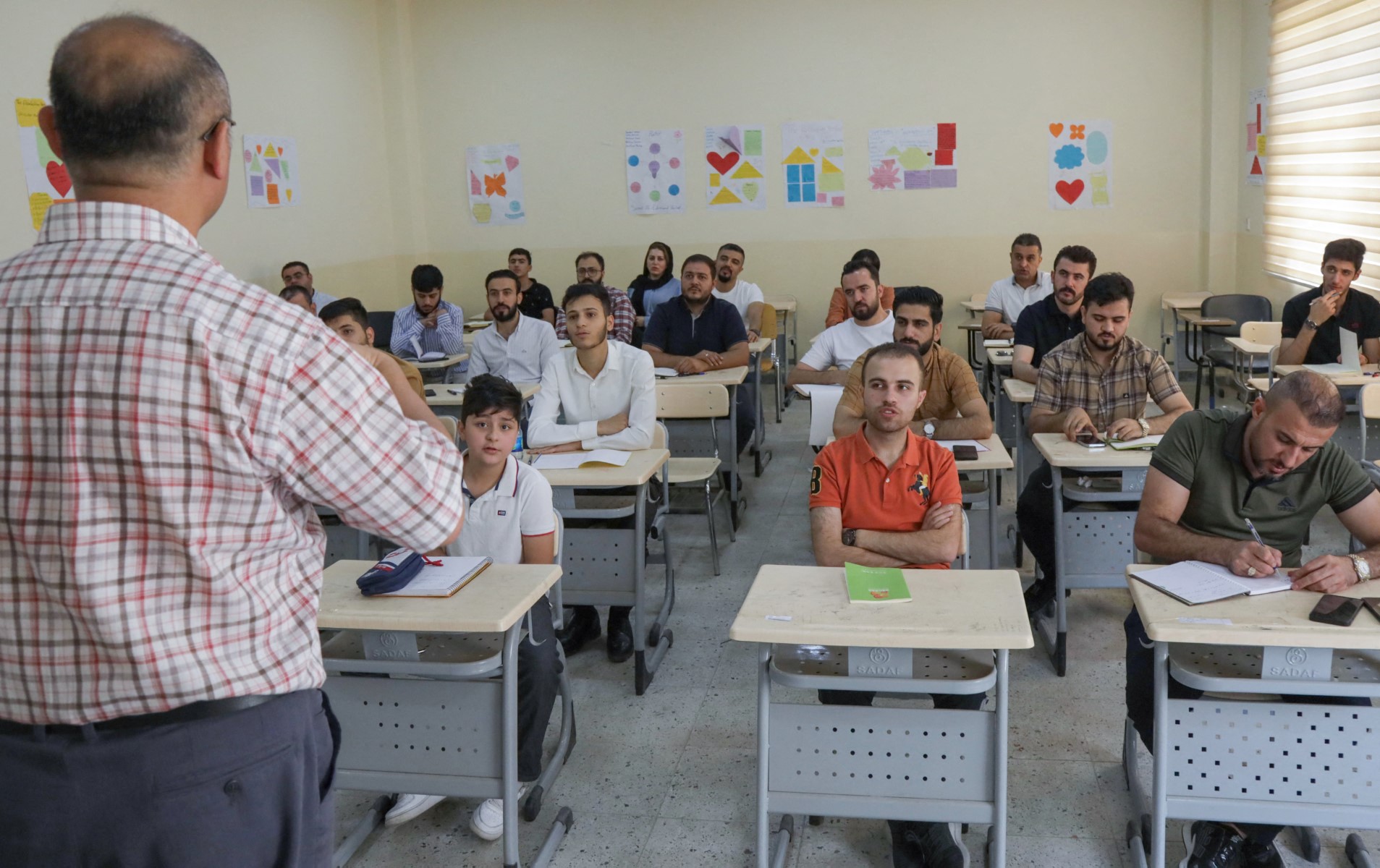
Iraqi Kurds attend Chinese language lessons in Erbil, the capital of Iraq’s northern Kurdish autonomous region, on July 20, 2022. (Photo by Safin HAMID / AFP)
As global power competitions loom, The Kurdistan Region’s capital Erbil (Hewlêr) is becoming a diplomatic center, a place that in many ways resembles Djibouti, the tiny nation in the Horn of Africa hosting the world’s military giants, including the US, China, the Gulf, and Europeans.
In December, the United States opened its largest consulate in the Kurdish city, while China has signaled long-term engagement through investing in major diplomatic missions and increasing cultural and economic ties.
The new U.S. consulate is more than a series of buildings and infrastructure; it is a testament to the ever-strengthening relationship between the United States and the Kurdistan Region of Iraq, according to high-ranking U.S. Department of State official Deputy Secretary Rigas. Alongside the U.S., China is also deepening ties with the Kurds, and the construction of a Chinese mega-consulate is currently underway.
These developments focus on more than just Kurdistan, as the size, architecture, and infrastructure of the new consulates reflect wider regional ambitions.
Chinese Initiatives:
The Great Wall Association
In addition to the new consulate, China is also busy establishing new associations and think tanks in the city. On December 8 it opened the Great Wall Association, which aims to bring together prominent figures in the Kurdistan Region who are knowledgeable about China and committed to deepening bilateral ties across various sectors.
The Association is comprised of more than a thousand people who have visited China in the past few years and attended various courses organized by the Chinese government, and its launch marks a new step in the China-Kurdistan relationship.
It has two honorary presidents: Falah Mustafa, Special Assistant to the Kurdistan Region President for Foreign Policy Affairs; and Mohammad Saber Ismail, the first post-Saddam Iraqi ambassador to China.
What is noteworthy is that the two presidents reflect the two ruling parties in Kurdistan, namely the Kurdistan Democratic Party (KDP) and the Patriotic Union of Kurdistan (PUK). This move reflects a hallmark policy of Chinese foreign relations: maintaining the status quo and navigating through it.
Before China had strong links on the ground, Chinese initiatives aimed to reach people in different parts of society and encouraged them to visit China. At the time, the reasons for these trips were unclear. However, in retrospect, the strategic thinking is evident, as the people who visited China years ago are now among the first members of the Great Wall Association. The next expected step will be how to organize this base to enhance China’s presence, image, and interests in the region.
What is amusing is the name of the association, which is rather contradictory. The contradiction of the name lies in the reference to the Great Wall. Throughout history, the Great Wall was a bulwark and represented an isolationist worldview that had built the wall over the millennia.
However, the reasoning behind the name appears to be fairly straightforward: most of those who visited China have been to the Great Wall, as one of the attendees told me, and the image of the Great Wall has become synonymous with China, in Kurdistan and globally. Thus, it is a powerful symbol of Chinese soft power.
Global Civilization Initiative Research Center
the Chinese model calls for a plurality of civilizations and counters the Western liberal order
After opening the Great Wall Association, Jin Xin, Assistant Minister of the International Department of the Communist Party of China, arrived in Erbil to launch the Global Civilization Initiative Research Center (CGI). The Center attracts “more than 300 officials, scholars, and representatives from China, Iraq, Türkiye, Jordan, and other countries,” according to Chinese outlet Xinhua. The GCI will be headed by Kawa Mahmoud, former secretary of the Communist Party of Kurdistan – Iraq.
The initiative was announced by Chinese President Xi Jinping in his 2023 keynote speech at the Chinese Communist Party High-Level Dialogue with World Political Parties.
According to a staff member at the Center, their core goal is to be a part of the Chinese-led global project for cooperation and coexistence: the GCI works to deepen research and organize forums, debates, and dialogues between civilizations. In theory, this approach opposes Samuel Huntington’s argument in Clash of Civilizations, in which he states that cultural differences will become central sites of conflict in the post-Cold War era.
Instead, the Chinese model calls for a plurality of civilizations and counters the Western liberal order – although ironically, one can argue that its opposition to the Western order goes against the fundamental concept of plurality as it, too, is a civilizational model. Furthermore, the model takes a relativist stance on human rights, freedom of expression, etc., which, some critics argue, can legitimize political actors’ indecisions in practicing or enforcing them.
U.S.—China Competition
The developments in Kurdistan are not happening in a vacuum. The ties with the Kurdistan Region, officially a federal region of Iraq, are running in parallel to the rising trade between Iraq and China. China’s direct exports to Iraq reached $8.8 billion in the first half of 2025, reflecting a 9.3% year-on-year increase, according to a report released Thursday by the Iraq Future Foundation for economic studies and consultancy.
China’s increased engagement in the area reflects a wider pattern of political diplomacy and military expansion, with growing Chinese activities across Asia and Africa
China’s increased engagement in the area reflects a wider pattern of political diplomacy and military expansion, with growing Chinese activities across Asia and Africa. Geysen Patrick, a retired EU diplomat previously stationed in Erbil, said, “The U.S. always complains about the Chinese threat. However, a small comparison between U.S. and Chinese bases around the world would make that threat ungrounded.”
However, with the U.S. giving up USAID, particularly in Africa, it is certain its place will be taken by others, primarily China, as China is well-situated given its already-established relationships and investments focusing on infrastructure projects across Africa.
Despite building its largest consulate in Kurdistan, U.S. power is not as secure as it was in the past. This consulate is rather a manifestation of the ‘bunker diplomacy’ that refuses to expand and approach the local community.
Throughout modern history, China has refrained from establishing formal relationships with the Kurds
Additionally, the U.S.’s “policy by personality”, replacing decades of processes and institutions with a handful of inexperienced new names, might match the local culture’s personality-focused politics, but deprives the US of its story, shining hill image, and soft power.
Central to this age of change is Kurdistan.
These types of developments are novel to Kurdistan. Throughout modern history, China has refrained from establishing formal relationships with the Kurds – something the late Kurdish political leader Jalal Talabani highlighted when talking about his 1955 trip to Beijing.
Like all other great powers, China will come to Kurdistan and find local advocates. But it remains to be seen whether China will go about business as usual, as other great powers have in the past – i.e., with little understanding of Kurdistan and few common goals – or whether China will build a true bilateral relationship with the Kurdish people.

Sardar Aziz
Sardar Aziz is a researcher, columnist, and international advisor. Worked as senior adviser, Kurdistan Parliament, Iraq. writes in Kurdish and English. He focuses on Kurdish politics and economy, Iraqi politics, and China-Kurdistan and Iraq relationship. He has published with numerous think tanks in the US, Europe, and the Middle East. Author of a number of books in Kurdish in the areas of governing, institutions, and political economy. He has a PhD on the State in the Arab Middle East from University College Cork (UCC) Ireland. He teaches annually at the Asian Study UCC.