More than words: Decoding the crisis between Turkey and Barzani’s KDP
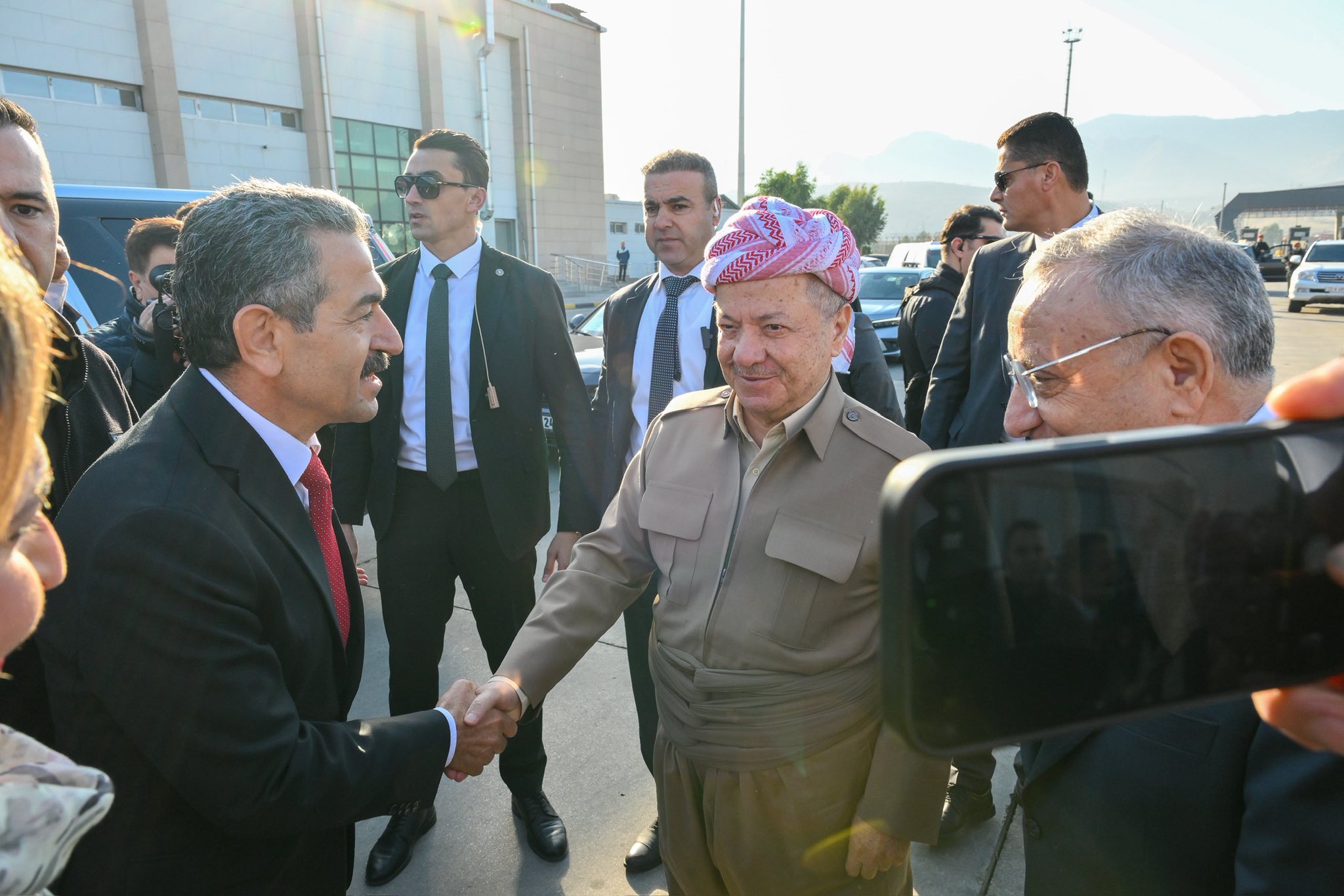
Barzani on his visit to Cizre, Turkey | Picture Credits: Mezopotamya Ajansı
The recent diplomatic spat between Ankara and the Office of Masoud Barzani, the former President of the Kurdistan Region of Iraq (KRI) and President of the Kurdistan Democratic Party (KDP), is more than just a war of words; it’s a symptom of deeper tensions within a region experiencing a major strategic realignment. Its implications are closely tied to two larger, concurrent events: the ongoing historic peace process between the Turkish Government and the Kurdistan Workers’ Party (PKK) on the one hand, and the inauguration of a massive new U.S. consulate in Erbil on the other. The row unfolded in the following manner:
Devlet Bahçeli, leader of the Turkish Nationalist Movement Party (MHP), criticized Masoud Barzani’s armed Peshmerga guards during the latter’s visit to Cizre, Turkey, as a “disgrace” and an attack on Turkish sovereignty
The Office of Masoud Barzani, known as Barzani Headquarters, responded by condemning Bahçeli’s remarks as “chauvinistic,” stating the security detail was part of an agreed protocol
The Turkish Foreign Ministry and President Erdoğan called the Barzani Headquarters’ response “unacceptable” and “impertinent”, demanding an explanation
AKP Spokesperson Ömer Çelik struck a contrasting tone, praising Barzani’s role in the peace process while announcing an investigation into the security arrangements
The diplomatic rupture is a sudden crack in a foundational partnership for the Middle East. It is best understood as a tense moment of recalibration between long-standing allies, forced by the dual pressures of a potentially paradigmatic internal peace process and a major external realignment of American power.
Turkey viewed the KRI as a stable buffer and its primary gateway into Iraq, a relationship built on extensive energy ties and shared opposition to the Kurdistan Workers’ Party (PKK)
For decades, the pragmatic alliance between Turkey and the Kurdistan Democratic Party (KDP)-led Kurdistan Regional Government (KRG) has been a cornerstone of Ankara’s regional policy. Turkey viewed the KRI as a stable buffer and its primary gateway into Iraq, a relationship built on extensive energy ties and shared opposition to the Kurdistan Workers’ Party (PKK). Barzani himself has been a pivotal supporter of the delicate peace process between Turkey and the PKK, a process that is now entering its most critical phase after the militant group’s declared withdrawal from Turkish territory. The Turkish nationalist accusation that Barzani’s security detail was a “disgrace” to sovereignty, along with the KDP’s retort labeling it “chauvinistic,” strikes at the core of mutual respect necessary for such high-stakes diplomacy. While the Turkish government’s demand for an apology underscores its insistence on hierarchical protocol, the underlying anxiety is about control and influence.
The uncertain trajectory of the peace process, which promises to redraw the political map of the Kurdish issue, is undoubtedly a primary driver. Success would transform the PKK from a banned insurgent group into a potential political actor, inevitably altering the calculus of Kurdish leadership across the border. At the same time, Ankara’s harsh tone towards Barzani could serve as a stark reminder to all Kurdish parties that, despite negotiations, Turkey remains the predominant arbiter of Kurdish political fortunes. The response signals the intent to carefully control the negotiations’ outcome and ensure no single Kurdish leader or entity, whether Barzani or PKK leader Abdullah Öcalan, emerges with unchecked influence.
This is not merely a new building but a profound strategic investment, telegraphing a long-term American commitment to the KRG as a key regional actor independent of Baghdad.
Equally consequential is the monumental opening of the new U.S. Consulate General in Erbil, a $796 million project that stands as the United States’ largest diplomatic mission globally. This is not merely a new building but a profound strategic investment, telegraphing a long-term American commitment to the KRG as a key regional actor independent of Baghdad. For the Barzani administration, this provides a renewed sense of diplomatic confidence and a powerful alternative anchor. For Ankara, it likely feeds into suspicions of a U.S.-backed KRG gaining strength and autonomy, potentially altering the balance of power in northern Iraq. The latter’s unexpectedly strong rebuttal to Turkish criticism likely draws from this newfound sense of bolstered international standing.
The implications of this friction ripple outward, touching core economic and (regional) security interests. Economically, it casts a shadow over the ambitious Turkey-Iraq Development Road Project (DRP), a trade corridor whose current proposed route has been lamented by the KRG for bypassing its heartland. The political tension now provides a charged backdrop for what was already a sensitive negotiation about inclusion and economic centrality. Regionally, actors like Iran, which traditionally backs the rival Patriotic Union of Kurdistan (PUK), will watch closely for any opportunity to exploit a rift between Ankara and Erbil to expand its own influence. While a full-scale escalation involving the Iraqi army remains unlikely, the central government in Baghdad may see an opening to mediate and reassert its own role in northern affairs, especially concerning the future of Turkish military presence linked to the PKK dialogue.
The old order, defined by a clear Turkish-KRG alliance against the PKK, is being challenged from within and without.
The crisis between Turkey and the Barzani leadership is a symptom of a pivotal transition. The old order, defined by a clear Turkish-KRG alliance against the PKK, is being challenged from within and without. The heated exchange is therefore a diplomatic skirmish in a larger struggle to define the new rules of engagement. The most probable path forward is not a clean break but a period of managed tension and difficult recalibration, during which both Ankara and Erbil will test the limits of their partnership while navigating the unpredictable currents of Kurdish political evolution and great-power attention. The stability of the Kurdistan Region and the success of the historic peace process now hinge on whether this recalibration can be conducted through dialogue rather than further confrontation.

Burhan Jaf
Ambassador Burhan Namik Salim Jaf is a retired Kurdish-Iraqi diplomat with decades of service in regional and international diplomacy. Born in Berlout - a small village (12 km away from Kalar) in Iraq, he holds a BA (Honours) in Politics and Sociology from the University of Greenwich in London. Jaf served in senior roles including Head of the Asia, Engineering and Communications departments in Iraq's MoFA (2016 - 2018), Head of Mission of the Kurdistan Region to the European Union in Brussels (1998–2009), Ambassador of the Republic of Iraq to Baghdad (2009), and Ambassador to Athens & Cypres from 2010 - 2016, Permanent Representative of Iraq to the UNEP & UN-Habitat (2018 - 2020) as well as ambassador to Kenya & Eastern Africa. Amb. Jaf retired in 2021. Fluent in English, Dutch, Persian, and Kurdish (his mother tongue).