From ISIS to new Syrian Government: The U.S. Security Dilemma in Syria
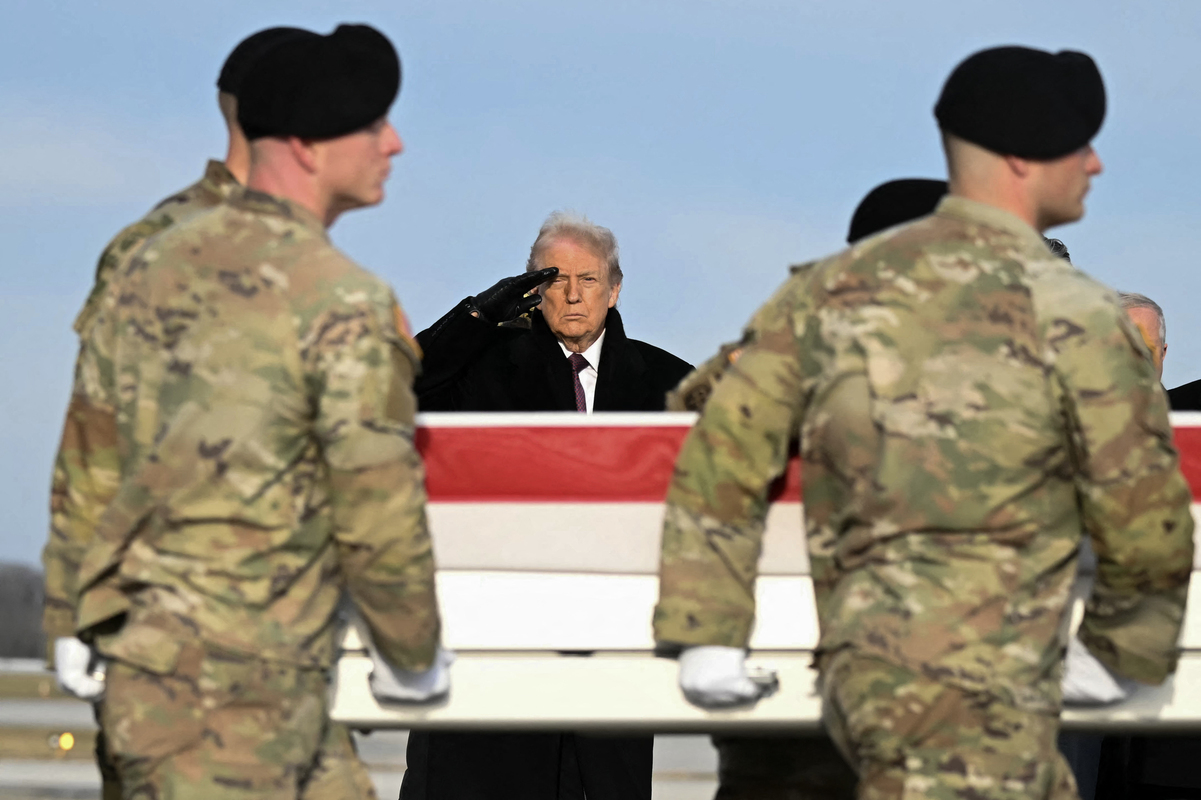
US President Donald Trump salutes the transfer case of Iowa National Guard Sgt. Edgar Torres Tovar as it is carried past him during a ceremony for the return of the remains of two Iowa National Guard members and a civilian translator killed in an attack in Syria at Dover Air Force Base in Delaware on December 17, 2025. (Photo by ANDREW CABALLERO-REYNOLDS / AFP)
The killing of two American soldiers in Syria highlights the persistent instability gripping the country and the Syrian Interim Government’s lack of control. But beyond the attack, the U.S. response – and the Trump administration’s framing of the incident – reveals deeper political and strategic tensions surrounding America’s presence in Syria.
Initially, the Trump administration attributed the attack to ISIS, but a few days later, it stated that the attack had no connection to Syria’s Interim President Ahmed al-Sharaa, the new Syrian Army, or al-Sharaa’s government, or, as others stated, it was a ‘lone wolf’ operation. This change can be seen as part of a calculated strategy to control the crisis in the complex environment of post-Assad Syria.
The U.S. attributing the attack to ISIS in the immediate hours following the incident touches on a familiar narrative of U.S. security policy. In such moments, the US government requires a simple narrative that is easy to understand, and ISIS fulfils this role well: accusing the terrorist group gives the American public at home a known enemy and gives Washington leeway to engage in limited military or security actions.
In security and counter-terrorism literature, a “lone wolf operation” does not necessarily imply that the perpetrator is entirely disconnected from extremist networks. The term is usually applied to individuals who act without direct orders, but who may have been former members of formal or semi-formal structures, or at the very least have been radicalised or inspired by them.
Using this definition, the U.S. can designate ISIS as the ideological source of the threat while relieving other actors from structural and governmental responsibility. This also reflects the balance that Trump was seeking: the possibility of a limited response without becoming embroiled in a new “forever war”.
Washington’s implicit message is clear: as long as the incident remains an isolated event, the US does not wish to escalate a military conflict.
In this context, the exclusion of Ahmed al-Sharaa and the Syrian Army from the official narrative is particularly significant. Referring to these actors directly would not only escalate the crisis but also disrupt the fragile balance of power in northern and central Syria. Washington’s implicit message is clear: as long as the incident remains an isolated event, the US does not wish to escalate a military conflict. However, it is worth adding that, besides the retaliatory strikes against ISIS, Trump has also renewed the ban on Syrian nationals entering the United States.
The attack and events around it take on greater significance when considered alongside the United States’ long-standing cooperation with the Autonomous Administration in Rojava (Kurdistan Region in Syria) and the Kurdish-led Syrian Democratic Forces (SDF).
The SDF in North and East Syria has a relatively transparent command structure, local control of the battlefield, shared interests with the U.S. in fighting ISIS, well-established intelligence coordination mechanisms, and, importantly, secular democratic values. Despite heavy local casualties, the result of this cooperation has been a significant reduction in casualties and injuries for U.S. forces and the formation of operational trust between the sides.
By contrast, central Syria is a fragmented and permeable arena where multiple actors, conflicting interests, individual radicalisation, and a lack of strategic trust are intertwined. In this chaotic environment, relatively small-scale action can catalyse the eruption of major crises. Given this context, it is no surprise that despite all regional pressures, the U.S. still considers the SDF its most reliable partner on the ground.
Unlike the SDF, Ahmed al-Sharaa’s Syrian army is composed of factions with extremist Islamist ideologies, whose operational history is rooted in hostility towards the U.S. and Israel.
So, while Ahmed al-Sharaa attempts to portray himself as a pragmatist in the media and tries to speak about rapprochement with the West, the rank and file meant to be under his command do not seem willing to accept change. And experience in Syria has shown that a profound gap between leadership decisions and in-field behaviour can lead to violent, ideologically-charged actions and “lone wolves”.
When an armed force is founded on Jihadi and anti-Western ideology, the risk of individual radicalisation and action always exists,
When an armed force is founded on Jihadi and anti-Western ideology, the risk of individual radicalisation and action always exists, even if the leadership of those forces is temporarily seeking engagement or normalisation with the West. In other words, the issue is not just Ahmed al-Sharaa’s intentions or stance, but also the nature and background of the forces he relies on. From this perspective, while the narrative of a ‘lone wolf operation’ serves the function of crisis containment at the diplomatic level, it does not conceal the structural reality, nor can it provide long-term solutions.
The Trump administration’s changing statements about this attack should not be seen as contradictory, but rather as a tactical delegation of responsibility: ISIS was designated the official enemy, governmental and structural responsibility was denied, and the path to military escalation was deliberately blocked.

Ali Asghar Faridi
Kurdish-Iranian journalist based in Germany