Explainer: Why Is Turkey Opposing Syrian Kurds While Talking Peace at Home?
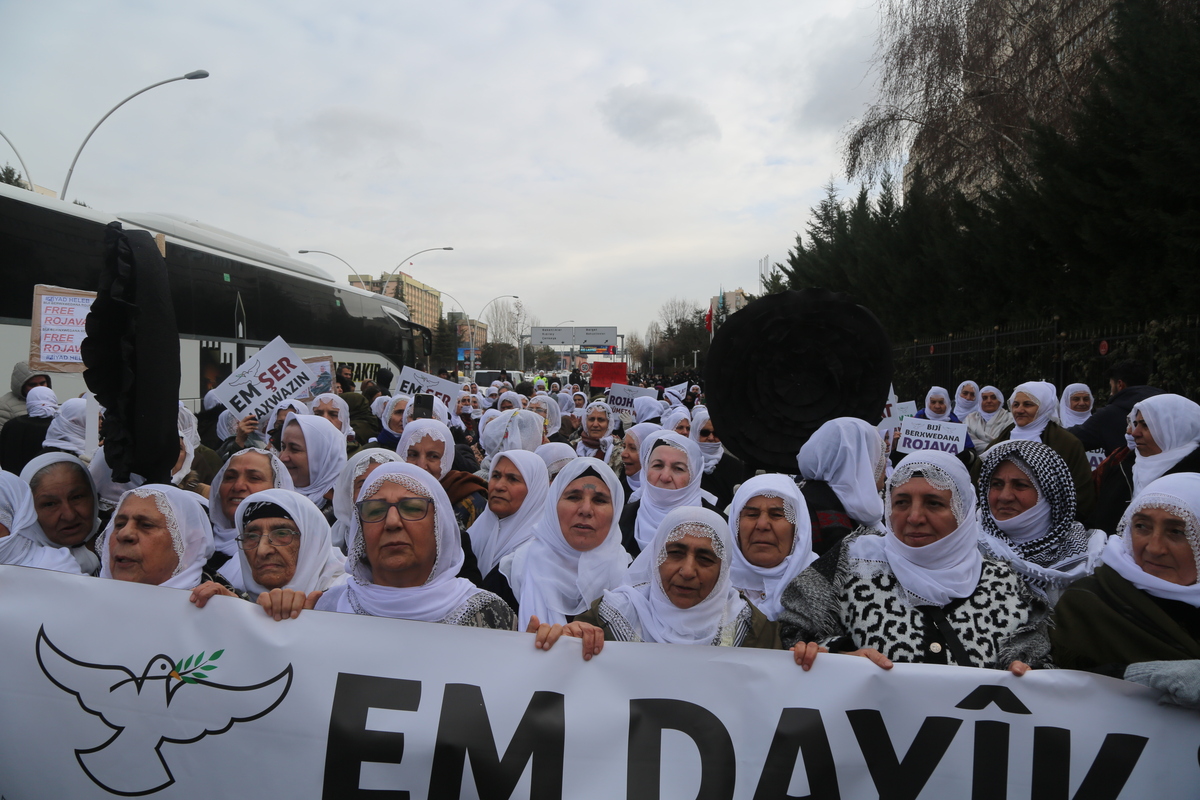
As Turkey once again speaks of a renewed “peace process” on the Kurdish question, it is simultaneously pursuing a hardline policy against Kurdish political gains in Syria.
This apparent contradiction has raised a central question: how can Ankara discuss peace with Kurds inside its border while rejecting Kurdish political authority just across it?
This explainer examines the historical, political, and regional dynamics behind this policy.
Turkey’s Kurdish Peace Process: What’s on the Table and What’s Not?
Turkey’s Kurdish question has long oscillated between armed conflict, denialist state policies, and limited reforms. The most recent comprehensive peace effort, between 2013 and 2015, was based on indirect negotiations between the Turkish state and the Kurdistan Workers’ Party (PKK). That process collapsed amid the Syrian civil war, the Kobane crisis, and shifting power dynamics in Turkey’s domestic politics.
Today, although there is renewed talk of a peace process, no legal or constitutional framework exists to expedite or formalize proposals and solutions. Pressure on the Kurdish political movement continues, and “peace” is increasingly framed as a security-focused normalization that can be tightly controlled. As a result, current discussions prioritize domestic security and the end of armed conflict, rather than addressing the Kurdish collective political status or broader political transformation.
How Did Syria and Syrian Kurds Enter the Debate?
The Syrian civil war that began in 2011 led to the collapse of central state authority across large parts of the country. From 2012 onward, Kurds in northern Syria, also known as Rojava (Kurdish: West Kurdistan), filled the vacuum left by the Assad regime, establishing local governing structures responsible for security, justice and basic services.
In 2014, ISIS attacks and the Kurdish resistance in Kobane transformed Syrian Kurds into de facto allies of the US-led Global Coalition to Defeat ISIS.
Following the defeat of ISIS, Kurdish-led forces consolidated control over much of northeastern Syria and established the Autonomous Administration of North and East Syria (DAANES).
DAANES was built on principles of ethnic and religious pluralism, gender equality, and women’s representation, while advocating a decentralized political system within Syria’s territorial integrity.
Historical Position of Syrian Kurds
Under the Assad regime and the Ba’ath Party, Syrian Kurds were systematically oppressed and marginalized. Many were denied citizenship, Kurdish political organizations were banned, and cultural rights were severely restricted. As a result, Syrian Kurds were largely excluded from formal political life for decades.
Against this background, the emergence of the Autonomous Administration after 2011 marked the first instance of institutionalized political existence for Syrian Kurds. For the first time, they exercised organized authority through governance, security and public services.
For Turkey, however, the institutionalization of Kurdish rights under DAANES symbolized something else. Ankara views the administration as a structure with ideological and organizational links to the PKK, and therefore as an oppositional Kurdish political project acquiring permanent and legitimate status just across its border.
The March 10 Agreement: What Was Signed and What Changed?
On March 10, 2025, three months after Assad’s fall, the Syrian transitional government and the Autonomous Administration signed a framework agreement outlining the integration of DAANES-administered areas and forces into Syria’s political and military structures. The agreement emphasized coordination and integration but deliberately avoided defining concrete political powers or governance arrangements.
While the agreement was widely seen as a significant political moment for Syria’s future, it stopped short of offering guarantees regarding decentralization or Kurdish political status. Nevertheless, it raised expectations that Kurdish gains could eventually be negotiated within a formal state framework.
Why Did the Agreement Stall?
Following March 10, al-Sharaa’s administration repeatedly delayed implementing the agreement. The Syrian transitional government avoided defining concrete political powers, timelines or decentralization mechanisms, and narrowed the framing of the deal as a matter of security coordination rather than a broader political settlement.
Turkey, while not a party to the agreement, publicly rejected any outcome that could normalize Kurdish political or armed security status in Syria. Ankara exerted military pressure and sustained diplomatic opposition, signaling that it would not tolerate steps that might legitimize Kurdish self-rule. As a result, no joint mechanisms became operational, no concrete measures were implemented, and the framework remained dormant.
In this sense, the agreement did not formally collapse but it could not move forward either.
Turkey’s Role: Security or Political Engineering?
Turkey’s approach to Syrian Kurds rests on three core premises:
First is the fear that Syrian Kurds gaining a permanent political status would set a precedent for Kurds inside Turkey.
Second, this fear is reinforced by an ideological antagonism: Erdoğan’s centralized, Sunni-Islamist state model is fundamentally incompatible with the DAANES’s emancipatory and pluralist paradigm.
Third is regional power politics. From Ankara’s perspective, an autonomous Kurdish administration limits Turkey’s influence in Syria. Any framework that normalizes Syrian Kurds as a political interlocutor, therefore, complicates Turkey’s ability to conduct future maneuvers. Rather than pursuing a political settlement, Ankara has favored a strategy of containment and controlled weakening.
This posture may appear contradictory given Turkey’s renewed talks with its own Kurds. However, a domestic peace process is seen as manageable within Turkey’s borders, while a cross-border Kurdish political status is viewed as a permanent and destabilizing model. For this reason, Ankara draws a sharp distinction between peace and status.
The Limits of Peace
For Ankara, peace itself is defined in narrow terms. Turkey’s current vision of Kurdish peace does not include political autonomy or collective rights. Instead, it is framed around the goal of a “terror-free Turkey,” emphasizing the end of armed conflict without broader political transformation. This stands in contrast to the Kurdish movement’s framing of “Peace and a Democratic Society,” which envisions change extending beyond disarmament to social and state structures.
Syrian Kurds, by contrast, have already secured de facto collective rights and begun institutionalizing political, administrative, and security structures. In this sense, for Ankara, the central issue is not making peace with Kurds per se, but controlling where, how, and under what conditions Kurdish political existence is permitted.
Same Peace Talks Under Different Regimes: A Comparison of 2013 and 2025-26
Turkey’s Kurdish peace initiatives in 2013 and 2025 employ similar language but unfold under different political conditions. In 2013, the process occurred at the height of Erdoğan’s hegemonic rise: Erdoğan was politically strong, state institutions remained plural, and peace functioned as a strategy to expand power by integrating Kurds into a new ruling coalition.
By contrast, currently, Erdoğan largely controls the state, but his political legitimacy has been eroded, and he faces a far more nationalist and militarist public and a stronger, more viable opposition. Under these conditions, peace operates less as a reform project and more as a form of risk management aimed at neutralizing Kurdish alignment with the opposition, managing regional instability, and preventing regime loss, rather than redefining state-Kurdish relations.
Turkey’s Kurdish policy is not contradictory; it is conditional. Peace is acceptable; Kurdish political status is not. And peace is understood as the silencing of arms, not societal transformation or power-sharing.

Serap Gunes
Serap Güneş is a freelance translator and writer based in Istanbul. She holds a PhD in International Relations and European Politics from Masaryk University, where her research focused on minority rights and EU–Turkey relations. Her work has appeared in both academic journals and independent media outlets.