The Maduro Test: Is Turkey’s Strategic Ambiguity Starting to Crack?
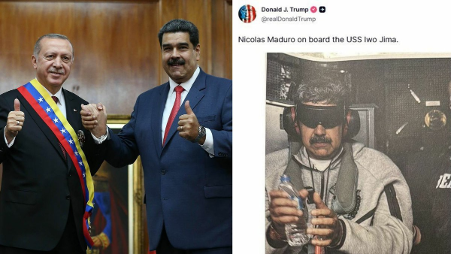
A composite image reshared by CHP leader Özgür Özel juxtaposes a past bilateral moment in which Turkish President Recep Tayyip Erdogan and Venezuelan leader Nicolás Maduro pose with a thumbs-up (left) with a screenshot of US President Donald Trump’s post announcing Maduro’s capture by US forces (right), as debates intensified in Turkish politics over Ankara’s response to the operation.
Source: X / @eczozgurozel
Turkey’s response to the United States’ operation that captured Venezuelan President Nicolás Maduro and brought him to New York has triggered a domestic political debate and exposed tensions between pragmatism and ideological rhetoric in Ankara’s foreign policy over the past decade.
In a U.S. operation carried out on January 3, Maduro and his wife, Cilia Flores, were taken from their residence in Caracas and flown to New York, where Maduro was publicly paraded through the city. The operation reportedly resulted in the deaths of around 80 people, including Venezuelan civilians.
While the move drew widespread criticism both inside and outside the US and raised serious questions about its compliance with international law, official responses from Western governments largely avoided directly targeting Washington.
Turkey’s initial reaction was also notably muted. On the same day as the operation, the Turkish Foreign Ministry issued a brief statement that refrained from identifying the US as a violator of international law or explicitly condemning the operation. Instead, it called on “all parties to exercise restraint,” emphasized “Venezuela’s stability and the peace and well-being of the Venezuelan people,” and urged that what it described as a “crisis” be resolved “within the framework of international law.”
Erdogan’s Response
CHP leader Özgür Özel accused Erdogan of avoiding a confrontation with US President Donald Trump and abandoning a former ally.
President Recep Tayyip Erdogan, who had previously cultivated close personal and political ties with Maduro, chose to remain silent for several days following the incident.
Erdogan’s silence was sharply criticized by the main opposition Republican People’s Party (CHP). On January 3, CHP leader Özgür Özel accused Erdogan of avoiding a confrontation with US President Donald Trump and abandoning a former ally. Describing the US operation as a coup, Özel characterized Erdogan’s silence as fear of Trump and an example of political and moral hypocrisy:
“Today, Erdogan swallows every word and stays silent; he buys Boeing planes [from the US] just to get an appointment [from Trump], sacrifices our critical rare earth resources to get an appointment, and even offers tax cuts on American goods and higher tariffs on Chinese products just to get an appointment,” Özel said.
Erdogan described Maduro’s abduction by the US as “an unfortunate incident,”
Özel’s sharp criticism was answered not by Erdogan himself but by ruling Justice and Development Party (AKP) spokesperson Ömer Çelik. Rejecting the opposition’s accusations, Çelik said that Erdogan has “always been a defender of international law, the legitimate sovereignty of states, and their territorial integrity.” However, his statement also avoided naming the party responsible for the alleged violation, limiting itself to a generalized emphasis on “legitimacy.”
Erdogan’s first public response came only on January 5. Speaking after a cabinet meeting and a phone call with Trump, Erdogan described Maduro’s abduction by the US as “an unfortunate incident,” adding that Turkey was striving to do “whatever is best and most appropriate, both for Turkey and for the friendly people of Venezuela.”
He characterized violations of state sovereignty and breaches of international law as “risky steps that could lead to serious complications at the global level,” saying he had conveyed Turkey’s sensitivities to Trump and emphasized the need to prevent Venezuela from sliding into instability.
While reiterating Turkey’s support for the Venezuelan people, Erdogan again avoided explicitly naming the US as the violator of international law or directly defending Maduro himself.
The restrained response from the Turkish government – from the Foreign Ministry to the presidency – stood in sharp contrast to the much harsher reaction of Erdogan’s key political ally, Nationalist Movement Party (MHP) leader Devlet Bahçeli. On January 6, Bahçeli openly condemned the US operation, describing it as “piracy.”
Drawing a direct comparison to Turkey’s failed July 15, 2016 coup attempt, Bahçeli said, “This is not something that can be tolerated. It bears similarities to the treachery of July 15,” and called for Maduro to be returned to Venezuela. He went further by personally targeting Trump, accusing him of having “lost his common sense and moral and intellectual faculties,” and urged the US Congress to “intervene immediately and take steps to put an end to the Trump administration’s political and military actions that violate the Constitution and international law.”
Allegations of Turkish Involvement
Later the same day, CHP leader Özel’s statements suggested that Turkey may not have been merely a passive observer in the US operation against Venezuela. He argued that Ankara’s role in the process needed to be clarified, warning that the government’s silence might point not only to diplomatic caution but also to tacit consent or even prior involvement.
In support of this claim, Özel cited remarks by US Republican Senator Lindsey Graham, who on January 5 said, “Maduro could be in Turkey today, but he’s in New York,” implying that exile in Turkey had been presented as an option before the operation. Özel argued that such an offer could not have been made without prior knowledge or approval of Erdogan, and directly challenged him by asking, “Were you aware of this, or were you not?”
Although Erdogan rejected these claims, US and Venezuelan officials interviewed by The New York Times confirmed that the Washington administration had offered Maduro a safe exile in Turkey in exchange for stepping down from office. When Maduro refused the offer, Trump authorized the military operation.
A new era in Turkish foreign policy?
President Erdogan’s delayed and restrained response signals a clear departure from the openly confrontational, anti-Western rhetoric that had characterized Ankara’s foreign policy in the years following the failed 2016 coup attempt.
The stark contrast between Erdogan’s tone and that of his nationalist ally Bahçeli may reflect a deliberate division of labor aimed at managing domestic perceptions of this shift. While opposition criticism sought to portray Erdogan’s caution as weakness and inconsistency, Bahçeli’s far more uncompromising rhetoric appears designed to absorb nationalist and anti-Western reactions. This dynamic allows Erdogan’s muted diplomatic language to be reframed as the calculated restraint of a statesman attuned to global power balances and strategic realities.
The Maduro episode, however, points to a deeper structural issue rather than reopening debates over the sincerity of Erdogan’s past anti-imperialist gestures, such as “One minute” or “The world is bigger than five.” Taken together, these developments suggest that Turkey’s long-standing preference for strategic ambiguity, its avoidance of clear alignment, and its willingness to subordinate stated principles to pragmatic calculations in the name of national interest may be approaching the limits of sustainability in the current international environment.
As those limits draw closer, the risk that Erdogan-era Turkish foreign policy could fracture – either domestically or on the international stage – is difficult to dismiss.

Serap Gunes
Serap Güneş is a freelance translator and writer based in Istanbul. She holds a PhD in International Relations and European Politics from Masaryk University, where her research focused on minority rights and EU–Turkey relations. Her work has appeared in both academic journals and independent media outlets.