Former Iraqi President Barham Salih to Become New U.N. High Commissioner for Refugees
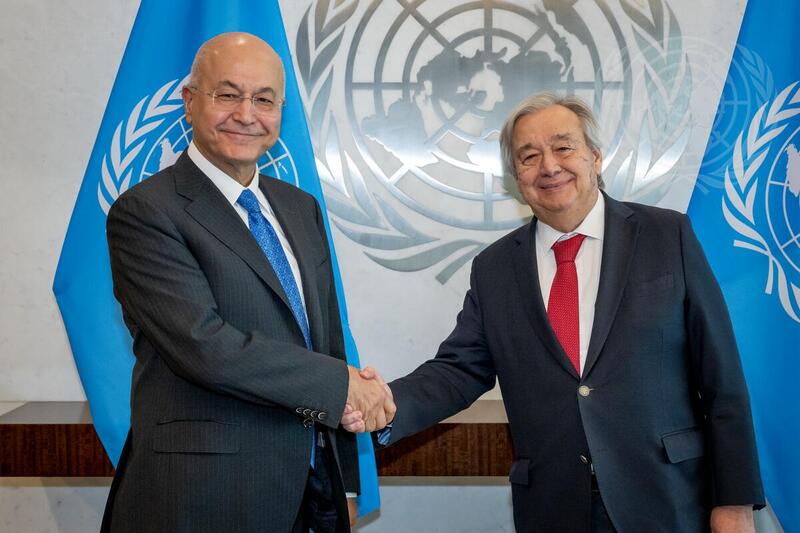
Secretary-General António Guterres (right) meets with Barham Salih, Former President of the Republic of Iraq. 8 November 2024. UN Photo
Sources close to Barham Salih, the former president of Iraq and one of the country’s most seasoned Iraqi-Kurdish statesmen, have confirmed to The Amargi that Salih is expected to be appointed the next United Nations High Commissioner for Refugees (UNHCR), after his nomination by UN Secretary-General Antonio Guterres. The move would place the Iraqi Kurdish veteran political figure at the helm of one of the U.N.’s most consequential humanitarian agencies at a time of unprecedented global displacement.
The anticipated appointment follows Salih’s most recent meeting with U.N. Secretary-General António Guterres on November 8, 2024, a conversation that some at the time described as “forward-looking” and which focused on global refugee crises and the humanitarian fallout of conflicts in the Middle East.
Salih would become the first Iraqi, and the first Kurd, to lead UNHCR, a role charged with overseeing protection and assistance for more than 100 million forcibly displaced people worldwide. His appointment would carry deep political significance in Iraq and across the Kurdish region, where millions of families have experienced displacement across decades of war, persecution due to ethnic and cultural background, and the rise of the Islamic State.
Salih’s appointment would also mark a historic break with precedent: since UNHCR was founded in 1950, every High Commissioner has come from Western or Western-allied nations. For more than seven decades, leadership of the world’s principal refugee agency has been dominated by Europeans, along with representatives from Japan and other wealthy donor states. Salih would be the first figure from the Global South – and the first from the Middle East – to hold the position. This shift reflects growing recognition that the countries most affected by displacement are no longer willing to remain passive recipients of international policy but seek a seat at the table that decides on humanitarian agendas .
A Career Defined by Conflict, Diplomacy, and Institution-Building
Born in 1960 in Sulaymaniyah, Salih joined the Kurdish resistance movement as a teenager and was twice imprisoned by Saddam Hussein’s regime in 1979, spending more than a month in security detention before fleeing to Britain. He went on to earn a doctorate in statistics and computer applications at the University of Liverpool before returning to Kurdish politics.
Over the past thirty years, Salih has held some of the highest positions in both the Kurdistan Region and the federal government of Iraq, including Prime Minister of the Kurdistan Regional Government (2001–2004 PUK-led Sulaymaniyah Administration), KRG Prime Minister (2009—2012), Deputy Prime Minister of Iraq in both the interim and elected governments (2004—2005; 2006—2009), and Iraq’s eighth president from 2018 to 2022. He is widely recognized as a pragmatic mediator who has maintained working relationships across Iraq’s polarized political landscape. After Jalal Talabani’s death in 2017, Salih split from the PUK over leadership roles and formed the National Alliance, which he later dissolved to rejoin the PUK and become Iraq’s President.
During the 1990s and 2000s, Salih, who was leading the PUK’s foreign affairs at the time, played a central role in expanding Kurdish and Iraqi diplomatic engagement with Washington , and he later founded the American University of Iraq, Sulaymaniyah – one of the region’s prominent educational institutions.
Unlike many leaders in Iraqi Kurdistan’s political scene, Barham Salih came from a modest background. He is one of the few prominent Kurdish figures to rise without the support of a political dynasty or tribal base, building his career largely on personal merit. That same lack of entrenched backing may also help explain why he has since struggled to maintain his position in Kurdish politics.
Why This Post Matters – for Iraq, for Kurds, and for Salih
For Salih, a Kurdish political figure whose life has been shaped by exile, repression, and state failure, leading UNHCR carries symbolic and strategic weight.
Politically, the role enhances Kurdish visibility on the global stage at a time when Kurdish communities across Iraq, Syria, Turkey, and Iran remain deeply vulnerable. As a former Iraqi president, Salih’s appointment would also reflect the country’s desire to project stability and international engagement after years of conflict. Iraq and the Gulf countries have firmly supported Salih’s nomination.
For many Kurds, the position represents something more personal: the international community’s recognition of their long struggle with displacement from the Anfal genocide of the 1980s to the mass refugee waves triggered by the Islamic State in 2014 in Iraq and Syria.
For Iraq, placing a respected national figure in one of the U.N.’s highest humanitarian posts strengthens Baghdad’s international standing and signals a commitment to global governance at a moment when the Middle East continues to face mass population movements.

The Amargi
Amargi Columnist