U.S. and Iran Negotiate on the Edge of Conflict
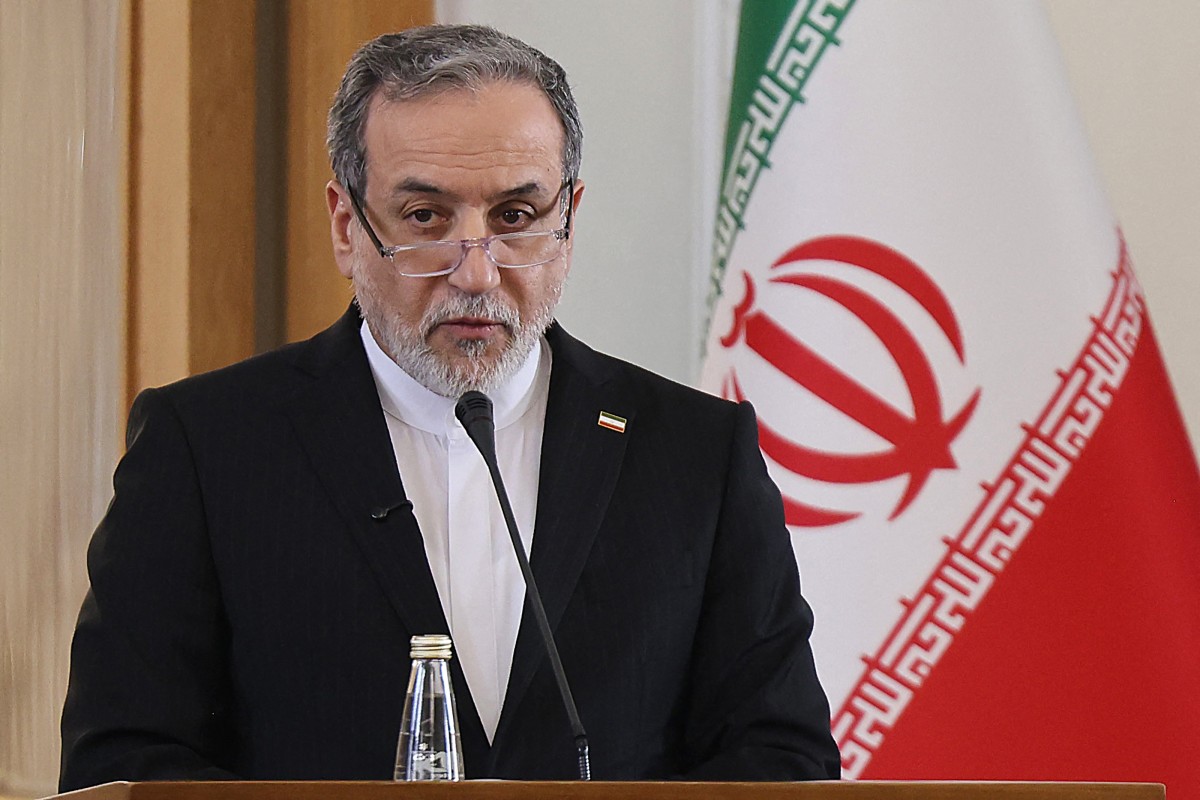
Iranian Foreign Minister Abbas Araghchi in Tehran on January 18, 2026. (Photo by ATTA KENARE / AFP)
Iran and the United States resumed indirect talks in Muscat, Oman, on Friday after an eight-month rupture triggered by last year’s 12-day war between Israel and Iran. Iranian Foreign Minister Abbas Araghchi described the discussions as “positive and a good start,” adding that both sides had agreed to continue negotiations. Oman’s Foreign Ministry said the talks had “focused on preparing the appropriate conditions for resuming diplomatic and technical negotiations,” without elaborating.
As senior Iranian and U.S. officials gathered in Muscat, the U.S. Virtual Embassy Iran issued a statement urging American citizens to “leave Iran now
The U.S. delegation was led by Steve Witkoff, a senior envoy to President Donald Trump, alongside Jared Kushner, Trump’s son-in-law, and Admiral Brad Cooper, commander of U.S. forces in the Middle East. The participation of senior military officials in what were nominally diplomatic talks drew criticism from some analysts, who said it risked blurring the line between negotiation and coercive pressure.
As senior Iranian and U.S. officials gathered in Muscat, the U.S. Virtual Embassy Iran issued a statement urging American citizens to “leave Iran now,” citing security concerns and warning of possible internet disruptions. The advisory urged U.S. nationals to prepare backup communication plans and not to rely on government assistance when arranging departures, noting that overland routes to Armenia and Türkiye remained open.
The advisory said that Americans unable to leave should shelter in a secure location, stock up on essential supplies including food, water and medication, and avoid demonstrations or other public gatherings. It also urged U.S. citizens to monitor local media, remain vigilant, keep phones charged, stay in regular contact with family and friends, and enroll in the State Department’s Smart Traveler Enrollment Program (STEP) for security updates.
Shortly after the talks concluded, the U.S. Treasury Department announced new sanctions on 15 entities and 14 vessels linked to Iran’s so-called “shadow fleet,” in a move aimed at curbing Iranian oil exports and restricting revenue streams.
The talks also come amid a significant buildup of U.S. military forces near Iran. U.S. Central Command released images showing the Abraham Lincoln Carrier Strike Group, accompanied by two military supply ships and two U.S. Coast Guard cutters, operating in the Arabian Sea, with aircraft from Carrier Air Wing 9 flying overhead. U.S. officials framed the display as part of President Trump’s doctrine of “peace through strength.”
A day before the talks, Araghchi said Iran would enter the negotiations with “a steady memory of the past year,” signalling caution after months of conflict, sanctions pressure, and regional instability.
Iran enters the renewed negotiations in a weakened position following months of nationwide protests calling for political change. Human rights groups estimate that security forces killed at least 6,000 demonstrators as authorities deployed sweeping force to suppress unrest, highlighting the regime’s reliance on coercion to maintain control.
The subject of our talks is solely nuclear, and we will not discuss any other issue with the Americans
Despite the renewed engagement, the gap between the two sides remains wide. Washington wants negotiations to address a broad set of issues, including Iran’s nuclear programme, ballistic missile development, support for regional proxy groups, and human rights practices. Secretary of State Marco Rubio said meaningful progress would require limits on Iran’s missile arsenal, an end to backing for militant organisations, and a halt to domestic uranium enrichment.
Iran, however, insists the talks remain confined to nuclear matters. “The subject of our talks is solely nuclear, and we will not discuss any other issue with the Americans,” Araghchi told state news agency IRNA following the Muscat meeting. Iranian leaders view their missile programme as a strategic red line and their network of regional allies as central to their revolutionary ideology.
Last June’s 12-day conflict, launched by Israel with brief U.S. involvement, dealt a heavy blow to Iran’s nuclear and military infrastructure, fuelling speculation that Tehran might temporarily rein in uranium enrichment in exchange for sanctions relief. Yet Israeli officials remain deeply alarmed by Iran’s expanding long-range missile arsenal and continue to press Washington to pursue far tighter constraints.
“Hopefully we’ll make a deal. If we don’t make a deal, we’ll find out whether or not he was right.”
While Tehran may display tactical flexibility on enrichment following the damage inflicted by U.S. airstrikes in June 2025, it has shown no willingness even to entertain discussion of its missile programme — a pillar of its deterrence strategy and a core symbol of its regional power projection.
Tensions between the two countries are approaching a boiling point as Washington intensifies economic pressure on Iran. Supreme Leader Ayatollah Ali Khamenei has warned that any renewed confrontation would engulf the wider region. “Americans should know that if they start a war this time, it will be a regional war,” he said in a recent address. President Donald Trump responded in kind, saying, “Hopefully we’ll make a deal. If we don’t make a deal, we’ll find out whether or not he was right.”

Rojin Mukriyan
Rojin Mukriyan has PhD in the Department of Government and Politics at University College Cork, Ireland. Rojin’s main research areas are in political theory, feminist and decolonial theory, and Middle Eastern politics, especially Kurdish politics. She has published articles in the Journal of International Political Theory, Philosophy and Social Criticism, and Theoria. Her research has thus far focused on the areas of Kurdish liberty, Kurdish statehood, and Kurdish political friendship. She has published many think tank commentaries and reports on recent political developments in eastern Kurdistan (Rojhelat), or north-western Iran. She has also frequently appeared on a variety of Kurdish and Persian language news channels. X account: @RojinMukriyan