Analysis: Party Reports on the Kurdish Question and the “Peace Process” – Turkey and Kurdistan
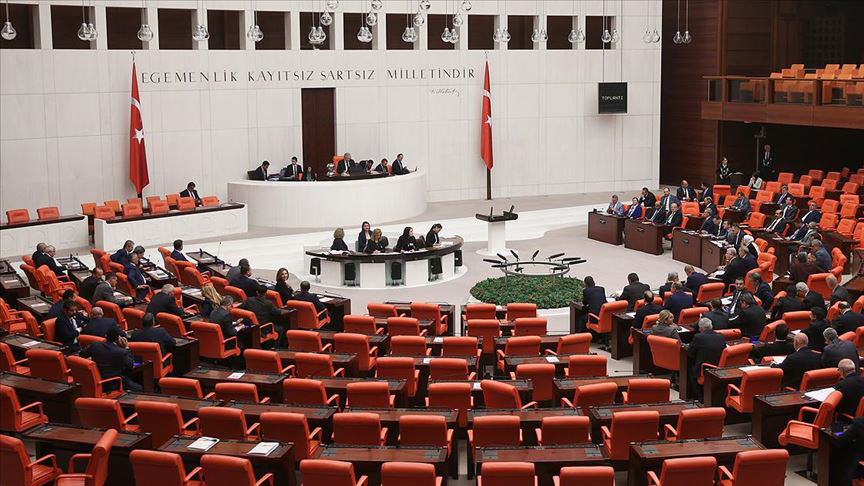
Various political parties in Turkey submit their reports for the Parliamentary Commission established under the Peace and Democratic Society Process, to the Parliamentary General Secretariat ” Picture Credits: Mezopotamya Ajansı
The peace process in Turkey, formally launched in October 2024, has entered a decisive phase as political parties represented on the process commission submit their reports and legal proposals. While the reports point to areas of convergence – particularly on political participation and conflict de-escalation – they also highlight disagreements over the scope and definition of the Kurdish question itself.
The commission is now tasked with drafting these submissions into a single report for the Turkish Grand National Assembly; throughout this period, the parties will have the opportunity to discuss legal regulations and concrete changes.
So, how do the parties frame the Kurdish question, where do their positions converge, and which disagreements risk the prospects of a comprehensive settlement?
Framing the Process
The ruling Justice and Development Party’s (AK Party) report describes the issue as “ultimately a matter of democratization”; it even highlights “Turkey’s test with itself” and the country’s “capacity to solve problems.” The report offers a three-legged framework for a solution: security, democratization, and development.
The Nationalist Movement Party, the ruling party’s partner (MHP), directly links the process to “terror and violence”, rather than Kurdish grievances, and claims that “there is no problem in our founding principles,” – referring to the foundation of the republic in 1923, which denied the existence of a Kurdish people. Additionally, it does not accept the term “Kurdish question/issue.” Within this approach, the solution is framed mainly as security-centered goals – such as the disarmament and dissolution of the Kurdistan Workers’ Party (PKK). In this sense, the most rigid approach to the Kurdish question appears in the MHP report.
The opposition Republican Peoples’ Party (CHP) lays out the solution to the Kurdish question as the idea that “social peace must be built on a foundation of holistic understanding”, which can only be achieved by “rebuilding the rule of law through democratic reforms.” The CHP makes its position clear: security policies alone will not solve the Kurdish question; they call for legitimate political guarantees against the narrowing of the democratic political space. Yet, despite its democracy-centered approach, the CHP report glosses over the Kurdish question, devoting only about one page of the 53 to it. CHP seems to have put little thought into what the main topic of discussion is.
The Labour Party (EMEP) report addresses the problem by framing it as a product of class/social inequalities, an oppressive order, and denial. It defines the solution as “the right of working peoples, Kurds, Turks, and people of different nationalities, to live together voluntarily, equally, and within a strong social order.” The party affirms its commitment to the principle of “the right of nations to self-determination.”
The Workers’ Party of Turkey (TİP) predicates the issue on socio-structural and historical grounds. For them, the Kurdish question is not merely a matter of public order; it is one of the main factors shaping politics and governance, tied to the state’s founding principles and spanning more than a hundred years. TİP breaks down the issue into five main axes: denial of identity, political representation, economic inequality, armed conflict, and geopolitical dimensions.
The New Path (Yeni Yol) Group report describes the commission’s jumping off point as “the process of ending the PKK’s de facto and armed presence.” It also stresses the need for “freedom, democracy, and the rule of law.” In other words, the diagnosis puts the security dimension at the center, but the solution design focuses on the risks of running this process without a legal framework and democratic standards.
The parties’ legal proposals differ from one another. But, in almost all the reports, there is the need for a “legal basis” is discussed, albeit each party’s reasons for it differs.
In the People’s Equality and Democracy Party (DEM) report, the Kurdish question is described as a matter that cannot be reduced to security alone; rather, it is one with historical, political, social, and legal dimensions. The report brings attention to the difference between “handling the issue only through security and counterterrorism” and “building a legal-democratic ground that will eliminate inequalities”. The party likewise highlights the distinction between “negative peace” (the end of conflict) and “positive peace” (removing the causes of violence). It links progress toward “positive peace” to enacting concrete legal proceedings such as a “peace law”, which entails legal reform supporting civil rights and political access; personal liberties and security; and changes to the penal code to ensure social peace in both the short and long term. Additionally, the DEM Party presents a future-oriented framework around a “Democratic Republic”, decentralization, equal constituent partnership, and constitutional citizenship.
Proposals for Peace Process
The parties’ legal proposals differ from one another. But, in almost all the reports, the need for a “legal basis” is discussed, albeit each party’s reasons for it differ.
The AK Party report proposes a “separate and temporary law” for the process to move forward in a healthy way. It states that this law should establish mechanisms to “identify and verify” steps, such as PKK disarmament, surrender, and integration. Here, law is treated more as a framework for managing the process and a tool for verification and oversight.
The MHP report states, “Continuing trials for those prosecuted for membership in a terrorist organization may not be compatible with the spirit of the process.” Instead, it proposes “a special institution for suspending prosecution” and details oversight and obligations, probation periods, and conditions for dismissing charges. It also adds that “within the scope of a Terror-Free Turkey”, the Turkish parliament should amend laws pertaining to sentencing and sentence enforcement to improve prison conditions.
The New Path Group’s main proposal is a “process-specific framework law.” This law would cover a broad range of issues, from investigations and prosecutions to the legal basis for PKK demobilization and social integration programs. It also proposes an “independent monitoring and oversight commission” that would regularly report to the Turkish parliament on the law’s implementation. In addition, it offers concrete legislative proposals, such as ending the trustee practice in local governments and repealing the Municipal Law provisions that enable it.
The CHP report presents a varied set of proposals based on the 29-point democratization package announced in the summer. In particular, it proposes repealing the regulation that makes the trustee system possible, with an amendment proposal to the Municipal Law; removing provisions in the Anti-Terror Law (TMK) and the Turkish Penal Code (TCK) that obstruct freedom of expression; and re-evaluating the sentencing and sentence enforcement laws on the basis of the right to health and the right to life. It also includes criticisms of legislation and practices regarding sick detainees, and calls for special work in the parliament. The CHP’s approach is less of a process-specific law and more so reforms that would open the space for democratic politics.
The EMEP report sees the existence of the Anti-Terror Law (TMK) as a “sword of Damocles” – an existential threat – hanging over lasting peace. They argue that this “special law” should be repealed and state that terror-related crimes can be regulated under the penal code without needing a separate special law. The EMEP report emphasizes the need for new arrangements on issues such as solitary confinement and sick prisoners. Additionally, the party demands a general amnesty “for all prisoners and trials, whether detained or not.”
TİP begins with the assessment that the current legal system has turned into an “emergency regime”. It argues that for lasting peace, a mere declaration of intent will not be enough; it must be equipped with “legal and constitutional guarantees.” According to TİP, a “call to lay down arms”, made before these legal steps are taken, would not strengthen social peace, but only reinforce the government’s security. TİP also advocates not for a special law, but for a general legal arrangement.
The DEM Party report emphasizes the role of parliament in the process and the centrality of the “peace law”. It states that steps such as abolishing trustees, releasing sick detainees, and implementing Constitutional Court (AYM) and European Court of Human Rights (ECHR) decisions would increase trust and strengthen the process. The report underlines equal citizenship and democratic integration in particular. It is also very clear on language rights: it proposes lifting restrictions on all languages, especially Kurdish, and adopting a “multilingual” approach, from preschool to university, including “free education in one’s mother tongue.”
The Future and Turkey’s Social Structure
The first is a vision of shared citizenship through normalization and the rule of law.
Here, two different visions of the future are apparent:
The first is a vision of shared citizenship through normalization and the rule of law.
With its emphasis on “equal citizenship” and “the rule of law,” the CHP frames the solution to the Kurdish question as part of Turkey’s general need for democratization. The New Path Group also discusses strengthening local governments, abolishing trustees, and decentralization within a framework “compatible with the unitary state structure.” On the AK Party side, they blend a few concepts: recognizing cultural differences while fostering a shared sense of citizenship and democratization, reinforcing unity and integrity.
The second vision for the future is a more structural transformation through a decentralization-pluralism perspective.
Here, the DEM Party has built an approach based on constitutional citizenship in a democratic republic, “recognizing different identities and beliefs as equal constituent elements” – with decentralized local democracy, language rights, and multilingualism complementing the framework.
EMEP’s vision of the future is class-based and shaped around what they call “voluntary and equal unity of peoples”. The EMEP report seeks to address current grievances while simultaneously engineering Turkey’s future “social and political architecture”.
TİP envisions a transition from a monolithic and authoritarian structure to a pluralistic and democratic republic.
The outlier is MHP’s future vision, which is radically different from all mentioned above. MHP’s future is based on a unitary framework, within which exists a “Kurdish civil society”. The MHP report aspires for a future of “building a pluralistic, libertarian Kurdish civil society,” but make this goal secondary to “removing terror and violence from the agenda” and disarming the PKK. For the MHP, future normalization with Kurds is contingent on the successful resolution of the state’s current security issues.
Common Ground and Divergence
Valuable common ground exists between the seven reports: in one way or another, all the parties acknowledge the process’s need for a legal framework, societal legitimacy, and process management.
However, divergence cuts through at two critical points: a) differing diagnoses of the Kurdish question; b) the method for resolving it.
Highlighting the discord around whether it is “a Kurdish problem,” a “terrorism problem,” or “Turkey’s democracy and rule of law problem”?
While the MHP stands at the terrorism end of this spectrum, DEM, TİP, and EMEP are more on the side of political, identity-based, and structural inequalities; the CHP lies on the axis of democratization and the rule of law; and the AK Party and the New Path accept the security dimension but add democratization with varying degrees of emphasis.
The “First disarmament, then political changes!” approach is more dominant on the AK Party/MHP side.
The bigger picture shows that discussions on the Kurdish question in Turkey is not merely a discussion about “solving a problem”; it is also a major debate about the form of government, citizenship regime, local democracy, basic rights, and security policies
The “Peace will not last without simultaneous democratization and legal normalization” approach is more prominent on the CHP, DEM, EMEP, and TİP sides.
The New Path Group enters the discussion from a more technical perspective, asking questions such as, “How should the process be designed? How should it be monitored? Which institutions should be involved and how?”
The bigger picture shows that discussions on the Kurdish question in Turkey are not merely a discussion about “solving a problem”; it is also a major debate about the form of government, citizenship regime, local democracy, basic rights, and security policies. For this very reason, the reports inevitably raise not only the question of “What should be done about the Kurdish question?” but also the question of “What kind of country should Turkey be?” Some reports – like the DEM Party’s – address this seriously, while others touch upon the issue without much concern.
There is a silver lining, though: the sides stand on common ground on at least ten points:
• The cessation of armed violence is a must;
• a parliament-centered process and the process having parliamentary legitimacy are necessities;
• widespread acceptance of the idea of a “temporary legal framework” specific to the process;
• agreement on the need for transparency, accountability, and oversight;
• rule of law, judicial guarantees, and limitations on arbitrary political actions;
• centering human rights and equal treatment in the penal code and sentence enforcement in prisons;
• revising legislation on terrorism and provisions that restrict freedom of expression;
• legal provisions for “return home/social integration/reintegration” (different phrasings used) for political exiles and PKK members are a necessity;
• recognition of historic grievances, repairing social harmony, and consideration for cultural and social sensitivities;
• and protecting the process against sabotage, provocation, and ensuring institutional continuity.
There is a clear consensus on these points. All eyes are now on the forthcoming report and how well it can address differences and strengthen commonalities.

Özgür Amed
Journalist and writer. Contributes to various newspapers and magazines. Works on memory, humor, politics, and cinema. Author of two books: Böbreği Kim Yedi (2018) and Kürdocul İşler (2011).