From Tea to Latte: Erbil’s Quiet Social Revolution
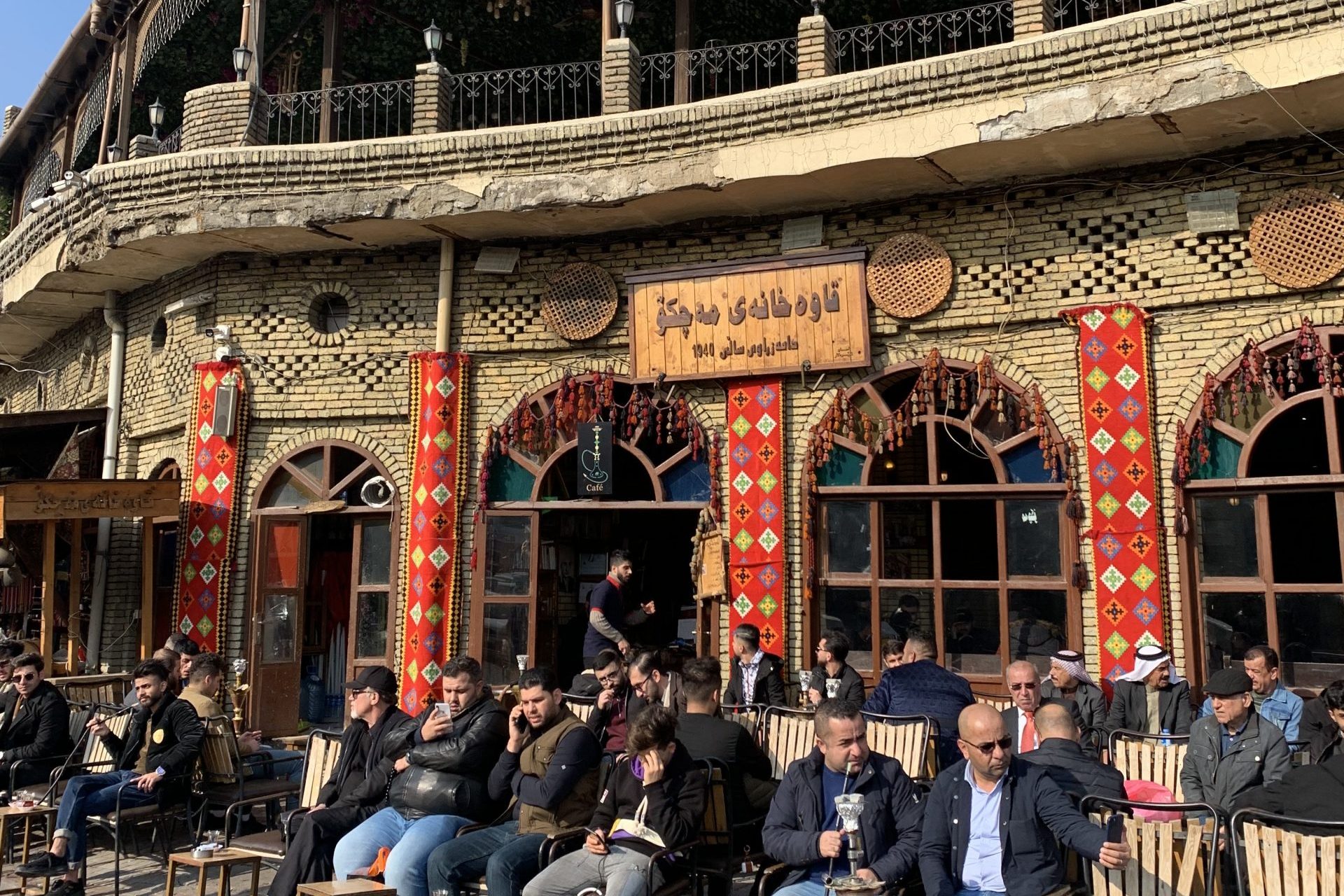
Twenty years ago, Erbil offered few places for a casual coffee. Those seeking a mocha, a latte, or a cappuccino had little choice but to return home, disappointed. Evenings in the city generally unfolded in the dim light of men-only teahouses near the ancient citadel, and in others scattered across neighbourhoods, where conversations rarely strayed beyond familiar circles, domino games, and endless glasses of strong, black tea. Social life clung to strict norms, and the tidy streets of the Kurdistan Region’s capital felt homogenous and insulated from the chaos beyond its borders.
Today, that version of Erbil seems to be in the distant past. Along the 60-metre road in the buzzing suburb of Ankawa, there are over 260 cafés that pulse with life; outside Baghdad, this is one of Iraq’s densest café hotspots. Here, young Kurds from the region huddle with fellow Arab students from Mosul and Baghdad, sketching designs on laptops. Others share shisha pipes, while women sip matcha lattes into the night. This demographic mosaic, forged by the influx of IDPs from the ISIS war along with Syrian refugees, expats, and global tourists, has supercharged Erbil’s economy and birthed one of Iraq’s most fascinating lifestyles.
Erbil’s café boom traces a clear arc. Zirak Beeko, head of the Erbil branch of Kurdistan’s Hotels and Restaurants Association, explains: “We have two forms of permit: national [traditional] teahouses, mostly run by Kurds, make up about 160 places in Erbil. There are also about 260 star-group cafés, and this number is still increasing. This number was about a month ago; since then, tens more have been registered.” Star-group cafes are “establishments that are classified by the size of provided services;” in other words, establishments with a more modern vibe.
Official data backs this up: according to the Kurdistan Region Statistics Office (KRSO), the number of restaurants and cafeterias in the Kurdistan Region, both national (traditional) and star-group, has surged from 1549 in 2013 to 2118 by 2020.
There are many factors contributing to this: waves of displacement as a result of several wars in the region, in addition to the regular migration of job-seekers from Kirkuk, Sulaymani, and Duhok. Years ago, “there were not many coffee shops around,” recalls Marwan Sardar, a barista at Origin Cafe, Erbil’s self-proclaimed first specialty coffee house on Erbil Avenue. “But now there are many!”
“at least 75 percent of the employees must be Iraqis, and about 40 percent Kurds, per Prime Minister’s [Masrour Barzani] orders.”
Along with the opening of new places, saturation arrived swiftly: “In the suburb of Ankawa, permits are no longer issued for new cafes for nearly two or three years now,” noted Beeko. However, growth persists, as the KRG aims to bring more tourists via platforms such as Visit Kurdistan. International organisations such as UNDP and USAID have trained approximately 170 women and youth in Erbil to create handicrafts for tourists that reflect Kurdish culture.
Cafes power jobs in a salary-strapped economy. Sardar said the Origin cafe draws “various clients, including Kurds, Arabs, foreigners. There are many of them,” creating a demand for baristas, bakers, and drivers. Policy appears to be prioritising the locals too; as Beeko explained, “at least 75 percent of the employees must be Iraqis, and about 40 percent Kurds, per Prime Minister’s [Masrour Barzani] orders.”
KRSO tallies thousands of employees, with Erbil accounting for over half of the 232 billion IQD in tourism income despite the COVID-19 pandemic.
Diversity drives revenue. Rawa Yassin, owner of Xray Cafe kiosk on 60-Meter Street, observes youth from “every background” stopping by his place to have a coffee and a chat, noting that Arab clients are the majority, which he finds acceptable. “I don’t care about the identity of the customer. I am running a business here, and the tourists are bringing us money. Of course, they are always welcome. I would love to have so many foreigners and tourists come to the city so that our businesses thrive,” he said.
Cafes also reshape routines. “People come here to rest, to study. It has even affected the nature of sitting together. There are more friend groups now joining; very different from teahouses,” observed Sardar. He adds that even elderly people and people of diverse religious backgrounds visit his cafe, “Lots of them come here daily. They come and sit here without any problem. It is welcoming for everyone!”
“The new cafes have not affected our business at all. We are doing our own work, because our tea has the taste of the older times … The cafeterias cannot do that.”
Inclusivity in cafes spans genders, with mixed tables buzzing until midnight, in contrast to the divide seen in teahouses. However, tradition holds firm. Goran Mawlud’s 30-year Erbil Bazaar teahouse banks on loyalty: “Nearly 75 percent of our customers are our own… I know what kind of tea they like.” Arabs, Turkmens, and Mullahs mingle together at Mawlud’s teahouse, and this is what makes it beautiful to him, insisting that everyone is welcome to their teahouse.
Said Isa Chaychi, who inherited the 100-year-old Said Salim teahouse near the historic citadel, insists that the new trends do not affect them. “The new cafes have not affected our business at all. We are doing our own work, because our tea has the taste of the older times. A tea has three traits: taste, colour, and scent. We prepare our own tea mixture, then sieve it until it is clear and palatable. The cafeterias cannot do that. They are not the masters of the craft,” he said.
Said Isa said that their tea has become a daily ritual for some, while for others, it remains a long-standing source of nostalgia, prompting generations to return for another sip.
“We have clients who drink three teas one after another; they say they can’t start their day without our tea, and they complain that they can’t brew tea at home. There are clients who say they used to come to our teahouse with their father,” he said.
Growth has come at a cost. In the city where cafés now line the pavements, competition has thinned margins. Yassin, who opened his cafe a year ago, put it plainly: “Many similar cafes have been opened since then. The money is not the same.” The increase in competition and saturation of cafes in neighbourhoods has turned Erbil’s cafe boom into a test of endurance as much as of ambition.
“Our city is the capital. And a capital city everywhere requires all sorts of people.”
Yet resilience runs through Erbil’s social economy. Through war, mass displacement, and sharp contraction of tourism during the ISIS war and the pandemic, the city’s public spaces have adapted rather than fractured. The KRSO data of Erbil’s tourism income stresses its central role as the Region’s cultural and commercial hub.What distinguishes Erbil is not simply the number of cafes but their transformation into a shared ground. The unfolding conversations across backgrounds and accents that were once rarely heard together are not an erasure of tradition, but an expansion.
Teahouses remain the city’s anchors, keepers of ritual memory and craft, while cafes act as crossroads, absorbing new rhythms and generations and facilitating the integration of strangers into the culture. As Mawlud observed, “Our city is the capital. And a capital city everywhere requires all sorts of people. I don’t mind anyone coming to the city; others might, but I don’t. As long as they are well-mannered and good people, they are very welcome.”

Azhi Rasul
Azhi Yassin Rasul is a multidisciplinary researcher and writer based in Madrid. His work sits at the intersection of urban analytics and storytelling. With experience spanning journalism, urbanism, and engineering, he focuses on understanding how cities function and how policy, design, and lived experience converge. He has reported from the field and covered topics spanning Kurdish politics across Iraq, Turkey, and Syria, as well as environmental issues.