How Paramilitaries Reordered Land and Village Life in Kurdistan
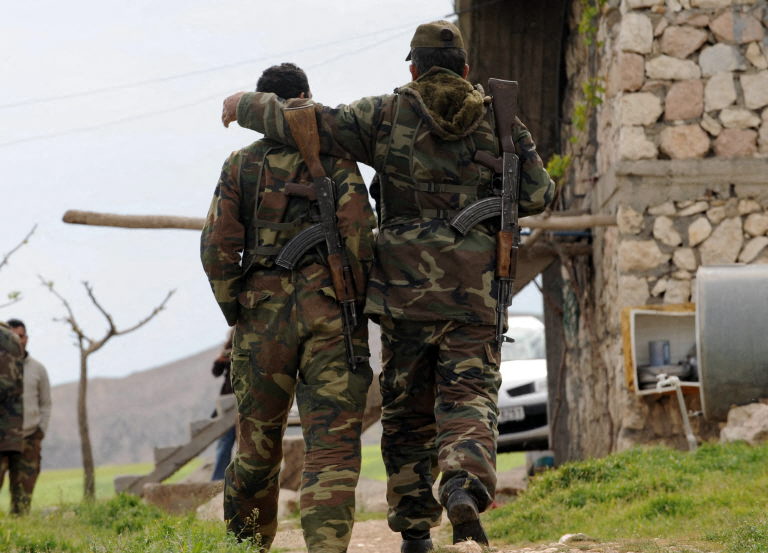
Village guards walk together near the road in Silvan in Diyarbakir province on April 8, 2010. (Photo by BULENT KILIC / AFP)
This article is co-authored by Joost Jongerden & Francis O’Connor
In the mid-1980s, when the Kurdistan Workers Party (PKK) launched an insurgency, the Turkish state revived an old playbook: recruiting local militias to fight on its behalf. The resulting Village Guard system was, in theory, a temporary paramilitary force tasked with ‘protecting’ their villages from PKK guerrilla units. In practice, the ‘temporary’ Village Guards became something else entirely: a vast, enduring paramilitary institution, tens of thousands strong, that has embedded itself into the region’s economy, social order and political life. Far from being a short-term counter-insurgency measure, the Village Guards have become key actors in the appropriation and reconfiguration of land ownership and access.
Exceptional rule, made local
The Village Guard system was born within this architecture of exception
Kurdistan in Turkey has long been governed through “exceptional” legal and administrative arrangements. From inspector-general systems in the early republic in the 1920s and 1930s to decades of martial law and the Emergency Rule (OHAL) era between1987 and 2002. Extraordinary governance has become the norm in Kurdistan. The Village Guard system was born within this architecture of exception: legally enabled by emergency measures and operationally driven by the pursuit of a military solution to the Kurdish issue. As part of this military solution, the system scaled quickly, becoming a mass institution integrated into counterinsurgency operations: surveillance, intelligence gathering, patrols, and direct participation in combat—sometimes even in cross-border operations into the Kurdistan region in Northern Iraq.
War is political—but it’s also local
Research on paramilitarism, from the former Yugoslavia to Colombia, shows that militias aren’t merely biddable state puppets of the state or exclusively motivated by financial incentives. They are political formations shaped by local social orders, historic memories, institutions, and emergent opportunities across socio-political and economic contexts. Militias often emerge where preexisting practices of authority, such as tribal affiliation, patronage, and local brokerage, can be mobilized into armed structures. While much of the research on the topic has justifiably looked at the military functions of paramilitary forces and their inevitable engagement in mass human rights violations, paramilitaries can also generate profound transformations related to access and ownership of land, reconfigure resource allocation, and broader control over the local economy.
How counterinsurgency “drained the sea”
After the PKK began its insurgency in 1984, small guerrilla units moved through the countryside recruiting, propagandizing, and attacking targets associated with the Turkish state. By the early 1990s, the PKK controlled large stretches of rural terrain — “semi-liberated zones” — across provinces like Hakkari, Şırnak, Diyarbakır, Bingöl, and others. Villages and hamlets served as the insurgency’s lifelines, providing shelter, food, recruits, intelligence, and popular legitimacy.
…more than 3,000 rural settlements were forcibly evacuated, affecting millions of Kurds in one of the region’s largest mass population displacements in recent decades
Initially, the Turkish military only defended major towns and larger villages, inadvertently allowing the PKK to consolidate its domination of the countryside. The state reversed this policy in the early 1990s with a shift toward “field domination”, and the creation of mobile special forces, including commando brigades, rapid response police, and gendarmerie teams, to carry out a strategy aimed at compressing insurgent space, disrupting guerrilla mobility, and intimidating the PKK’s rural support base.
This escalation was paired with mass displacement: more than 3,000 rural settlements were forcibly evacuated, affecting millions of Kurds in one of the region’s largest mass population displacements in recent decades. These acts of violent expulsion and village destruction were usually carried out by the army and special forces according to a classic counterinsurgency logic: severing the insurgents from their support base. Nonetheless, the Village Guards on the ground, with their deep local knowledge and own incentives to displace their erstwhile neighbors, played a key role in the micro-implementation of the strategy.
A micro-case with big implications: İslamköy (Kuyê), Kulp
To understand how such a vast system worked on the ground, focusing on a single case can help serve as a form of exemplary keyhole to analyse the broader phenomenon. A recent article on how the Village Guards have transformed Kurdistan’s economy, focused on the village of Kuyê in the Kulp district in a mountainous, cave-ridden terrain, once famous for its silk production. It became a zone of intense conflict in the early 1990s. Like much of rural Kurdistan, Kuyê had been neglected by the state in terms of service provision and development. In this space of state neglect, the regular presence of the PKK’s forces and their forms of ‘rebel governance’ became normalized. This period came to an abrupt, violent end: Families accused of sympathizing with the PKK, especially those who refused to join the Village Guards, were threatened, their homes burned, and were eventually evacuated at gunpoint. In a case taken to the European Court of Human Rights, it was documented that in the course of Kuyê’s evacuation, damage was not only limited to houses but that the village’s flour mill, food stocks, sheds for animals, and even the mulberry trees needed for silk production were all systematically destroyed, making the village uninhabitable.
How militias reorder social hierarchies
Village Guard mobilization was propelled by the question of land: by becoming Village Guards, its poorer members used paramilitarisation as a lever to overturn their marginal position and secure access to resources, such as mountain pastures and water, which had previously been denied to them. People who were once at the bottom of the social ladder now had weapons and the backing of the state, and could simply appropriate land and water. War, in other words, became a vehicle for class mobility and social reversal. Not necessarily because the poor villagers had ideological hostility to the PKK from the start, but because militarization altered the bargaining power and hierarchy within the village. Yet, at the same time, the social costs and personal risk to Village Guards were severe; to give an example, in only two months in the summer of 1994, the PKK killed six and wounded ten Village Guards. Aside from the physical risk, Village Guards and their families were also strongly stigmatized, disparagingly labeled by their neighbors as caş, or donkey foals, a Kurdish term used for traitors
Two villages, one wound
In several parts of Kurdistan, by the early 2000s, almost a decade after the expulsions, people started to slowly return to their evacuated villages. In the case of Kuyê, on the advice of the military, the state planned a concentrated (previously the village was dispersed in several hamlets) and controllable settlement, rebuilding the village at a different location nearby. However, only Village Guards and their families moved there. Those who had refused to participate in the Village Guard system rejected the new location and instead rebuilt their homes amid the ruins of the village, living seasonally in tents during the warmer months as they reconstructed their original homes. The outcome was effectively the construction of two settlements, each claiming to be the real village: one justified by sacrifice ostensibly in the name of the state (“we defended it”), the other anchored in historical continuity (“we rebuilt what has always been ours”). Since then, the residents have lived parallel but resolutely separate lives, even linked to nearby Kulp by different transport routes, coexisting with mutual distrust. The armed conflict of the early 1990s didn’t end; it simply rearticulated itself in a spatial manner, where any potential flashpoints are avoided to not re-ignite the violence of the past.
What Kuyê/İslamköy teaches us about the Village Guards
Any serious settlement would need to address not only the state-PKK conflict but also the intra-community ruptures that the Village Guard system has entrenched
Kuyê/İslamköy is a single case, and the Village Guard system is deeply heterogeneous across Kurdistan. But the case clarifies several broader points, firstly, the Village Guards are not just instruments of state power. They are also products of local dynamics such as tribal rivalry and class struggle, as well as those of survival strategies rooted in the access to and control of water, trees, and land. Secondly, the system is no longer defined by its security function but has become a pillar of governance. Its persistence, expansion, and scale reflect its role in structuring local socio-political, cultural, and economic order, and how it fosters dependence, loyalty, and local order. Thirdly, as in cases the world over, conflict and domination inevitably fracture the colonized from within. The system deepened intra-Kurdish cleavages, turning disputes over land and water into durable political antagonisms. Finally, peace requires more than a ceasefire or the mere absence of active violence. Any serious settlement would need to address not only the state-PKK conflict but also the intra-community ruptures that the Village Guard system has entrenched.
Closing thought
Turkey’s Village Guard system began as a counterinsurgency tool in the 1980s. Over time, it became an arena where local actors reworked social hierarchies, secured (or lost) access to land and water, and used the cover of “anti-terrorism” to claim authority and legitimacy. A ground-up perspective shows paramilitary institutions as relational and political, shaped by the interactions of state strategy, insurgent violence, and local struggles over land and other resources. If we want to understand how wars transform societies, we must follow the guns—but also the irrigation canals, the cattle herds and the pastures, the mulberry trees, and the village ruins.

Joost Jongerden
Joost Jongerden (PhD) is an Associate Professor of Rural Sociology at Wageningen University, the Netherlands. His research focuses on forced migration, rural development, and political and violent conflict in the Kurdistan region, with particular attention to dispossession, displacement, and how people actively pursue alternative futures—an approach he describes as Do-it-Yourself Development.