Rojava Protests: Kurdish Youth’s Reckoning
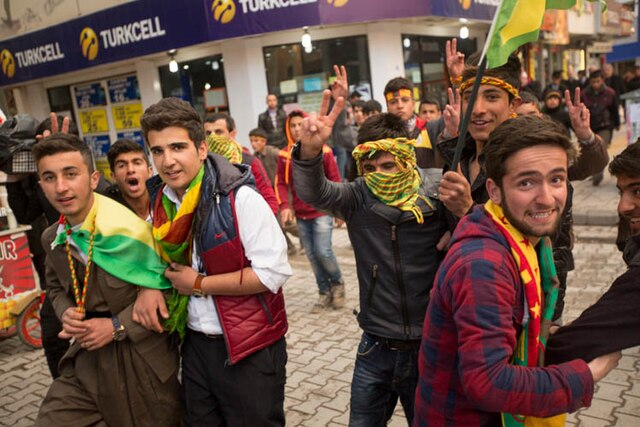
Kurdish youth at a march to a Newroz celebration | Picture credits: sunriseOdyssey/ FLICKR, Licensed under CC BY-SA 2.0
Protests erupted across Europe in response to attacks on Rojava by the Syrian Transitional Government military under former HTS leader Ahmed al-Sharaa. In city squares, Kurds from all four parts of Kurdistan call for Kurdish unity, while younger demonstrators voice frustration with Kurdish political leadership and disillusionment with Western powers.
On January 6, al-Sharaa’s forces launched an offensive against Rojava, the Kurdish-led self-administration in north-eastern Syria. Across Europe, the Kurdish diaspora took to the streets to protest the attacks.
Demonstrators argued that Kurds who had fought the Islamic State (ISIS) had been abandoned, calling for solidarity and Kurdish cohesion. They also urged European states and the United States to provide support for Rojava.
“I feel like I’ve been betrayed”
“We fought for them, we did their dirty work.”
In the Netherlands, large rallies were held in The Hague, Rotterdam, Amsterdam, and Arnhem. Slogans emphasised Kurdish unity, such as “Rojava and Rojhilat [Iranian Kurdistan] – Kurdistan is One Country” and “The Kurdish People Are One”. Slogans in support of imprisoned Kurdish figurehead Abdullah Öcalan were notably scarce.
Alaa Kalaf, a Syrian Kurd living in the Netherlands who has actively raised awareness of the situation in Rojava on social media, participated in multiple protests across Dutch cities. He described the protests as charged with both anger and sadness.
“I feel betrayed by everyone, truly, by the whole world,” he told reporters. Pointing to the US, he stated, “What they did was betrayal. We fought for them, we did their dirty work[CW1] .”
Between 2015 and 2019, the Syrian Democratic Forces (SDF), militarily led by the Kurdish People’s Defence Units (YPG), played a central role in operations that expelled ISIS from Arab-majority cities such as Raqqa, Deir ez-Zor, Tabqa, and Manbij, which were later incorporated into the Democratic Autonomous Administration of North and East Syria (DAANES).
Alaa explained that while the Kurds protected their own territory, they also defended Arab cities from ISIS, effectively carrying out the “dirty work”, only to be left abandoned by the US.
“The narrative of brotherhood of peoples is an illusion”
Alaa argued that the defection of some Arab tribes in Raqqa and Deir ez-Zor to the ranks of the Syrian Transitional Government forces undermined hope for solidarity across communities in Syria.
“Arab tribes are not loyal to anyone; we cannot trust them. Therefore, the idea of brotherhood among these peoples, that we can build a democratic, secular, feminist Syria, is an illusion.”
On Öcalan’s political theories, which emphasise multi-ethnic democratic confederalism and shape Rojava’s governance model, Alaa said: “I have great respect for Öcalan. But I think what he wrote is too principled and utopian for this period.”
“Kurds should think about their own home first”
“So this is how they thank us for fighting ISIS.”
Uğur Cihan, an electrical engineer who joined protests in Cologne, Germany, echoed feelings of abandonment by Western powers. “So this is how they thank us for fighting ISIS[CW2] ,” he said, referring to Europe’s limited response to the January offensive by the Syrian Transitional Government military.
Cihan also criticised anti-Kurdish rhetoric in the Turkish media and highlighted contradictions in Turkey, where a reconciliation process with Kurdish representatives is officially underway, yet authorities continue to detain individuals for showing support for the Kurdish community in Rojava. Symbolic acts of solidarity, such as women braiding their hair, have been treated as terrorist propaganda, resulting in arrests and job dismissals.
Cihan called for a shift in Kurdish political strategy. “The Kurdish mind that shapes politics needs to change,” he said. He argued that Kurdish unity should take priority over efforts to democratise the states that govern Kurdish regions – a position that departs from the democratic confederalism framework guiding much of the contemporary Kurdish movement.
“The Kurds should stop carrying water to their neighbour’s fire and put out their own fire,” Cihan added, framing Kurdistan as a colonised territory, an analysis developed by Turkish sociologist İsmail Beşikçi and adopted by the Kurdistan Workers’ Party (PKK) in its early years.
“Let those who pay the price decide”
The West perceives conflicts involving Kurds in the Middle East as ‘business as usual’.
Ezo Önder, who took part in protests in France, expressed admiration for Kurdish unity but criticised European inaction, attributing this to a perception that conflicts involving Kurds are ‘business as usual’ in the Middle East. [CW3] Önder suggested that decades of Kurdish armed struggle have desensitised the Western public and their policymakers.
She further argued that strategic decisions should be made by those directly affected. “Let those who pay the price decide what should be done and how. The people involved in this issue are those who have been fighting for years and risking their lives,” Önder said, adding, “We must respect them.”
A turning point?
The ceasefire agreement reached on January 30 between the Kurdish-led Syrian Democratic Forces (SDF) and the Syrian Transitional Government gave the Rojavans – who are fighting for their survival – a temporary reprieve, though it came at a significant cost to the autonomous administration.
The crisis briefly bridged divides among Kurdish political factions. Coordination between SDF Commander Mazloum Abdi and prominent Iraqi Kurdish leader Masoud Barzani demonstrated the potential for cooperation despite historical tensions between Kurdish groups in Syria and the Kurdistan Regional Government, which maintains close ties with Turkey.
The resistance in Rojava, alongside the diaspora’s response, demonstrates the Kurds’ capacity for rapid mobilisation and self-organisation. Whether this represents a genuine turning point and how it might shape their political trajectory remains uncertain, given ongoing developments in northeastern Syria and the stagnant peace process in Turkey.
Note: This article is based on interviews with three protest participants in the Netherlands, Germany, and France. Their perspectives may not represent the full range of views within Kurdish diaspora communities.

Mehmet Fırat Özgür
Mehmet Fırat Özgür is a Netherlands-based journalist and a member of RFG Media, covering European politics, refugee policies, and human rights.