Iran Unrest Spreads as Rial Slide Triggers Shop Closures
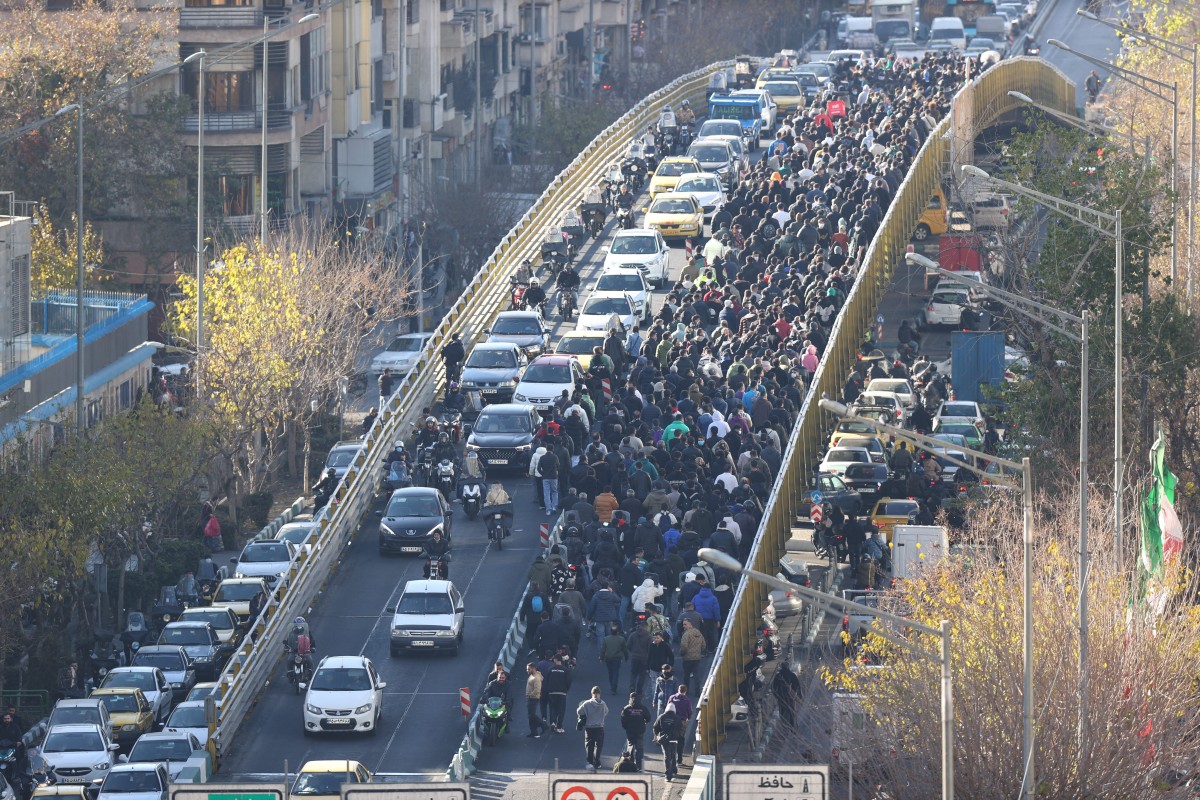
Shopkeepers and traders walk over a bridge during a protest against the economic conditions and Iran’s embattled currency in Tehran on December 29, 2025. (Photo by HANDOUT / FARS NEWS AGENCY / AFP)
Protests flared across Iran on Sunday after the Iranian currency slid to a record low, triggering a wave of shop closures in Tehran’s main commercial districts and exposing growing public anger at a cost-of-living crisis that traders say has made normal business impossible.
Protests erupted across Iran on Sunday, December 28, 2025, after the rial collapsed to a record low of 1.42 million to the U.S. dollar, prompting mobile-phone and electronics shopkeepers to shutter their stores near Tehran’s Grand Bazaar, saying they could not price goods or replace inventory as the exchange rate moved sharply within hours. Hundreds gathered near the closures, chanting “Don’t be afraid, we are together,” as riot police deployed tear gas, according to video posts on social media.
The unrest, which expanded to cities including Hamadan, Isfahan, Qeshm island, Mallard, and Karaj on Monday, marked the largest protest since mass demonstrations in 2022, with demonstrators shouting anti-government slogans such as “death to Khamenei” and expressions of support for the former Pahlavi monarchy, according to videos verified by BBC Persian.
University students shortly joined the merchants. At several universities, students urged peers to join demonstrations after unrest erupted at Tehran University’s dormitory complex. Security forces surrounded the dormitory on Monday evening and closed its gates, witnesses said, with a heavy security presence around the campus. Students chanted “Woman, life, freedom” and “Students die but do not accept humiliation,” according to videos published on X and Instagram.
Iran’s currency has been under sustained pressure since sanctions were reimposed in 2018, and the 12-day Iran-Israel war in June 2025 accelerated the rial’s decline
On the third day of unrest, protests continued to spread, with Kermanshah joining in, and students from Tehran University, Kharazmi University, and Sharif University of Technology staged demonstrations. Slogans included “Neither Gaza nor Lebanon, my life for Iran.” Videos and social media reports also showed shopkeepers in Shiraz and Ahwaz closing their shops in solidarity with merchant strikes.
Source of Unrest
Iran’s currency has been under sustained pressure since sanctions were reimposed in 2018, and the 12-day Iran-Israel war in June 2025 accelerated the rial’s decline, pushing the currency toward unprecedented lows by year-end. The U.S. Dollar, which traded at about 892,500 rials before the Israel-Iran war, rose sharply in subsequent months amid intensified sanctions pressure, the reactivation of the snapback mechanism after nuclear talks stalled, and broader regional tensions.
The dollar reached 1.2 million rials on Dec. 3, 2025, and surpassed 1.3 million rials by Dec. 15, according to market accounts. By Sunday, Dec. 28, it hit 1.42 million per dollar, before easing to around 1.38 million the following day. That trajectory represents an approximate 59% decline in the rial’s value compared with the pre-war level.
“What are we left to do? The dollar has gone up by 15,000 tomans since this morning.”
The currency fall has compounded inflation and deepened economic uncertainty. According to Iran’s Statistical Center, annual inflation rose to 42.2% in December, up 1.8 percentage points from November. Food prices climbed 72% year-on-year, while health and medical costs rose 50% compared with December last year, the agency said. Bread prices were up 100%, according to the same account.
For merchants, the problem is not just the exchange rate but its volatility. “What are we left to do? The dollar has gone up by 15,000 tomans since this morning,” a Tehran shopkeeper told local media. “The item I sold this morning was worth 6 million, and now, if I want to buy it again and replace it, it’s worth 8 million. That means I didn’t make any money, and I lost a lot. It’s better not to sell.” He then pulled down the shutters.
Traders say consumer demand is collapsing as households struggle to afford basic goods. Merchants describe a market that is increasingly dysfunctional, with supply chains disrupted by rapid price changes and customers unable to keep up. In recent years, class stratification has widened rapidly, with many who were previously middle- or upper-income slipping into the working class. Trade has effectively reached a deadlock, as businesses struggle to cope with the rapid rise in the dollar and persistent inflation.
The turmoil intensified on Monday with the resignation of Iran’s central bank governor, Mohammad Reza Farzin, after the rial’s plunge and the spread of protests, according to reports. The resignation came amid mounting pressure on the authorities to stabilize the currency and contain public unrest.
Government Response
The Islamic Republic responded with a mix of security measures and political messaging. Within hours of the shop closures on Sunday, anti-riot police in full gear were deployed around the Grand Bazaar, Saadi Street, and other downtown districts. Videos posted online showed crowds being dispersed with tear gas. Some reports alleged the use of live fire in certain locations, though the scale and circumstances could not be independently verified.
Gholamhossein Mohseni Ejei, head of Iran’s judiciary, issued a warning aimed at protesters and others he said were undermining economic stability. “Any individual or movement that disrupts the economic system or people’s livelihoods, even without political intent, will be subject to legal action,” he said. Observers note that the resignation of Iran’s central bank governor, Mohammad Reza Farzin, may be inconsequential, given that Iran’s crisis is driven by structural factors rather than individual figures.
President Masoud Pezeshkian said on his X account that livelihoods were his “daily concern” and that the government had “fundamental measures” on the agenda to reform the monetary and banking system and protect purchasing power. He said he had instructed the interior minister to engage with “representatives of the protesters” through dialogue so the government could “act responsibly” to resolve problems. Government spokesperson Fatemeh Mohajerani reiterated the president’s remarks today, saying the government “recognizes the protests” and that it would listen “patiently even if it is faced with harsh voices,” according to her comments.
Some Iranians also reported receiving a warning text message on their phones.
In parliament, Mohammad Bagher Ghalibaf said in a statement read out that Iranians “know the enemy and their sinister goals” and would prevent protests from turning into chaos. Separately, the government announced that all offices, government institutions, commercial centres, schools, universities and higher education centres, banks and municipalities in Tehran province would be closed on Wednesday, Jan. 10, citing cold weather and energy supply needs.
Some Iranians also reported receiving a warning text message on their phones. One message said: “Your presence in connection with the illegal gatherings on 21/10/1404 was monitored by intelligence; it is recommended that you and your loved ones strictly refrain from attending such illegal gatherings, which are the enemy’s desire.”
Outlook
The unrest comes amid a broader crisis in Iran, where many see the current turmoil as the culmination of long-term economic mismanagement, institutional dysfunction, and the costs of foreign policy choices. With inflation high, the currency volatile, and public confidence eroding, critics argue the country is now facing a polycrisis that requires structural transformation. Many believe the regime’s only viable path to survival is meaningful structural change from within, but just as many believe such internal reform is impossible.

Rojin Mukriyan
Rojin Mukriyan has PhD in the Department of Government and Politics at University College Cork, Ireland. Rojin’s main research areas are in political theory, feminist and decolonial theory, and Middle Eastern politics, especially Kurdish politics. She has published articles in the Journal of International Political Theory, Philosophy and Social Criticism, and Theoria. Her research has thus far focused on the areas of Kurdish liberty, Kurdish statehood, and Kurdish political friendship. She has published many think tank commentaries and reports on recent political developments in eastern Kurdistan (Rojhelat), or north-western Iran. She has also frequently appeared on a variety of Kurdish and Persian language news channels. X account: @RojinMukriyan