Iran’s 2025: Failure, Failure, and Nationalism
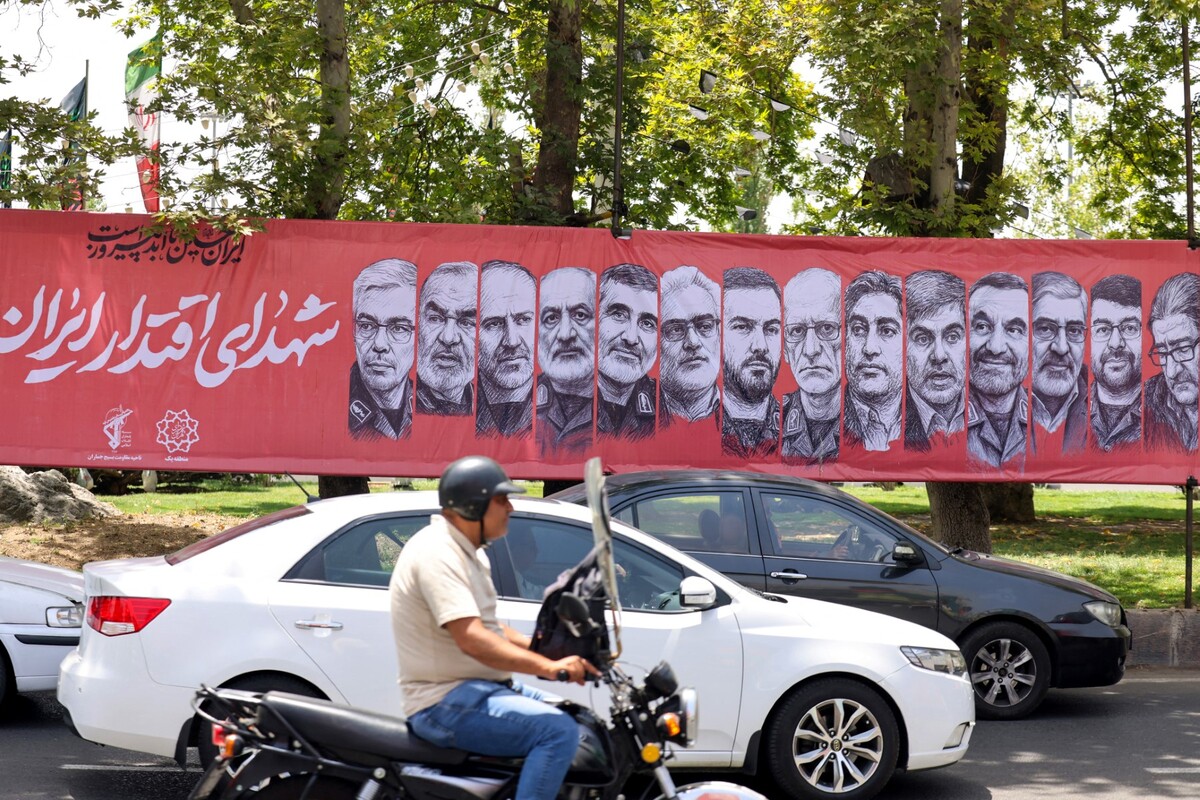
Traffic moves past a large banner depicting Iranian commanders and scientists killed in Israeli strikes during the 12-day war between Iran and Israel, at Tajrish Square in the capital Tehran on June 30, 2025. (Photo by ATTA KENARE / AFP)
For the first time since the 1979 Revolution, Iran is confronting multiple existential threats simultaneously. With its main pillars of defence – its nuclear program, missile capabilities, and proxy network, the so-called “Axis of Resistance” – all substantially diminished, the Islamic Regime has been pushed into a defensive posture on its own territory.
Adding to the quagmire, the country’s already deteriorating and shrinking economy continues to wither under Trump’s “maximum pressure” campaign, the Iran–Israel war, the activation of the snapback mechanism sanctions, and severe drought and environmental crises. All of this has further destabilized the Regime, leaving it unable to even generate sufficient electricity and gas for domestic consumption.
Iran’s Strategic Contraction and the Limits of External Balancing
Iran jumped into 2025 with a number of cumulative strategic setbacks, as 2024’s unresolved challenges only compounded in the new year. Over the course of 2024, Iran lost significant elements of its “Axis of Resistance,” following Hamas’s attack on Israel on 7 October 2023, and the ensuing regional escalations.
While Iran’s defence strategy had aimed to project control and influence across the region and in the Mediterranean and the Red Sea, its collapse in 2025 exposed Iran to regional pressures and left it vulnerable to Israel’s expanding operational reach.
The assassination of Hamas leader Ismail Haniyeh in Tehran during Iran’s presidential inauguration ceremony in July 2024, the killing of Hezbollah’s Hassan Nasrallah two months later in Beirut, and the collapse of the Assad regime in Syria in December 2024 cleaved through “Axis of Resistance”.
To counter these setbacks, Tehran sought new security guarantees, signing a “comprehensive strategic partnership treaty” with Russia in January 2025. However, the treaty proved to be a hedge rather than a shield. During the 12-day Israel–Iran War, Russia did not provide Iran with military assistance, and several Iranian officials, including Mohammad Sadr, a member of Iran’s Expediency Council appointed by Supreme Leader Ali Khamenei, claimed that Russia may have even shared intelligence regarding Iran’s air defence systems with Israel.
Iran Nuclear Program: Trump’s Diplomacy of Maximum Pressure
Iran’s political challenges were further compounded by Donald Trump’s second term as U.S. president. Upon returning to office, President Donald Trump, who withdrew from the Iran nuclear deal (JCPOA) in 2018, reinstated “maximum pressure” to force Iran into a new nuclear agreement on different terms.
Trump presented the Iranian regime with a two-month ultimatum with two options: either accept zero uranium enrichment and sign the agreement, or face military action against its nuclear sites.
The Iranian regime miscalculated Trump’s resolve and insisted on its right to enrich uranium; they mistakenly believed that the U.S. would not greenlight Israeli attacks on Iran, given Trump’s general disinterest in Middle Eastern entanglements. Prior to the fifth and final official round of talks between Trump’s special envoy for the Middle East, Steve Witkoff, and Iran’s foreign minister, Abbas Araghchi, Araghchi wrote on his X account that “Zero nuclear weapons = we DO have a deal. Zero enrichment = we do NOT have a deal.”
As Trump’s two-month ultimatum expired without an agreement, Israel seized the moment: on June 13, 2025, Israel launched “Operation Rising Lion” with Washington’s tacit approval. The same day, Trump wrote on Truth Social, “Two months ago, I gave Iran a 60-day ultimatum to ‘make a deal.’ They should have done it! Today is day 61. I told them what to do, but they just couldn’t get there. Now they have, perhaps, a second chance!”
Israel targeted key nuclear sites, scientists, and high-ranking IRGC officials, including Commander-in-Chief Hossein Salami, while Israeli intelligence penetrated Iran’s military and intelligence networks and systematically struck missile launch sites and uranium enrichment facilities. However, the attacks also caused significant damage to civilian infrastructure, including hospitals, power plants, and urban areas.
According to France24, the strikes, targeting over 900 military sites, killed some 30 senior Iranian security officials and 11 nuclear scientists, while Iranian state media reported around 700 civilian deaths.
Iran responded with missiles and drones: they reportedly launched 550 missiles and 1,000 drones at Israel, resulting in 36 impacts, 28 of which struck civilian sites. The attacks killed 28 people and wounded over 3,000.
On June 22, the United States joined Israel with seven B-2 stealth bombers for a one-night strike, dubbed “Operation Midnight Hammer”, targeting nuclear facilities. Iran retaliated with missile attacks on Al Udeid Air Base in Qatar, the U.S.’s largest base in the region. Trump announced a ceasefire the next day, declaring they had achieved their objectives.
By the end of the 12-day War, Iran’s three pillars of deterrence and foreign policy – its nuclear program, missile capabilities, and the “Axis of Resistance” – had been severely undermined, exposing critical weaknesses in their air defences, intelligence, and security systems. The attacks set Iran’s nuclear program back by years, but did not eliminate it.
The Activation of the Snapback Mechanism by the E3
Seizing on Tehran’s post-war vulnerability, and amid ongoing drone transfers to Russia, the E3 powers – United Kingdom, France, and Germany – moved to trigger the economic sanctions snapback mechanism under U.N. Security Council Resolution 2231.
In July 2025, they offered Iran a reprieve in exchange for three concessions: resuming nuclear talks with the U.S., granting full nuclear site access to the International Atomic Energy Agency (IAEA), and providing information regarding 400 kilograms of highly enriched uranium. Iran refused.
On September 27, 2025, the snapback mechanism was formally activated, automatically reinstating the full set of pre-JCPOA U.N. sanctions, including an arms embargo, bans on nuclear- and missile-related technology, asset freezes, travel bans, and broad trade and financial and transport restrictions. The measures also prohibit supplying Iran with sensitive equipment and authorize member states to prevent or seize prohibited shipments. The move further deepened Iran’s strategic isolation, weakened its regional influence, and left its foreign policy in near-total deadlock.
From Ummah to Iranian Nation:
The war’s existential pressure triggered a notable ideological shift within Iran’s leadership. To rally domestic unity, the Regime pivoted from its foundational emphasis on the transnational Islamic Ummah to a starkly nationalist appeal to the “Iranian nation.”
Before the war, Supreme Leader Ali Khamenei repeatedly dismissed ethno-national identities: in a September 2024 speech, Khamenei stated, “For years, I have deliberately emphasized the term ‘Islamic Ummah’ to remind us that we are one Ummah. Yes, some of us are Iranian, some Iraqi, some Syrian, and so on. However, these borders do not alter the fundamental truth of the Islamic Ummah.” However, two weeks after the Iran-Israel ceasefire, Khamenei appeared at the annual Muharram mourning ceremony and asked the eulogist to perform Ey Iran, a patriotic anthem with deep nationalist symbolism.
The conservative speaker of parliament, Mohammad Ghalibaf, also stated in a post-12-Day War interview: “In the face of this aggression and the attempt to divide and overthrow Iran, it should be known that the hard core of this regime consists of 90 million people. We are all united,” and added, “nation and Islam are aligned with each other.” This framing was echoed by Mohammad Javad Zarif, Iran’s former foreign minister, who argued that what ultimately preserved the regime was “unity among the people,” an achievement he said must be protected, with the “Iranian nation” incorporating both pre-Islamic and Islamic elements. The Regime emphasized this shift further in November 2025, when Tehran unveiled a towering statue depicting the Roman Emperor Valerian kneeling before the pre-Islamic Persian king Shapur I.
The crackdown has run parallel with a tightening of border security, particularly in Iran’s northwest and northeast, Kurdistan and Baluchistan, respectively.
Iran’s turn toward nationalism in 2025 was accompanied by a sharp escalation in repression. Authorities forcibly expelled around one million Afghans, including many born in Iran, with more than 500,000 Afghans deported after the Iran-Israel war. Following the ceasefire, security forces also intensified arbitrary arrests, detaining about 20,000 people, including Afghans, Baluchis, and Kurds, and members of the Baha’i, Christian, and Jewish communities. Iran also carried out more than 1,500 executions between January and December, including at least 231 Kurdish prisoners, a disproportionate share given that Kurds make up about 12% of the population.
Amid this surge of executions, at least 61 women were executed between January and December, an increase of roughly 70% compared with the previous year. Women from minority communities faced disproportionate, arbitrary imprisonment: at least 23 Kurdish women were arrested in 2025 for reasons linked to civil rights, political or labour activism, participation in peaceful gatherings, or, in some cases, with no specific charges.
The crackdown has run parallel with a tightening of border security, particularly in Iran’s northwest and northeast, Kurdistan and Baluchistan, respectively. The Regime has also built new bases and watchtowers, expanded electronic surveillance using advanced cameras and sensors, and begun construction of a border wall in the east.
Economic and Energy Crises
The economic crisis is also entangled with one of the most severe water shortages in the country’s history, driven by prolonged drought, decades of mismanagement, and what officials describe as “water bankruptcy.”
Nationalist appeals have not masked profound, dysfunctional governance. Failed nuclear diplomacy and the 12-day War battered Iran’s economy, with inflation reaching 43% and the depreciating Iranian rial eroding wages and household savings. The IMF’s October 2025 forecast projected a real GDP growth of just 0.6%, down from 3.7% in 2024 and 5.3% in 2023.
The economic crisis is also entangled with one of the most severe water shortages in the country’s history, driven by prolonged drought, decades of mismanagement, and what officials describe as “water bankruptcy.” Lake Urmia has dried up completely, and authorities warn that some 800 cities, including the capital Tehran, towns, and villages, face risks of land subsidence. Tehran’s five main reservoirs hold barely one-fifth of their capacity, with some dams nearly empty.
At least 15 provinces have reported zero rainfall this water year, and groundwater is being depleted faster than it can be replaced, exacerbating shortages for agriculture and industry.
The water crisis has compounded Iran’s energy problems, as hydroelectric output has nosedived, straining a grid already weakened by high temperatures and aging infrastructure. And despite having some of the world’s largest natural gas and crude oil reserves, Iran faces an energy crisis driven by sanctions, mismanagement, outdated infrastructure, overconsumption, and targeted Israeli strikes. For Iran, 2025 can be summarized as the year of strategic failure: Geopolitical setbacks, military vulnerability, diplomatic isolation, and intersecting economic and environmental crises converged, intensifying multifaceted struggles and deepening isolation.

Rojin Mukriyan
Rojin Mukriyan has PhD in the Department of Government and Politics at University College Cork, Ireland. Rojin’s main research areas are in political theory, feminist and decolonial theory, and Middle Eastern politics, especially Kurdish politics. She has published articles in the Journal of International Political Theory, Philosophy and Social Criticism, and Theoria. Her research has thus far focused on the areas of Kurdish liberty, Kurdish statehood, and Kurdish political friendship. She has published many think tank commentaries and reports on recent political developments in eastern Kurdistan (Rojhelat), or north-western Iran. She has also frequently appeared on a variety of Kurdish and Persian language news channels. X account: @RojinMukriyan