Revisiting Churchill’s Racist Record Against the Kurds
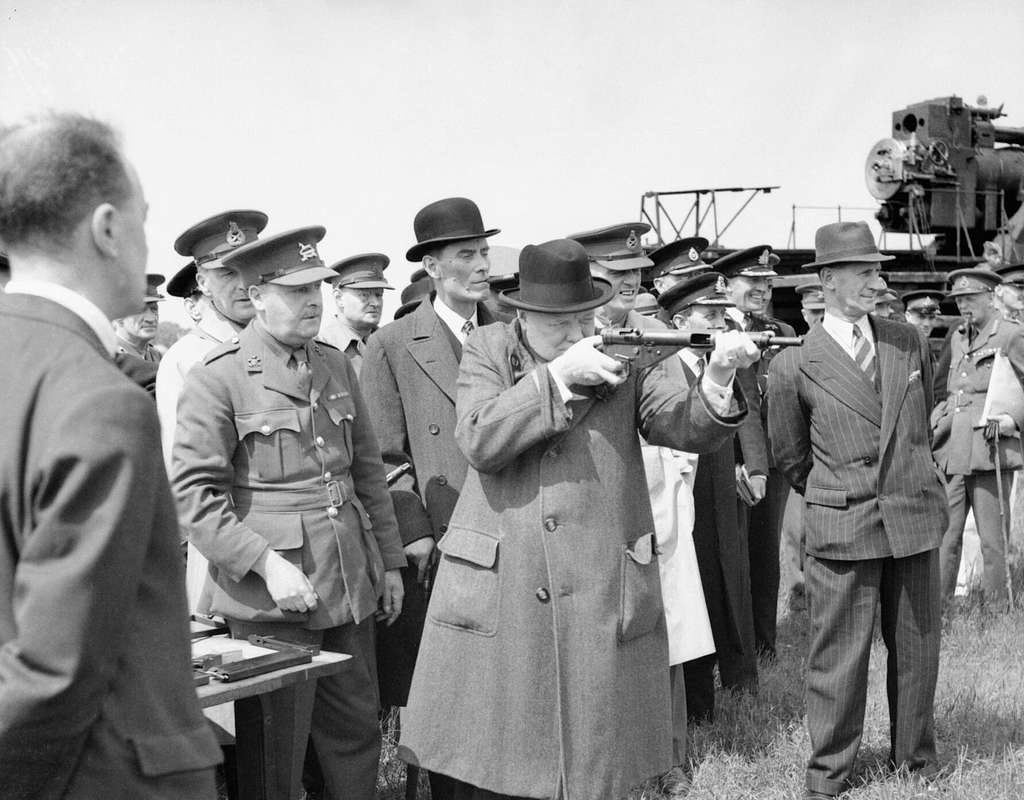
Winston Churchill takes aim with a Sten gun during a visit to the Royal Artillery experimental station | Picture Credits: Imperial War Museum / PICRYL
Winston Churchill is widely regarded as the statesman who helped halt the spread of fascism in Europe and subsequently defeat it. Celebrated for his oratory, writing, and policies during the Second World War, he is lauded in museums, numerous biographies, and school curricula worldwide. But, from the perspective of people in Iraq and Kurdistan in general, his legacy looks very different. Winston Churchill’s view of the Kurds was shaped by the ruthless logic of empire: they were a people to be managed, contained, or punished, rather than a nation whose aspirations should guide policy. That outlook, expressed in his private memoranda and reflected in British practice on the ground, is one reason his name still provokes anger across Kurdish memory.
In Tariq Ali’s Winston Churchill: His Times, His Crimes, Churchill appears not as the wartime savior of Europe but as a senior imperial minister at a time when Britain was trying to hold together the ruins of the former Ottoman empire.
Ali recounts how, as Secretary of State for War in 1920, Churchill supported the terror bombing of civilians when Kurds and Arabs resisted British plans for Iraq.
Tariq Ali, a British-Pakistani writer, historian, and political commentator, is known for his critiques of empire and Western foreign policy. In his book, he challenges the heroic wartime image by foregrounding Churchill’s imperial record, especially in places like Iraq, where British force was deployed against Kurds and Arabs. A key feature of Ali’s approach is that he largely uses Churchill’s own words and official statements to build his case, letting the record of memos, remarks, and policy positions serve as the core evidence of the attitudes he criticises.
Ali recounts how, as Secretary of State for War in 1920, Churchill supported the terror bombing of civilians when Kurds and Arabs resisted British plans for Iraq. In Ali’s telling, Kurdish tribal chiefs were bribed, pliant groups strengthened, and whole communities reorganized through what officials called ‘re-tribalizing’– a divide-and-rule method aimed at weakening resistance.
The deeper shock, however, is the language Churchill used.
Ali quotes Churchill’s impatience with objections to chemical weapons. The famous line is stark: “I am strongly in favour of using poisoned gases against uncivilized tribes.” This was not a throwaway comment. It was part of a policy debate in 1919–1920 about how Britain could police Iraq with fewer troops, leaning instead on air power and new weaponry. A surviving War Office memorandum from 12 May 1919 shows Churchill pressing exactly this case, arguing that “gas would create terror and compel submission”.
In practice, British commanders in Iraq increasingly relied on the Royal Air Force. Ali’s book shows how British officers describe bombing as a form of corporal punishment. One RAF voice spoke of having to “spank” Kurdish communities with bombs and guns when they failed to “behave themselves in a civilized way.” Another officer, Arthur Harris, later infamous as “Bomber” Harris, boasted that a village could be devastated in under an hour.
For the Kurds, these were not abstract imperial debates, but lived experiences. Kurdish leaders initially welcomed the British presence after the First World War, believing the international circumstances might allow higher autonomy or even independence. That optimism faded quickly when it became clear that London had little sympathy for a Kurdish state. The rebellions in 1919–20 around Sulaymaniyah, led by Sheikh Mahmud Barzanji, were suppressed by a combination of ground forces, air power, and the looming threat of chemical warfare, with an autonomy that was promised but did not materialize.
Churchill’s place in this story is both political and architectural in the long term. British decisions, in which he played a central role, helped fold Kurdish areas into the new Kingdom of Iraq. Indeed, some officials in London argued for a separate Kurdish arrangement, even a buffer state between Iraq and Turkey, while influential figures in Baghdad pressed for incorporation into an Arab-led state. In the end, the integrationist camp prevailed, setting a path that would leave the Kurds a large minority in a state not designed around their national project.
Yet reading Churchill only through a Kurdish lens is to miss the wider pattern. His view of the Kurds as an “uncivilized” people was not unusual in his imperial worldview; it echoed how he thought about other colonized populations.
Churchill defended racial hierarchy in general terms and argued in 1937 that he did not accept that indigenous peoples in places such as America or Australia had necessarily been wronged by conquest, because a “stronger” and “higher-grade” race had taken their place.
This is the thread that runs through the imperial Churchill: the conviction that order, modernity, and stability belonged to the empire, while resistance by colonized peoples was a symptom of backwardness…
With India, Churchill’s private hostility was even sharper. Sources drawing on the wartime diaries of Leo Amery, his Secretary of State for India, report that Churchill denounced Indians in sweeping, contemptuous language during the 1942 crisis. The exact phrasing is debated by historians, but the thrust is widely recorded: Churchill saw India’s independence movement not as legitimate self-government but as a “civilizational challenge” to British authority.
His comments about Arabs and Africans also fit the same hierarchical frame, with some accounts describing him as viewing parts of the Islamic world and Black Africa through a vocabulary of “grade,” “civilization,” and fitness for rule. Churchill described the Arabs as a “lower manifestation” than the Jews, whom he viewed as a “higher grade race” compared to the “great hordes of Islam”. He referred to Palestinians as “barbaric hordes who ate little but camel dung”.
This is the thread that runs through the imperial Churchill: the conviction that order, modernity, and stability belonged to the empire, while resistance by colonized peoples was a symptom of backwardness, a mindset that made coercion feel not only permissible but virtuous.
The defenders of Churchill also have a say in all of this. One of the most persistent points is that the “gas” Churchill advocated was not necessarily mustard gas of the First World War imagination. As the BBC has reported, the Cambridge historian Warren Dockter argues that what Churchill proposed for Mesopotamia was more likely lachrymatory gas (essentially a tear agent) intended, in Churchill’s own justification, to incapacitate and intimidate rather than to kill. This distinction, defenders say, matters when judging intent.
They also argue that Churchill’s language, appalling to modern ears, was not idiosyncratic for an imperial minister in 1919. The term “uncivilized tribes” was embedded in the bureaucratic lexicon of the age, and chemical weapons had been normalized by the preceding world war.
Churchill helped save Europe from one catastrophe while embodying and defending an imperial order that inflicted other kinds of violence elsewhere.
But the Kurdish memory is not so easily reconciled. For communities that experienced British air control as a form of punishment and heard their identity described in the language of “uncivilized tribes,” Churchill’s celebrated story has always had a second chapter. That sense of betrayal and duplicity surfaces even in recent history: in his 2020 book on the independence referendum, Former President of the Kurdistan Region Masoud Barzani accuses then British ambassador Frank Baker of signaling support for “the future Kurdistan” in 2017 while, at the same time, ignoring “treason and plots” against Kurds in the disputed areas and even taking part in schemes against the Kurdistan Region.
It is a reminder that historical giants often cast overlapping shadows. Churchill helped save Europe from one catastrophe while embodying and defending an imperial order that inflicted other kinds of violence elsewhere.

Renwar Najm
Renwar Najm is an Iraqi Kurdish journalist with a career that began in the early 2010s at the esteemed Awene newspaper. He holds a master’s degree in Peace and Conflict Studies from the University of Kent and Philipps University of Marburg.