Turkey in 2025: Stability at the Expense of Justice and Freedom
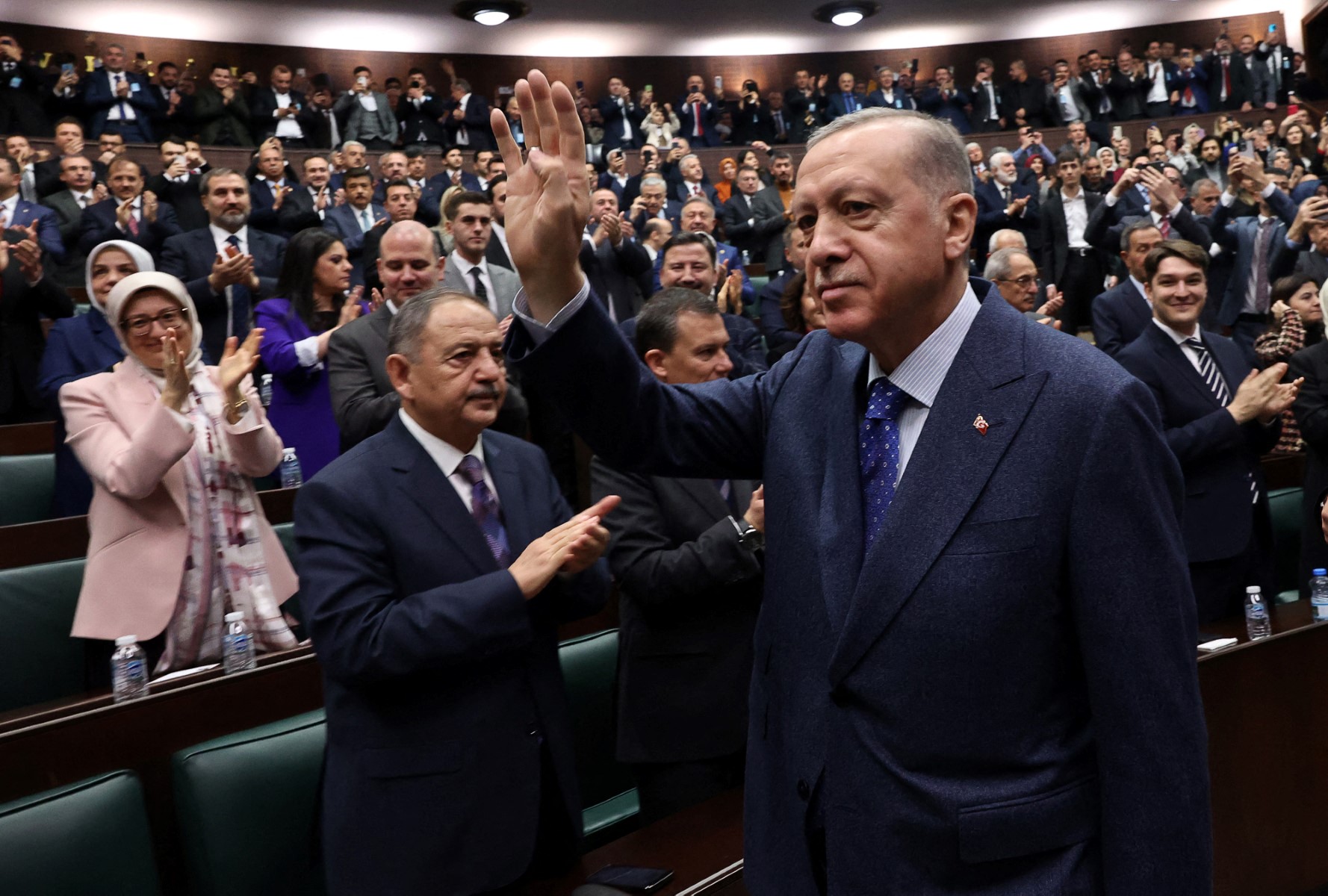
Turkish President and Leader of the Justice and Development (AK) Party Recep Tayyip Erdogan waves as he is applauded during his party’s group meeting at the Turkish Grand National Assembly in Ankara on February 1, 2023. (Photo by Adem ALTAN / AFP)
In 2025, Turkey saw political stability being enforced through tight control and repression, while structural problems were repeatedly deferred.
The Erdoğan government managed to contain potential crises and maintain dominance by leaving little room for opposition, be it in parliament or in civil society. Yet beneath this veneer of “stability through repression,” was a nation experiencing a deepening deficit of justice driven by the politicization of the judiciary; an economy squeezing nearly 70 percent of the population toward proletarianization; a Kurdish issue that saw a surprising breakthrough but has yet to produce substantial progress with some serious steps from the parliament but slow government reaction; and a model of capital accumulation that grows at the expense of child labor, workplace fatalities, and environmental destruction, now reinforced by the new Mining Law.
While the AKP-led government succeeded in reducing Turkey’s global isolation through an active foreign policy in 2025, tangible benefits remain limited. Ankara leveraged NATO’s Nordic enlargement to its advantage, eased tensions with the United States, resolved the S-400 impasse, and secured Eurofighter jets in place of the F-35, while also emerging as a key player in post-Assad Syria. Yet the Israel-Greece-Cyprus agreement announced late in the year once again highlighted the country’s geopolitical constraints.
Authoritarian Consolidation and Emerging Cracks at the Center of Power
The defining feature of Turkey’s political landscape in 2025 was the continued consolidation of state power at the center. Decision-making remained concentrated in the executive under a presidential system on steroids, while institutional oversight, especially parliament and the judiciary, was further weakened. The space for organized opposition and civil society continued to shrink, and checks on the monopolization of power were effectively dismantled.
At the same time, 2025 also indicated internal strain within the ruling bloc. Factionalism within the state became more visible, to the point that simultaneous operations targeting the media and rival football clubs (notably Galatasaray and Fenerbahçe) were widely interpreted as the product of competition between parallel bureaucratic factions and their counter-moves. These dynamics did not indicate a loss of control, largely because prior operations against the opposition, particularly the CHP, had already been largely successful.
An Opposition Rebranded
Judicial procedures against the primary opposition, the Republican People’s Party (CHP), began in March with the arrest of İstanbul Metropolitan Mayor Ekrem İmamoğlu, Erdoğan’s potential rival in the 2028 presidential elections, and continued with the appointment of trustees to provincial party branches; the removal of mayors from office; and the prosecution of hundreds of party members. These measures effectively paralyzed the CHP in part, severely undermining its ability to mount coordinated and organized opposition at the national level.
As a result, the CHP’s image as a “constructive and pluralistic opposition” suffered a serious blow, and its long-standing claim, dating back to the Gezi Park protests of 2013, to represent a pluralistic majority was undermined.
Yet the CHP’s most significant setback came in the final quarter of the year, following the party’s response to a symbolic but critical moment in the Kurdish peace process. On 21 November 2025, the parliamentary commission voted by a qualified majority to visit İmralı to hear Abdullah Öcalan. The CHP chose not to appoint members to the delegation, effectively distancing itself from the process. This stance drew sharp criticism from opposition circles, including the pro-Kurdish DEM Party, and was described as electoral opportunism, political timidity, and an evasion of historical responsibility.
As a result, the CHP’s image as a “constructive and pluralistic opposition” suffered a serious blow, and its long-standing claim, dating back to the Gezi Park protests of 2013, to represent a pluralistic majority was undermined. By falling into the trap set by the government – “either bear the political cost and contribute to peace, or be branded nationalist and reflexive” – the CHP was pushed into a negative opposition role in the eyes of Kurdish voters and broader democratic constituencies alike. The ruling bloc thus achieved significant success in its goal of managing the opposition.
Slowing Inflation, Exchange Rate Suppression, and Large-Scale Proletarianization
In 2025, Turkey’s macroeconomic indicators indicated limited short-term improvement, including a modest decline in inflation. However, these gains had little impact on everyday life. While official TÜİK data suggested annual inflation was approaching single digits, trade unions and independent research groups reported much sharper increases in food and basic living costs, with purchasing power continuing to decline.
According to TÜRK-İŞ, the monthly food expenditure for a family of four exceeded the minimum wage of 22,104 TRY (US$515.85). In November 2025, the hunger threshold (food expenditure) stood at 29,828 TRY (US$696.10), while the poverty threshold reached 97,159 TRY (US$2,267.43). The debate over the minimum wage, therefore, reflected more than mere adequacy; it highlighted a deeper shift in Turkey’s wage structure. DİSK-AR data for 2025 showed that roughly 46.7 percent of workers earned the minimum wage or less – a proportion rising to about 60.1 percent among women – indicating that the minimum wage had effectively become the norm rather than the floor. Compared with Europe and OECD countries, where minimum-wage earners are far fewer (approximately 8 percent in Germany), Turkey stood out markedly.
The Kurdish Peace Process: Non-Violence Achieved, Rights Pending
The peace process on the Kurdish issue, launched in October 2024, entered a new phase in February 2025. Abdullah Öcalan, through a DEM Party delegation, called on the PKK to disarm and dissolve. The PKK subsequently decided to disarm and dissolve at its 12th Congress in May, with disarmament ceremonies completed by July, ushering in a period of complete non-violence.
In August, the Turkish Parliament established the Commission on National Solidarity, Brotherhood and Democracy, which held more than 20 meetings and heard from 135 individuals and institutions over the course of the year. In December, political parties submitted their reports: the AKP proposed a limited “return law” (for PKK members) following the end of “terrorism;” the MHP opposed any general amnesty for political prisoners; the DEM Party demanded constitutional change and mother-tongue education; while the CHP focused on democratization. The commission’s mandate was extended to February 2026, with a final report still pending.
However, a general amnesty was not placed on the agenda, and political prisoners did not benefit from the 11th Judicial Package. Although violence ceased completely during the year, no fundamental legal steps were taken on Kurdish identity or cultural rights. The process generated cautious optimism, but a comprehensive resolution was postponed to 2026.
Crime, Impunity, and Selective Justice
Despite the Interior Ministry’s claims of dismantling 15 major criminal networks, the response largely remained narrowly security-focused, sidelining the socio-economic drivers of youth crime and fueling reactionary calls to try children as adults.
In 2025, organized crime, particularly a new generation of gangs involved in motorcycle attacks, extortion, drug trafficking, and contract killings, occupied an unprecedented place in public discourse. Groups such as Daltons, Redkits, and Caspers (all cartoon names) that recruit young people via social media thrived amid urban poverty, youth unemployment, widespread hopelessness, and an economy increasingly intertwined with grey and illicit channels. The Global Organized Crime Index noted that criminal networks in Turkey operate close to political and economic structures, with political influence preventing effective investigation of certain cases. Court files documented children as young as 15 being hired as hitmen for payments of 15,000–20,000 TRY (US$350-466).
These gangs only became a central security issue after high-profile assassinations shocked public opinion. Despite the Interior Ministry’s claims of dismantling 15 major criminal networks, the response largely remained narrowly security-focused, sidelining the socio-economic drivers of youth crime and fueling reactionary calls to try children as adults.
Perceptions of selective justice further shaped public anger. Days after the 11th Judicial Package came into force, a man released under the law murdered his wife, reinforcing persistent warnings from women’s groups.
The We Will Stop Femicide Platform recorded 446 femicides in 2025, including a record 267 suspicious deaths. Similar concerns followed weak accountability in workplace fatalities, many of which involved children drawn into the workforce under the government-sanctioned child recruitment program (MESEM).
Adding to these concerns, the end of 2025 saw ISIS re-emerge as a domestic security threat. On 28-29 December, three police officers were killed during an anti-terror operation in western Turkey in which six suspected ISIS militants were also killed, triggering renewed debate over the domestic costs of Turkey’s foreign policy choices.
Foreign Policy: Isolation Broken, Influence Under Duress
The AKP government’s active foreign policy in 2025 significantly reduced Turkey’s global isolation, but most initiatives produced asymmetric returns: substantial diplomatic and financial investment yielded only partial gains. Relations with the West improved noticeably. Erdoğan’s September meeting with Donald Trump at the White House was described as producing “meaningful progress” in defense and trade; Trump indicated a possible easing of CAATSA sanctions related to the S-400s, though no concrete outcome had materialized by year’s end. The €11 billion Eurofighter deal signed during UK Prime Minister Keir Starmer’s October visit bolstered air power but became even more costly when combined with the losses resulting from Turkey’s expulsion from the F-35 program.
Somaliland emerged as an additional constraint on Turkey’s Red Sea posture, reinforcing fears in Ankara that Israel’s regional hegemony is no longer hypothetical
Turkey’s apparent regional gains were also constrained. Following Assad’s fall at the end of 2024, Ankara emerged as a dominant actor in Syria under a new HTS government, expanding military advisory roles, trade ties, refugee returns, and leverage over Kurdish groups. Turkey positioned İstanbul as a platform for Ukraine-Russia talks and acted as a mediator in Gaza. Yet the December 2025 Jerusalem summit between Greece, Cyprus, and Israel deepened defense, energy, and security cooperation in a bloc explicitly perceived by Ankara as adversarial. Somaliland emerged as an additional constraint on Turkey’s Red Sea posture, reinforcing fears in Ankara that Israel’s regional hegemony is no longer hypothetical but real. The crash of a Libyan aircraft on 23 December further fueled speculative narratives amid these regional rivalries. Erdoğan’s pragmatic engagement with the Trump era yielded results, but they remained partial, fragile, and costly.
Ultimately, Turkey in 2025 was neither a collapsed authoritarian regime nor in any way a stable political order. It was a system that governed by suppressing crises without resolving them, redesigning the opposition, managing the economy through impoverishment, and keeping even peace under tight control, thereby transforming accumulated problems into future points of rupture.
Looking Ahead
The durability of Turkey’s crisis management through the suppression model will be tested on several fronts in 2026. Regionally, the implementation of the 10 March agreement between the Syrian Kurdish SDF and the Syrian transitional government, the risk of escalation with Israel across the Eastern Mediterranean and Red Sea theaters, and Ankara’s room for manoeuvre under a potentially shifting US foreign policy with a likely weakened Trump administration following midterm elections will test Turkey’s geopolitical posturing.
Domestically, the Kurdish peace process stands at a crossroads, with the transition from non-violence to legal and constitutional reform remaining uncertain.
Mounting economic pressure, deepening impoverization, the rise of new-age gangs, and the persistence of selective justice will continue to strain social cohesion.
All in all, the Turkish government’s ability to transform enforced stability into a genuine social and economic cohesion remains the central question for Turkey in the year ahead, with a lasting Kurdish peace holding the greatest potential to enable such a transition.

The Amargi
Amargi Columnist