Will Syria’s New Currency Ease Inflation?
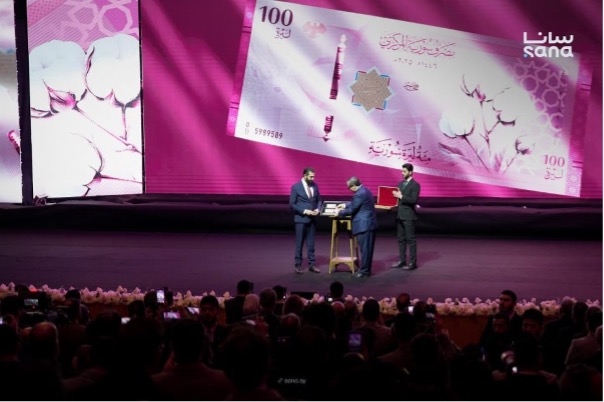
The official unveiling ceremony for new Syrian banknotes, Damascus, December 29, 2025. Photo Credits: Syrian Arab News Agency (SANA)
The new Syrian transitional government aims to fix years of inflation and economic stagnation by introducing new currency notes. However, financial experts say the lack of meaningful fiscal reform to address deeper economic issues means that a new currency will not have the desired impact.
On December 29, 2025, Damascus unveiled new banknotes with Decree No. 293, launching the “new Syrian national currency”, which has been in circulation since January 1, 2026. The redenomination removes two zeros from the old currency’s value: 100 old Syrian pounds is now equal to one new Syrian pound.
At an official unveiling ceremony in Damascus, al-Sharaa and Central Bank Governor Abdulkader Husrieh presented six new banknote denominations: 5, 10, 25, 50, 100, and 500 liras. In a symbolic political shift, the banknotes feature national symbols – wheat, olives, and roses – replacing portraits of Hafiz and Bashar al-Assad, who ruled Syria for five decades until the Ba’ath regime fell in December 2024.

“Removing zeros simplifies transactions,” al-Sharaa stated. He said the currency redesign aimed to increase confidence in the national currency and reduce reliance on foreign currencies such as the U.S. Dollar.
Walid Muhammad, co-chair of the Union of Currency Changers in northeast Syria, addressed this development, stating, “Removing two zeros from the Syrian currency may benefit citizens by reducing the weight of cash carried, rebalancing cash flow, and paving the way for more efficient monetary policy,” but added that without comprehensive “economic and financial reforms”, changing the currency structure will not have any meaningful impact on the Syrian economy.
Since 2011, the Syrian pound has lost more than 99 percent of its value, with the current exchange rate at around 12,500 Syrian pounds to the U.S. dollar, compared with approximately 50 Syrian pounds in 2011. However, inflation in Syria eased to 15.13% in August 2025 from 16.41% in July, reflecting a gradual stabilization amid ongoing economic challenges.
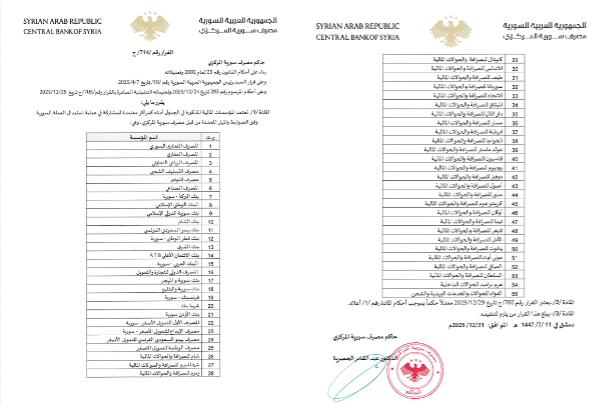
The Central Bank has scheduled a 90-day period to replace the old currency. They have stated that both currencies will be accepted during the replacement period, and that there is a possibility of extending the timeframe if needed.
Redenomination Without Clarity on Key Issues
The announcement, made without informing or consulting all Syrian parties, prompted citizens to rush to purchase dollars, fearing the old currency would become invalid. This led to an immediate increase in the exchange rate.
Redenomination typically occurs in the context of hyperinflation as a response to the practical challenges posed by extremely high nominal prices, a situation experienced by the Syrian population in recent years.
An exclusive Reuters report from mid-August 2025 revealed that Syria’s central bank had informed private banks of its intention to issue new currency by “removing zeros” to ease transactions and improve monetary stability. The government contracted Goznak, the Russian state-owned money-printing company, to produce the banknotes.
The move follows a similar pattern to the transitional government’s earlier initiatives, which have left the Syrian population off guard and unaware of incoming changes. Syrian human rights organizations have reported that such initiatives have lacked clear and transparent mechanisms. These findings mirror the statement by Bernard Duhaime, the UN Special Rapporteur on the promotion of truth, justice, reparation and guarantees of non-recurrence, who on October 17 said that the transitional government’s initiatives frequently overlook “gross violations to the rights to livelihoods, to health, to food, or to cultural rights often lie at the root of violence.”
It is also worth noting that the new Syrian government has not clarified how the Central Bank will handle funds held by businessmen linked to the Assad regime or address Syrian pounds circulating in neighbouring countries.
The new currency has not yet entered circulation in northeast Syria, pending the establishment of a coordination mechanism between the Currency and Payments Office of the Autonomous Administration of North and East Syria (DAANES) and Damascus’s transitional government. While DAANES regions are included in the replacement plan, the coordination mechanism required to inject new currency and withdraw old notes remains unestablished.
Before the latest attacks on SDF-held areas in northeast Syria, the Amargi contacted Renas Hamou, co-chair of the Cash and Payments Office in the al-Jazira region, northeast Syria, who stated that there have been no discussions with Damascus regarding the use and distribution of the new currency. “We are closely monitoring developments in the region to see how situations will unfold in the coming period,” Hamou said.
Officials at the Syrian Central Bank in Suwayda denied reports to The Amargi that the new currency is prohibited from circulating in Suwayda province. They explained that coordination delays occurred between the transitional government’s currency rollout and emerging decisions on replacement mechanisms, but confirmed Suwayda is included in the replacement plan.
The new currency will gradually enter Suwayda’s market through commercial transactions, accounting for the movement of goods entering and leaving the province. Rola Ezzi, director of the Commercial Bank in Suwayda, explained that they are following currency withdrawal and delivery operations under “exceptional arrangements” for the governorate.
Economic and Political Concerns
Syrian economists Al-Mashal and Qushji have warned that removing zeros without implementing productive economic reforms could lead to repeated currency collapses. They stress that success depends on effective political negotiations, along with robust economic frameworks, maintaining security, and restoring growth and market confidence.
Joseph Daher, a writer and political activist, shared a similar sentiment in a detailed report, writing that it is not clear how the new currency will control inflation and that lack of strict regulation will end up worsening inflation, which will affect “lower-income groups.”
The new currency launch occurs amid escalating armed tensions and ongoing hostilities against minorities in Syria, complicating the conditions needed to achieve stated economic goals. Against this backdrop, on 17 November 2025, the International Monetary Fund (IMF) issued press release No. 25/377, which stipulated that discussions on the new Syrian government’s 2026 budget remain ongoing to ensure it is based on realistic revenue and financing assumptions, and pointed out that the economic recovery remains fragile and requires deep structural intervention.
Some observers argue that changing the currency exceeds the transitional government’s legitimate powers and should fall within the remit of an elected government, aligned with transparent political, economical and societal debate. They contend the measure requires legislative endorsement by a democratically elected parliament, accompanied by robust political and institutional guarantees.

Soha Ezzi
A filmmaker, civil activist, and independent journalist based in Damascus, Syria