Kurds Seek Power-Sharing Arrangement in Damascus Following U.S. Abandonment
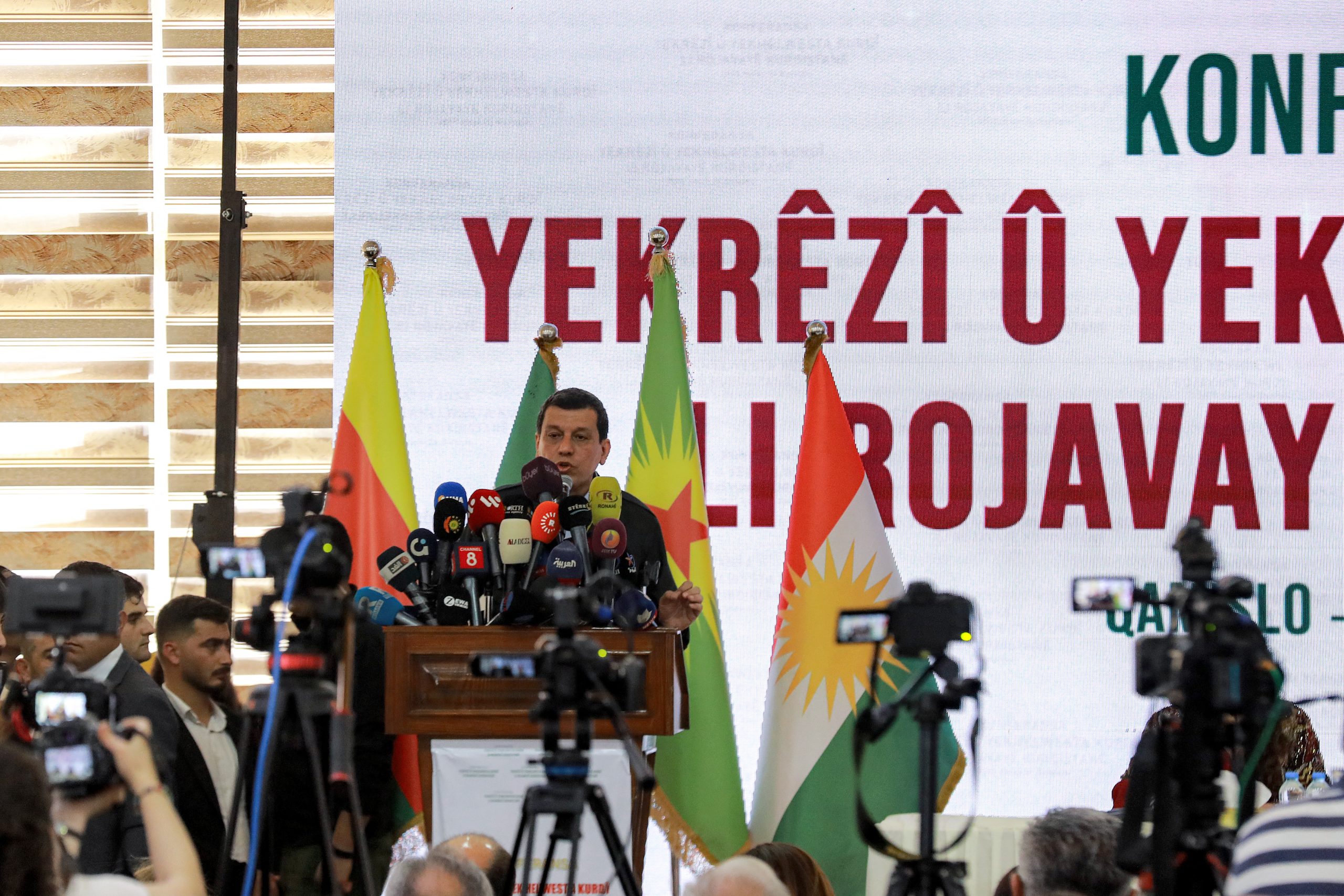
Mazloum Abdi, commander-in-chief of the Syrian Democratic Forces (SDF), speaks during the pan-Kurdish “Unity and Consensus” conference in Qamishli in northeastern Syria on April 26, 2025. (Photo by Delil SOULEIMAN / AFP)
As a new Islamist-led order takes shape in Damascus, Kurds are seeking to protect their political gains in the new Syrian state. The Kurds, western allies who gave more than 13,000 lives to defeat ISIS, are now at risk of falling under Islamist and Turkish rule after U.S. abandons them.
Mazloum Abdi, General Commander of the Kurdish-led Syrian Democratic Forces (SDF), announced he would visit Damascus to negotiate the details of the agreement announced by Syrian transitional president Ahmed al-Sharaa. This comes after the Syrian government forces advanced into SDF territories in northeast Syria, prompting the SDF to accept a comprehensive ceasefire agreement with Damascus.
The Islamist Hay’at Tahrir al-Sham (HTS)-led Syrian transitional government troops, Turkish-backed factions, and tribal groups in the region captured areas of Deir ez-Zor and Raqqa, formerly an ISIS stronghold, along with the strategic city of Tabqa and Syria’s largest oil installations.
Since 2012, the Kurdish-led SDF have liberated roughly one-third of Syria from ISIS, establishing the Democratic Autonomous Region of North and East Syria (DAANES). The SDF has now reached a “Ceasefire and Full Integration Agreement” with the Syrian government, formalizing a transition of authority across northeastern Syria.
On Sunday, Syrian President Ahmed al-Sharaa announced the ceasefire agreement, which was endorsed by SDF General Commander Mazloum Abdi. U.S. envoy to Syria Tom Barrack praised both parties for their “constructive efforts” toward building a unified Syria, describing the leaders as being driven by a shared goal of liberating the country from tyranny.
Previous Agreement Collapsed
The Kurds in Syria have decided to abandon their total reliance on the U.S. and take a more pragmatic political approach as they adapt to the new realities in Syria.
Discussions about integrating the SDF as a unified bloc based on March-10 agreement, including a women’s division, as well as demands for decentralization and a democratic transition in Syria, experienced a serious setback in late 2025. During the last round of negotiations in Damascus, Foreign Affairs Minister Asaad Al-Shaibani reportedly interrupted the proceedings just before an agreement was to be signed. This move is believed to be the result of Turkey’s longstanding efforts to prevent Kurdish autonomy along its border.
Among the Kurds, there is a growing belief that the United States has once again “betrayed” them. After partnering closely with Kurdish-led forces to defeat ISIS, Washington stepped back just as regional and domestic pressures mounted. This retreat, Kurds argue, emboldened hostile actors and helped trigger a dangerous escalation, one that left Kurdish regions vulnerable, politically weakened, and at risk of losing much of the self-rule they built over the past decade.
Due to this, the Kurds in Syria have decided to abandon their total reliance on the U.S. and take a more pragmatic political approach as they adapt to the new realities in Syria. Facing limited options, Kurdish leaders are now seeking a power-sharing arrangement with the new Syrian authorities, one that allows them to remain part of the state while preserving a degree of local control.
Mazloum Abdi will arrive in Damascus today, January 19, to negotiate power sharing arrangements and incorporating DAANES institutions into the state to avoid the catastrophic alternative of political exclusion, repression, and ethnic and sectarian violence.
“Ceasefire and Full Integration Agreement”
The 14-point ceasefire agreement represents a substantial shift in Syria’s political landscape, effectively dismantling the Autonomous Administration in the Arab-majority provinces of Raqqa and Deir ez-Zor, while leaving the future of Kurdish autonomy in other regions contested.
The document stipulates the immediate handover of military and administrative control in both governorates to the central government, along with the transfer of all border crossings, oil fields, and gas facilities to Damascus.
Additionally, SDF fighters will be integrated individually into Syria’s defense and interior ministries rather than maintaining separate military units, and ISIS detention facilities and camps housing militants’ families will come under the Islamist government’s authority.
The agreement also requires the withdrawal of heavy weapons from the Kurdish town of Kobani – which was the site of the first major ISIS defeat – retaining only a local police force under the Syrian interior ministry’s oversight.
Notably, the document makes no reference to self-governance or ethnic rights for Kurds. Instead, it acknowledges a recent presidential decree recognizing Kurdish as a “national” language – rather than an official language – and designating Newroz (the Kurdish New Year) as an official holiday. These measures fall short of the political autonomy the Kurdish-led DAANES had sought to preserve.
Displacement and International Dimensions
The Kurds are not expected to abandon their struggle for autonomy and a democratic Syria.
The military campaign has triggered new waves of displacement among Kurdish civilians, particularly those previously displaced from Afrin and Aleppo. Those who had already fled multiple times found themselves relocating again toward Qamishlo in northeastern Syria as government forces entered Tabqa.
On Sunday night, SDF Commander Mazlum Abdi stated that “a war was imposed on us” on January 6. Abdi said that the SDF had accepted the withdrawal from Raqqa and Deir ez-Zor in order to prevent further harm to civilians. He emphasized that Kurdish forces remain “determined to protect the gains of our people” and vowed to continue the struggle for autonomy.
The military offensive followed weeks of intensive diplomatic activity aimed at reshaping Syria’s post-Assad order. On January 6, Syria and Israel reached a deconfliction agreement in Paris through U.S. mediation. This agreement seemed to ease Israeli rhetoric supporting Druze and Kurdish autonomy and reportedly recognized Israeli control of southern Syria, particularly the Golan Heights. This seemingly gave Damascus, and indirectly Turkey, greater freedom to pursue its territorial objectives in the northeast.
As tensions mounted, SDF Commander Mazloum Abdi and DAANES Foreign Relations Representative Elham Ahmed traveled to Erbil, the capital of Iraq’s Kurdistan Region, for consultations with U.S. Syria Envoy Tom Barrack, Kurdistan Democratic Party Leader Masoud Barzani, and Iraqi Kurdistan Region Prime Minister Masrour Barzani. This was apparently an attempt to secure regional support for the Kurdish position.
However, Barrack’s subsequent visit to Ankara, which coincided with military developments in Syria, signaled a shift in priorities. Turkish Foreign Minister Hakan Fidan declared that Turkey would fully support the Syrian government and leadership. He added that the SDF had “no choice” but to accept previous integration terms or face military consequences. This statement highlights Turkey’s alignment with Damascus in dismantling Kurdish autonomous structures despite the peace process with the Kurds inside Turkey.
Although Al-Sharaa declared a ceasefire, Islamist factions and tribal groups have not complied and attacks continue. The agreement has not yet been finalized, and implementing its provisions will take time. The Kurds are not expected to abandon their struggle for autonomy and a democratic Syria.

The Amargi
Amargi Columnist