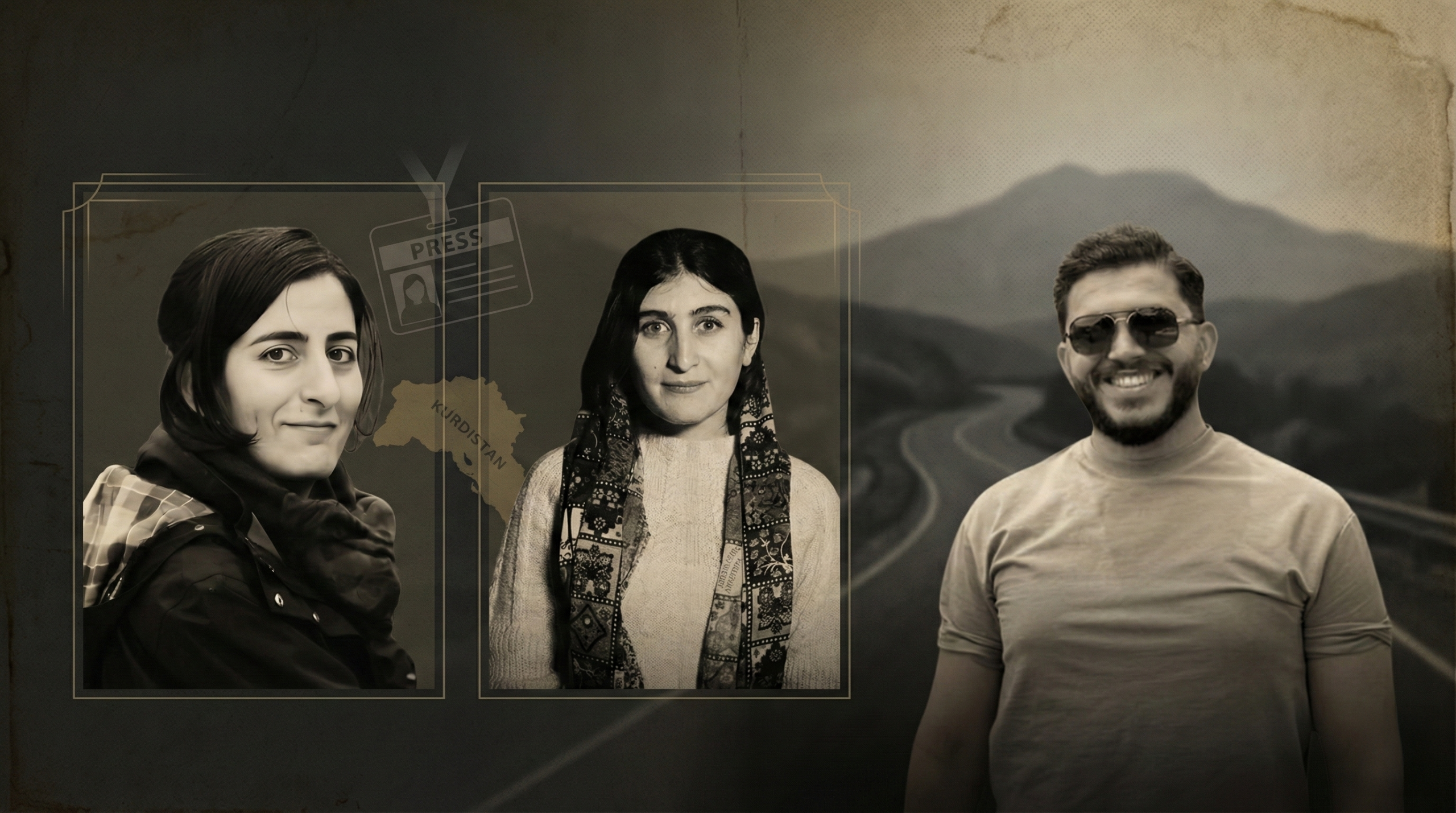
A Journalist’s Escape: Rebin, Hero, Guli’s Story
August 23, 2024, was an ordinary morning. Waking up, it did not occur to me that in a few hours, fire and smoke would engulf me, or that I would think to myself, “This is my last day.”
It was a hot morning, like any in August. That day, my colleagues from Chatr Media Productions and I, tired of the city’s chaos and summer heat, were going on a trip to Hewraman. The plan was to go to Hewraman for two things: to do some journalistic work and to find some peace and fresh air.
I arrived at the office at 9:10 AM. Soon after, two of my colleagues, Hasan and Kasar, drove in with a company car. Our fourth colleague, Hero, who lived right across from the company office, came out with her bag full of drawings and her usual warm smile. After her, Avesta and Guli arrived. Then we went to pick up Jinda, and we all set off together.
We stopped near Kani Panaka village, 38 kilometres east of Sulaymaniyah, for breakfast, and after our meal, we continued on. Guli sat up front in the passenger seat to smoke, and Hero moved to the back.
Driving along the New Halabja Road, I passed my phone to Hero, “What do you like to hear? Put something on.”
And Hero asked Guli, “What do you prefer?”
We were three young people escaping the city and its summer heat, busy with conversation and laughter. We didn’t know this was our last meeting.
Before the song was played, the gates of hell opened.
A massive explosion. Fire came from every direction; glass shattered; black smoke covered the blue sky and blocked the sun. The car was a burning furnace. And it was still moving at speed, steering itself across the paved road. The steering wheel was slipping, and I had nothing left in my hands. The glove compartment was burning, and alarms were going off, and the heat was in my throat.
When the car stopped and the light returned, I quickly checked my body. I thought I’d been in an accident – thinking to myself, perhaps a car had hit us.
I wanted to undo my seatbelt and get out, but I froze at the sight of my left hand: For the first time in my life, I saw my own skeleton. My bony fingers were red with blood. My thumb, like a pendulum clock, swung back and forth, as though counting down my final seconds.
I wished it were a nightmare.
Quickly, with my right hand, I pressed the seatbelt button, and fortunately, it unlatched. I pushed against the car door and, thank God, it opened, and I left this personal hell.
When I got out and tried to stand, searing pain made me realize I had a broken leg, and I collapsed. I crawled a few meters from the car, but had no strength, and my body went limp.
With eyes still clouded, I stared at my severed and lacerated hand, leg, and fingers. I opened my eyes further only to see a pool of blood underneath me and a fire that was still raging. I told myself that it was over; that this was my last day; that I had reached the end of the road.
Heading
I knew death was near. I was sure it surrounded me, and there was no escape. The smell of gunpowder, blood, and burning debris, combined with the summer heat, created a sweltering, suffocating warmth and a putrid odour that clung to my lungs. It seemed all that remained for me was to await the inevitable and let it carry me across the threshold.
But there were also people around me. Strangers. They stood far away and didn’t want to come close. They asked: “Who are you with?” I cried out to them, please help me, I’m bleeding, I’m dying. They looked back with fear.
But in that moment of despair came salvation.
A man in his fifties, dressed in Kurdish clothes, approached me with two or three others. They carried me up and put me in their car. When we started moving, I realized we were in a police car. They took me to Shaheed Peshraw Hospital in the town of Said Sadiq. And from there, I was transferred to Sulaymaniyah Hospital, where they put me in the operating room.
The Aftermath
I worked as a journalist at Chatr for Media Productions. The company had an official media license from the Kurdistan Regional Government. We produced programs, documentaries, and reports, and we had contracts with several channels for which we made these productions.
We were completely independent, but we were accused of sympathising with Kurds in North Kurdistan (Turkey), or sympathizing with the Kurdistan Workers’ Party (PKK). But hundreds of thousands of people in Turkey and across the world sympathize with Kurds and the Kurdish cause – that does not mean we support or belong to that party.
Hero and Guli were two pure, precious souls; the sharpest thing they ever carried were their pens. I remember their last smiles, their eagerness to see Hewraman, and that they didn’t get the chance to hear that final song.
Slowly, the physical wounds healed, but the psychological wounds needed much more time. I knew a harder task still awaited me.
I remember the first time I was on the road again after having healed. I was sitting in the back of a car, going from Sulaymaniyah to my hometown. As we approached the first checkpoint outside the city, I was seized by panic, and cold sweat ran through my whole being. I kept looking out the window, staring at the sky, searching for drones.
After several months of treatment and rehabilitating my physical condition, I tried to return to journalism, only to realize that many organizations feared hiring me. In one interview, I overheard an employee whisper to his colleague, “Be careful, a drone might come for us too!”
His colleague replied, “By God, I have a family and children. I can’t take that risk.”
There, I felt a kind of alienation. Their words, and the actions and behaviours of many others, who feared my very presence, made me feel that returning to journalism and finding new friends and colleagues would not be easy.
Though for me, one of the worst parts of it all was that my own government did not come to my defence or demand that the perpetrators be punished and make amends. Just a few hours after the bombing, the Anti-Terrorism Agency based in Erbil released a statement, claiming that the car that was targeted was carrying three PKK militants.
According to reports by the American CPT organization, more than 300 civilians have been killed by Turkish bombings, in addition to thousands wounded and displaced.
Fortunately, not much later, as a response to that agency, the Deputy Prime Minister of the Kurdistan Regional Government announced that those who were targeted were journalists and were in no way armed. Moreover, he stated that these attacks must be stopped against civilians and journalists in the country. He also called on the international community to speak up and take action. The Governor of Sulaymaniyah also condemned the attack on journalists.
But neither the Kurdistan Regional Government nor Baghdad took any serious measures against the perpetrators.
Turkish Attacks on Civilians
According to reports by the American CPT organization, more than 300 civilians have been killed by Turkish bombings, in addition to thousands wounded and displaced.
When I received my medical report, it said that my injury was caused by an explosion which had left shrapnel in my hand – with no mention of the bombing whatsoever. The American CPT organization has dozens of cases of civilians who were killed in Turkish bombings, where official reports attribute the deaths to other causes. The issue is widespread enough that the organization has made it one of its main suggestions for the Kurdistan Regional Government: to write the correct cause of death for victims of foreign military attacks, rather than labelling it an“accident”.
During my three years working with Chatr, I reported on news and published investigations. I had a passion for telling the stories of civilian victims of Turkish attacks, to amplify their voices in Kurdish and English, and to show these crimes to the world.
Then, I became a victim myself.
I continue to write and believe that every victim must have a voice and be heard. We must not allow fear to prevail and silence free voices and defenders of truth. If that happens, oppression and injustice will always reign, and flowers like Hero and Guli will always be plucked in the spring of their lives.

Rebin Bakr Karim
REBIN BAKR KARIM is a journalist and translator based in Sulaymaniyah. With four years of experience, he has worked as a social media officer at Chatr Media while also serving as a news editor.