Alawite Women Abducted, Assaulted, and Silenced Under Syria’s New Rulers
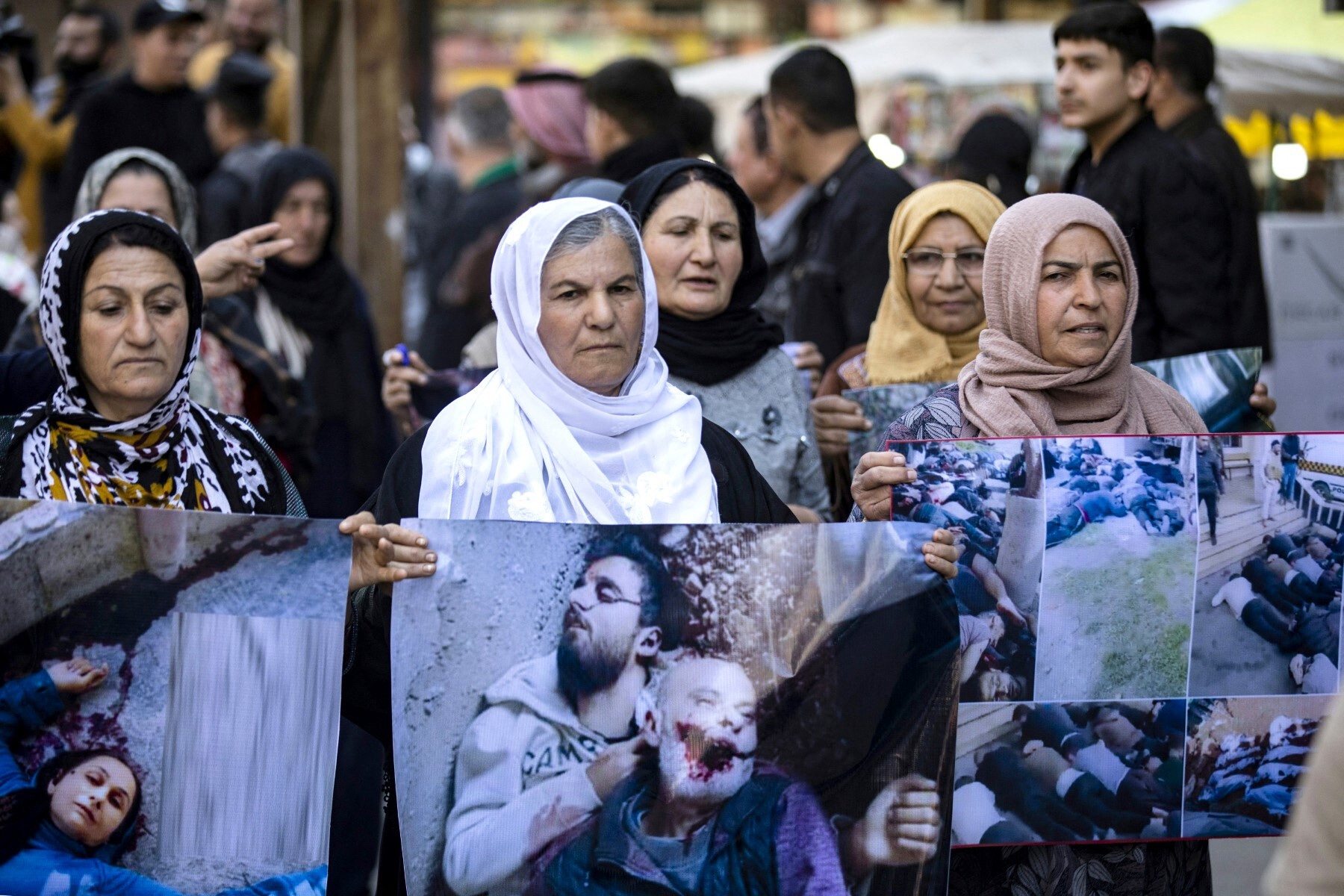
Women march with pictures of victims of a recent wave of sectarian violence targeting Syria’s Alawite minority in the west of the country along the Mediterranean sea coast, during a protest condemning the attacks in Syria’s northeastern city of Qamishli on March 11, 2025. (Photo by Delil SOULEIMAN / AFP)
One early spring morning, Faten answered the door expecting family. Moments later, she vanished. Her story is part of a growing pattern of kidnappings and coerced silence that Syrian authorities deny, even as human rights groups warn of a campaign targeting Alawite women across the country.
Faten is one of the many women who disappeared after Islamist factions formed Syria’s Interim Government. Months later, she returned emaciated and pregnant, but with strict orders from her captors: “Say you left voluntarily, or your family will pay the price.”
The threat of murder and revenge against all family members prompted the kidnapped women to provide false accounts, as several victims’ family members confirmed
Dozens of women are still missing, while others returned and appeared in videos claiming they had left due to family disputes. Amnesty International reported that since February 2025, at least 36 Alawite women and girls were abducted in Latakia, Tartus, Homs, and Hama. Eight cases were documented, including five minors, with abductions occurring in broad daylight.
The kidnappers soon learned a new trick: the case of Mira Jalal Thabet, a young woman shown in a video with her alleged lover, marked the start of the tactic where extremist groups disguised the abductions of Alawite women as voluntary elopements.
After Mira, many women reported missing later appeared in similar videos claiming they left willingly, and social media reactions often condemned these women as traitors, which shifted blame onto the victims and obscured the reality of sectarian abductions targeting the Alawite community.
The threat of murder and revenge against all family members prompted the kidnapped women to provide false accounts, as several victims’ family members confirmed to the Amargi. This reality raises critical questions: Why are abducted women denied the right to file legal complaints? Why are they silenced from sharing their stories? And how were their cases erased by imposing false narratives?
Faten’s Story
On March 24, 2025, after the Alawites massacres on the coast, Faten, 28, was preparing the Ramadan pre-dawn meal for her disabled husband, Mohammed. At 5:30 a.m,. someone knocked on their door in the city of Salhab, Hama. Faten opened the door, thinking that it was a relative bringing them fresh bread.
Speaking to The Amargi, all her husband recalled in those final moments was that she screamed: “Help, Mohammed! Mohammed!”
Mohammed crawled on his knees to try and rescue her but the kidnappers were faster: the door opened; she screamed; there was silence; then a car sped away. He called her again and again but could not reach her phone. At sunrise, he and his brother rode to the Salhab district headquarters, where bearded men had replaced security officers.
Most of the staff at the new district directorate were from Idlib, and ISIS and Hayat Tahrir al-Sham (HTS) flags hung everywhere.
Upon arrival, they told Mohammed and his brother that the Amir – an Arabic title meaning “prince”, which Islamist factions use for their leaders – was absent. He had to wait until 11 a.m.
The Amir was also from Idlib. He questioned Mohammed, then ordered his men to write a police report. One of the bearded men admitted he could not write and passed the task to another. After Mohammed gave his statement, the Amir promised help, but nothing happened.
After four months, Mohammed was hopeless. He shared his wife’s story on social media, prompting a visit from international organizations, which added Faten’s name to the list of abducted Alawite women.
As the story gained traction, an Interior Ministry representative, accompanied by Salhab’s mukhtar – an appointed neighborhood community representative – came to Mohammed’s home and promised to do everything possible to return Faten. Mohammed described the representative as “A clean-shaven man, polite and compassionate.”
…the kidnappers warned that if she aborted the child, they would kill her.
In November, eight months after she disappeared, and two months after the Interior Ministry’s visit, Faten returned to her parents’ home. However, she was a changed woman.
Mohammed described her as emaciated, bearing signs of abuse. And she was pregnant, bearing the child of a man she was forced to marry in Idlib.
Faten told them that her kidnappers had threatened to kill her, her son, and her brother – a former soldier in Assad’s Syrian army – if she disclosed her abduction. She asked for a divorce and refused to return home to Mohammed; the kidnappers warned that if she aborted the child, they would kill her.
Mohammed tried to reassure her and convince her they were only empty threats, “I asked her to tell the true story to the Interior Ministry representative. I assured her that I would stand by her and wouldn’t abandon her or her child, but she refused.”
Faten now lives in her parents’ house. She is pregnant because a man raped her and forced her into marriage. And to comply with her kidnapper’s demands, she now also affirms the coerced story: that she was, in fact, not kidnapped.
As for Mohammed, his family advised him to file a lawsuit, but so far, he has refused to do so. He said Faten is pressured to accuse him of abusing her, which, by law, would nullify his complaint.
Salma’s story
In early April 2025, four months after the Syrian regime’s collapse, 36-year-old Salma went missing. Her family lost contact with her at 11:30 a.m. as she was returning home to al-Maw’ah after a visit to her uncle’s home in Tartous.
Salma’s brother, Saeed, detailed the circumstances of her kidnapping to The Amargi:
Realizing that Salma had probably been abducted, he and Salma’s husband sought help from the mukhtar of al-Maw’ah. They filed a police report with the head of the Masyaf district directorate, a man from Idlib locally referred to as the “Sheikh”, who assured them of his support.
A few days later, like many others who were caught in the torrent of kidnappings, Salma’s family shared her photo on Facebook. Saeed said that after the photo was published, a man, who appeared foreign and spoke poor Arabic, called them and demanded $2,200 for her release. He threatened to kill her if they informed the General Security Service, and insisted the matter remain secret.
To keep Salma safe, the family followed the kidnapper’s instructions. Saeed explained that he sold his cow, which provided his livelihood, and sent the ransom money through a transfer office in Masyaf without notifying authorities.
Three days after sending the ransom, the kidnappers told Salma’s family to collect her from a village near al-Maw’ah. At that point, the family talked to the Security Service, who accompanied them on a patrol.
They found Salma tied beneath an olive tree; they had taken the gold jewelry she wore on her – something women in the region commonly do as a way of safekeeping the family’s material wealth amid unstable economies – her mobile phone, and her ID card.
In November 2025, the Syrian Interior Ministry announced that out of all cases reviewed, the state commission could only confirm one case of abduction, which they claim was then resolved peacefully due to government intervention.
Saeed recounted Salma’s experience in captivity, noting that she was drugged and carried to an unknown location. She found herself blindfolded, slumped over a wooden chair, alone in a small room, bound and glued to her place the entire time. The only sounds came when, once a day, her captors gave her food and hurled sectarian insults at her, but otherwise it was eerily silent.
She endured terrible moments but felt lucky enough not to be sexually assaulted; though, the ordeal was still deeply traumatic. Her family is now supporting her as she tries to heal from the trauma.
The Syrian Interim Government’s Story
In November 2025, the Syrian Interior Ministry announced that out of all cases reviewed, the state commission could only confirm one case of abduction, which they claim was then resolved peacefully due to government intervention.
However, contrary to the state-sponsored commission, the UN commission documented at least six cases. Amnesty International also interviewed relatives of eight abducted women and girls between February and June 2025.
For many years, Alawites were linked to political and military power, though the reality was very different: only a small percentage benefited from Bashar al-Assad’s rule. Despite this, they have been made a direct target for collective revenge.
Since December 2024, dozens of Alawite women have been kidnapped, with extremists claiming they are allowed to be taken forcefully, because they are “infidels”.
*Pseudonyms were used to protect the identities of victims and their families.

The Amargi
Amargi Columnist