Behind Iran’s Missile Programme: Development, Deterrence and Survival
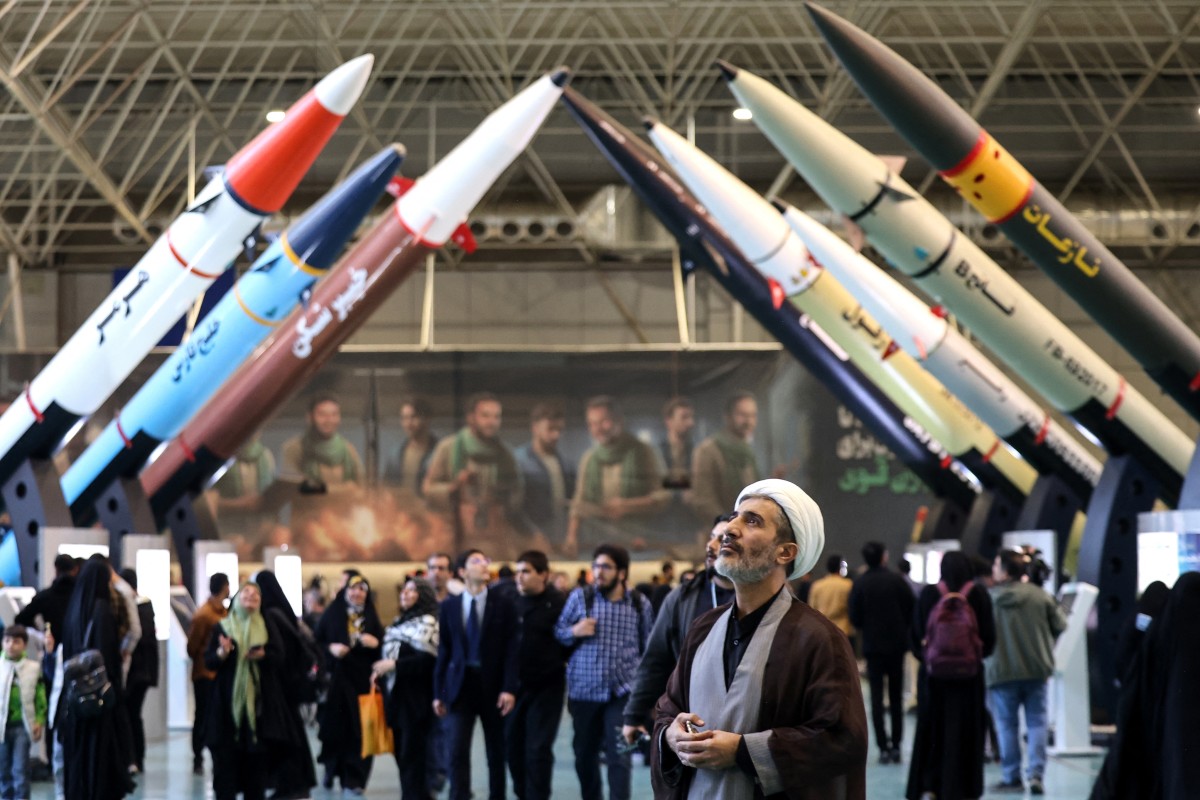
Iranians visit an exhibition showcasing missile in Tehran on November 12, 2025. (Photo by ATTA KENARE / AFP)
In what is now one of the longest periods of tension between Iran and the United States, the Islamic Republic’s missile programme has become one of the most sensitive and controversial international security issues. Over the past two decades, Washington has repeatedly said that this programme must be limited or halted, describing it as a threat to regional stability. Israel also considers Iran’s missile programme a direct threat to its national security and, together with the nuclear file, sees it as one of its core strategic red lines.
Iran’s pursuit of missile technology dates to the final years before the 1979 revolution
For its part, Tehran insists that its missile programme is defensive and necessary after a long history of war, sanctions, and military isolation. Iranian officials argue that when access to modern fighter jets, spare parts, and advanced technology was severely limited, developing missile capability was not a preference, but the only viable deterrence. To understand why this programme holds such strategic importance, it is necessary to look back four decades to the beginning of the Iran-Iraq war.
Origins: From Pre-Revolution Ambition to the Shock of War
Iran’s pursuit of missile technology dates to the final years before the 1979 revolution, when Tehran was attempting to diversify its military capabilities and enter advanced weapons sectors. Trade missions with Israel, including a contract known as ‘Project Flower’, reflected this ambition. Missile development was disrupted when the revolution took hold, as structural political changes and arms sanctions brought pre-existing projects to a halt.
When the eight-year war with Iraq began in September 1980, Iran was initially able to manage the shock of conflict by relying on military infrastructure and a relatively modern air force inherited from the pre-revolution period. Air operations, like the attack on the H-3 airbase inside Iraqi territory near the Jordanian border, allowed Iran to gain some degree of air superiority. However, as the war dragged on, equipment deteriorated, spare parts became scarce, and access to Western weaponry remained limited, so this advantage gradually eroded. Meanwhile, Iraq increased missile attacks against Iranian cities.
The “war of the cities” was not only a military campaign but also had targeted psychological and political aims. Iraqi missiles hit cities such as Tehran, Isfahan, Kermanshah, and Tabriz, placing the Iranian government under intense public pressure to respond. At this stage, Tehran began to consider missiles seriously as a tool of retaliation and deterrence.
In the mid-1980s, Iran received a stopgap supply of Scud-B missiles from Libya, with a range of around 300 km, and used them to respond to Iraqi attacks. But this cooperation was short-lived. Libya’s limited missile stock, political considerations, and disagreements over transfer volume quickly pushed Iran to seek alternative sources.
For more than two decades after the Iran-Iraq war, Iran’s missile and drone arsenal remained largely at the level of theoretical deterrence
When Libya’s missile supply proved insufficient, Iran turned to Syria, which under President Hafez al-Assad, was engaged in geopolitical rivalry with Ba’athist Iraq. Damascus provided training infrastructure and played a central role in preparing Iranian forces to operate Scud and Frog missile systems, from fuelling to launch and maintenance. This support helped Iran move from merely ‘possessing missiles’ to achieving effective operational capability. However, regional political complexities eventually curtailed Assad’s cooperation, leading Iran to focus on East Asia, primarily North Korea, to overcome these challenges.
From The Battlefield to Next-Generation Systems: Testing Missile Deterrence
For more than two decades after the Iran-Iraq war, Iran’s missile and drone arsenal remained largely at the level of theoretical deterrence. This changed with the Syrian civil war and the rise of ISIS. A key turning point came in June 2017, when, following an ISIS attack on the Iranian parliament, the Islamic Revolutionary Guard Corps (IRGC) Aerospace Force launched Operation Night of Power, striking ISIS positions in Syria’s Deir ez-Zor with Fateh-110 family ballistic missiles. This was Iran’s first long-range operational missile use since the 1980s and demonstrated that Tehran could hit targets hundreds of kilometres away from its own territory.
In subsequent years, this pattern continued. Iran expanded its missile operations while deploying suicide and attack drones extensively. In September 2018, Iran fired Fateh-110 and Zolfaghar missiles at the headquarters of Iranian Kurdish opposition groups, accusing them of killing several security personnel in Marivan, a city in western Iran near the Iraqi border. The missiles hit the headquarters of the Kurdistan Democratic Party of Iran (KDP-I) and the Democratic Party of Iranian Kurdistan (PDKI) in Koya, Iraqi Kurdistan, causing dozens of casualties.
A more significant turning point came in January 2020. In response to the US assassination of Qassem Soleimani, commander of Iran’s Quds Force, and Abu Mahdi al-Muhandis, an Iraqi paramilitary commander, Iran launched Operation Martyr Soleimani. Qiam ballistic missiles struck US bases in Ain al-Asad, western Iraq, and Erbil, Iraqi Kurdistan. This marked Iran’s first direct and officially acknowledged ballistic missile attack on US positions, although Tehran had informed US officials through diplomatic channels beforehand.
Over the next few years, Iran continued developing new generations of missiles. In June 2023, it unveiled the Fattah missile, claiming hypersonic capability. While many analysts doubted this claim, it still caused serious concern in Israel and the United States. Even without confirmation of hypersonic performance, the announcement signalled that Tehran was seeking to make its missiles harder to intercept by modern defence systems.
…missiles such as Sejjil, Khorramshahr-4, Fattah-2, and newer Kheibar Shekan variants were introduced as part of Iran’s strategic reserves
Tensions with Israel escalated following the October 7, 2023 Hamas attack. In 2024, Iran carried out two major waves of strikes on Israeli targets, citing the bombing of its consulate in Damascus and the assassination of Ismail Haniyeh, a senior political leader of Hamas, in Tehran. These operations employed a mix of drones, cruise missiles, and ballistic missiles, including Ghadr-110, Emad, and Kheibar Shekan. During the second wave and then later, during the 2025 ‘12-day war’, Iran also reportedly used Fattah hypersonic missiles against positions inside Israel.
Alongside these systems, missiles such as Sejjil, Khorramshahr-4, Fattah-2, and newer Kheibar Shekan variants were introduced as part of Iran’s strategic reserves. These missiles are said to feature higher speed, more advanced solid fuel, and improved manoeuvrability, making them more difficult to intercept.
Why Iran Refuses to Abandon Its Missile Programme
From Tehran’s perspective, the missile programme guarantees strategic survival. Iran lacks a modern air force and it remains unclear when it will acquire Russian Su-35 fighter jets. As a result, missiles, combined with drone capabilities, raise the cost of any large-scale attack by the United States or Israel without requiring air superiority.
However, recent conflicts, including the 12-day war, highlighted an important reality. Missile capability alone does not act as a full deterrent. These events demonstrated that even with the ability to retaliate with missiles, the absence of robust, multi-layered air defences leaves Iran strategically vulnerable.
In the early hours of the war, a significant portion of Iran’s military command structure was targeted. Air strikes also inflicted serious damage on sensitive nuclear facilities like Fordow and Natanz, as well as missile infrastructure. This experience demonstrated that missiles can serve as a tool of deterrence and retaliation but on their own cannot prevent a complex, large-scale war. In other words, while missiles can increase the cost of an attack, they are not a preventative measure, nor do they necessarily halt escalation.
By contrast, pursuing nuclear testing could carry far heavier consequences: harsher sanctions, risk of pre-emptive strikes, and the possible alienation of strategic partners. At present, Iran views its missile programme as a form of “manageable deterrence” that does not entail such severe international cost.
The United States and Israel perceive Iran’s missile programme as a separate threat from the nuclear issue. This gap in threat perception has made the programme one of the most persistent sources of tension. Without effective crisis management mechanisms, these tensions may not necessarily trigger outright war, yet still risk sparking dangerous and unpredictable confrontations.

Ammar Goli
Ammar Goli is an investigative reporter whose work focuses on the relationships between mafia groups and totalitarian governments, and on the Kurdish issue in the Middle East. He has contributed to various media outlets, including BBC Farsi, Iran International, and Radio Ferda, in Persian, Kurdish, and German, drawing on his deep understanding of the political and social dynamics of the region. At The Amargi, he writes specifically about East Kurdistan and Iran, offering valuable insights and analysis of current events.