DEM’s Imrali Delegation Meets Erdogan To Revive Stalled Peace Process
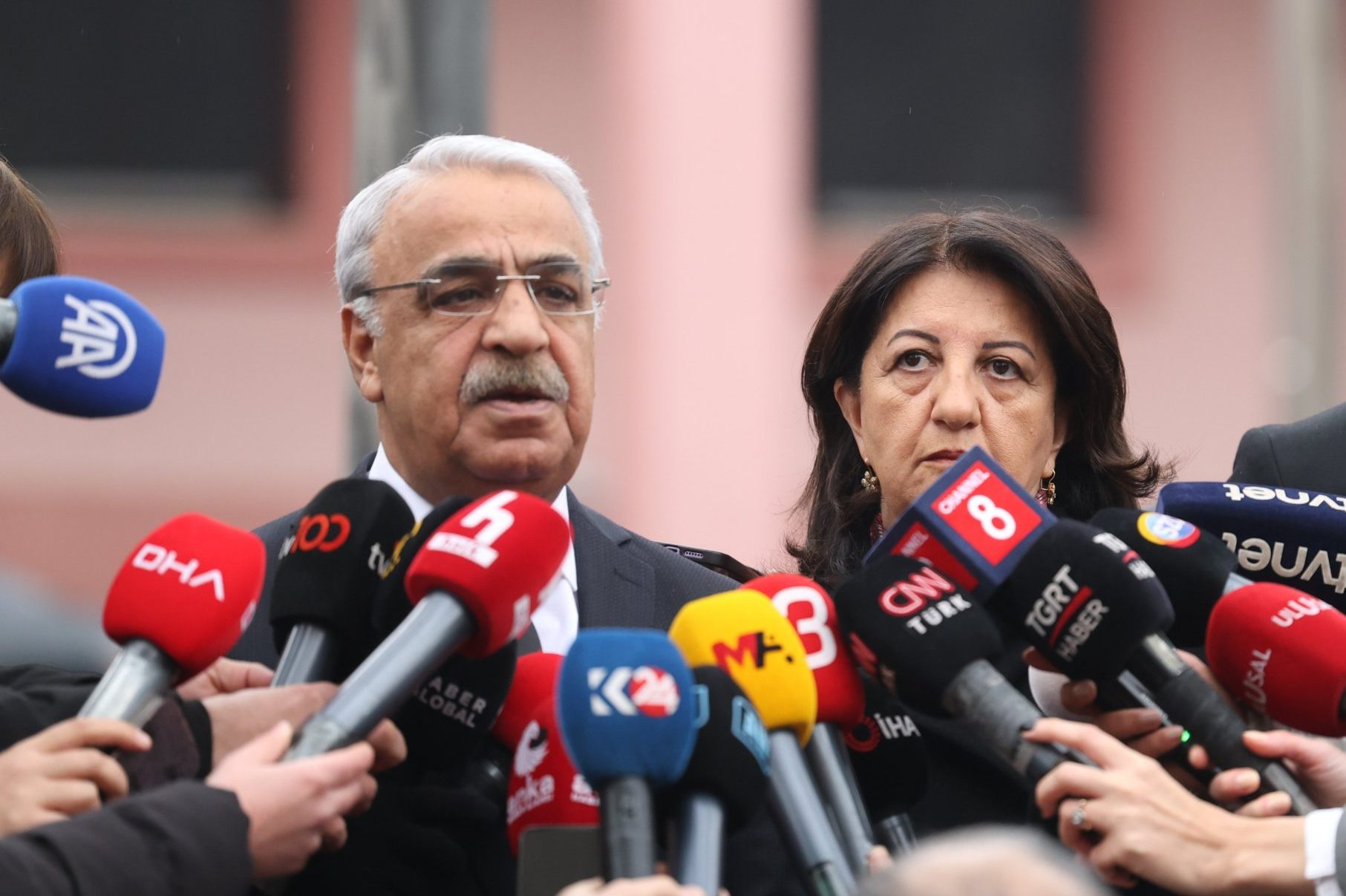
Picture Credits: DEM Party Website
Members of Turkey’s pro-Kurdish DEM Party Imrali Delegation met with President Recep Tayyip Erdogan on February 11 at the Presidential Complex in Beştepe, Ankara. Officials speaking to the press expressed their continued commitment, as the parliamentary commission will soon draft a report to propose potential solutions.
The meeting was attended by Peoples’ Equality and Democracy (DEM) Party’s Pervin Buldan and Mithat Sancar, and Justice and Development Party (AKP) Deputy Chair Efkan Ala and National Intelligence Organization (MİT) Director İbrahim Kalın, who have attended previous such meetings.
Speaking to the press ahead of the meeting, both delegation members emphasized its importance within the framework of the “Peace and Democratic Society Process,” referring to Turkey’s ongoing Kurdish peace talks, which began in October 2024 following an initiative by President Erdogan’s nationalist ally Devlet Bahçeli.
Pervin Buldan stated that the process had reached a significant stage, with the parliamentary National Solidarity, Brotherhood and Democracy Commission now entering the report-writing phase and generating considerable public anticipation regarding the next steps. She noted that four or five key agenda items would be raised with President Erdogan, but declined to disclose details to the press in advance, explaining that a written statement would be issued afterward to share the full agenda and outcomes of the discussions with the public.
Although ahead of the meeting, Pervin Buldan told the press that this would be their “fifth visit” with President Erdogan, the 11 February 2026 encounter was in fact the fourth publicly documented meeting between the DEM Party Imrali Delegation and Erdogan, following the earlier ones on April 10, July 7, and October 30, 2025.
Mithat Sancar noted that significant developments had occurred in both Turkey and Syria since the previous meeting, while the parliamentary commission’s work had reached its final stages. He explained that the delegation would discuss these developments along with other key agenda items with President Erdogan, exchange views, and present their own proposals. Regarding the commission’s joint report, he said the process was still underway and not yet complete; a draft had been shared with the political parties for their input, after which the drafting committee would reconvene to finalize the text.
Sancar stressed that the commission aimed to produce the report through the broadest possible consensus, employing language that would align with the widest segments of society and help alleviate concerns. He noted that a solid foundation for such consensus existed and expressed hope that all political parties would engage constructively with it. He underlined the importance of reaching an outcome aligned with the spirit of the process, one that would ultimately reassure every segment of society. Sancar affirmed that the DEM Party would make every effort to foster agreement and expected a reciprocal commitment from the other parties. Under these circumstances, he added, it was realistic to expect the report to be finalized by the end of February.
Asked about the “right to hope,” a concept discussed in relation to the possible release of Kurdistan Workers’ Party leader Abdullah Ocalan, Mithat Sancar said he would not address specifics. He said the talks would instead focus on developments to date, next steps in the process, and other priority issues.
The roughly three-and-a-half-month gap since the previous meeting on October 30, 2025, marked a period during which Turkey’s Kurdish peace process appeared largely stalled.
The DEM Party Imrali Delegation issued a written statement on February 12, confirming that discussions had focused on regional developments and their implications for Turkey and the Peace and Democratic Society Process. The statement emphasized that both sides reaffirmed their shared commitment to continue the process with determination. It highlighted the need for the Turkish parliament, relevant ministries, and public institutions to intensify efforts to implement concrete and confidence-building measures.
The delegation also stressed the importance of preparing the National Solidarity, Brotherhood, and Democracy Commission’s report with an inclusive approach, providing a solid foundation for democratic reforms and freedoms, and establishing a legal framework that reflects broad consensus and supports Turkey’s democratic future.
The DEM Party concluded by expressing confidence that the meeting would contribute to peaceful coexistence for Turkey and the region and thanked President Erdogan for receiving the delegation.
Changes in 2026
Turkey openly supported al-Sharaa’s forces during operations against Kurdish-held areas, while anti-Kurdish rhetoric intensified in pro-government Turkish media.
The most significant development during this interval was the January 6, 2026, attacks launched by forces of Syria’s transitional government, led by Ahmed al-Sharaa – also known as Abu Mohammad al-Jolani of Hayat Tahrir al-Sham (HTS) – against Kurdish neighborhoods in Aleppo. These attacks quickly escalated into a broader offensive targeting the Kurdish-led Autonomous Administration in northeast Syria (Rojava).
Turkey openly supported al-Sharaa’s forces during operations against Kurdish-held areas, while anti-Kurdish rhetoric intensified in pro-government Turkish media. Although a ceasefire was reached on January 18, 2026, between the Syrian transitional government and the Kurdish-led Syrian Democratic Forces (SDF), Turkey’s stance did not change.
Despite the ceasefire, the Kurdish-majority city of Kobani, near the Turkish border, has remained effectively under siege by transitional government forces and Turkey-backed groups. Turkey has largely ignored humanitarian appeals from the Kurdish side, echoing the crisis during 2014 when ISIS had besieged Kobani.
On February 11, humanitarian aid trucks reportedly reached Kobani after weeks of blocked attempts. Civil society groups in Diyarbakir (Amed) collected supplies for 25 trucks to deliver to the city’s residents who lacked basic goods and faced the harsh cold weather. Initially, the convoy was blocked at the border, but after negotiations and bureaucratic coordination, the trucks crossed via the Kilis-Çobanbey border gate under the supervision of Turkey’s Disaster and Emergency Management Authority (AFAD) and bore Syrian Arab Red Crescent (SARC) emblems. Kurdish journalist Leyla Ebdi documented the convoy’s arrival, highlighting this as a sign that the blockade on Kobani had eased somewhat.
Agreements Not Yet Implemented
The partial easing of the blockade on Kobani also coincided with US lawmakers scrutinizing their government’s Syria policy in congressional hearings.
Despite the January 18 ceasefire and a renewed integration agreement reached on January 29, HTS and Turkey-backed armed groups did not fully withdraw from the city or surrounding villages. Entry and exit remain restricted, internet access is cut, and access to basic necessities is severely limited, indicating that the siege continues in practice. Electricity has been only partially restored after several weeks, shortly before the U.S. Senate began considering the Save the Kurds Act, a bill introduced on January 29, 2026, related to Kurdish issues. Kurdish sources on the ground have described the small improvements as a limited concession intended to alleviate international pressure rather than a genuine resolution.
The partial easing of the blockade on Kobani also coincided with US lawmakers scrutinizing their government’s Syria policy in congressional hearings. During hearings, witnesses called for monitoring mechanisms for the integration agreement and also called for the passage of the Save the Kurds Act, which would impose consequences for violence against Kurdish areas.

Serap Gunes
Serap Güneş is a freelance translator and writer based in Istanbul. She holds a PhD in International Relations and European Politics from Masaryk University, where her research focused on minority rights and EU–Turkey relations. Her work has appeared in both academic journals and independent media outlets.