Turkey Signals Greater Flexibility in Iran–US Nuclear Talks
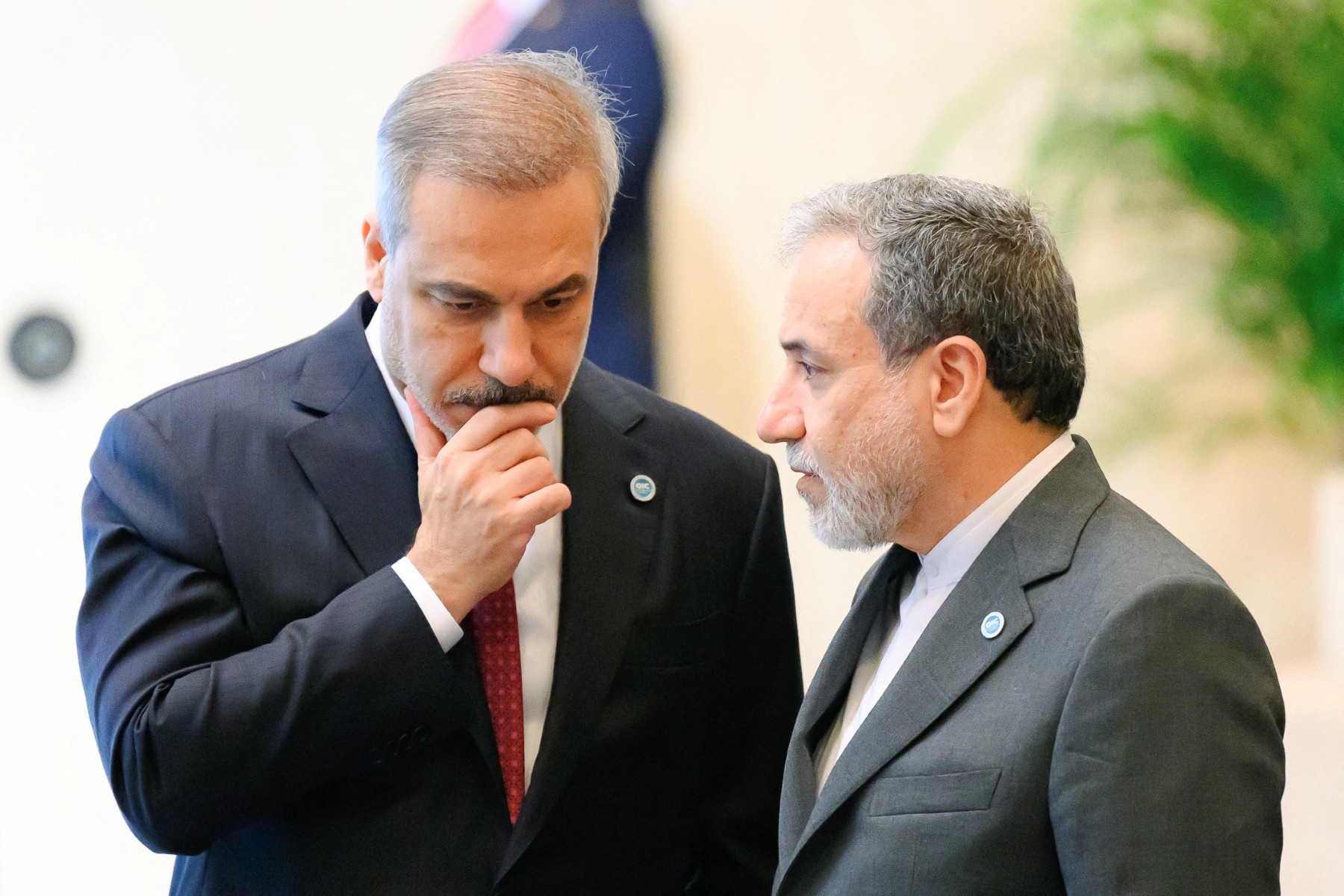
Iran foreign minister Abbas Araghchi (R) speaks with Turkey foreign minister Hakan Fidan (L) in Istanbul, on June 21, 2025. (Photo by Yasin AKGUL / AFP)
Although tensions between Iran and the United States over Tehran’s nuclear programme continue and concerns about a possible escalation in the region remain, there are some signs of progress in the diplomatic efforts to control the crisis. An agreement may be close, according to Turkey’s foreign minister, Hakan Fidan, who optimistically expressed that both sides have shown more flexibility. But Iran’s missile program has proven to be a hindrance in reaching an agreement.
According to Fidan, as reported in the Financial Times, the United States may be willing to accept a certain level of Iranian nuclear enrichment as part of a possible agreement. This position could show greater flexibility from Washington in efforts to revive nuclear diplomacy, which would be a positive development.
Fidan, who has played an indirect role in mediating discussions between the two sides, stated:
“The Iranians now recognise that they need to reach a deal with the Americans, and the Americans understand that the Iranians have certain limits. It’s pointless to try to force them.”
He also said that Tehran might be willing to set limits on enrichment levels and to allow strict inspections, similar to stipulations in the 2015 nuclear deal. However, he also warned that extending the scope of negotiations to issues such as Iran’s missile programme or regional activities could heighten the risk of military conflict.
In an interview with Oman state television, Ali Larijani, Secretary of Iran’s Supreme National Security Council, said that the current negotiations focus solely on the nuclear issue and that Iran has not negotiated with the United States on military or regional matters. He added that the American side has also concluded that the talks should remain confined to the former and that Washington’s traditional approach to this matter is evolving.
Informal negotiations between Iranian and American representatives took place last week in Muscat with Omani facilitation. The meetings are described as the first serious engagement since tensions rose in recent months, and both sides are reported to have characterized them as constructive.
Turkey’s foreign minister, Fidan, added that he believes Tehran “genuinely wants to reach a real agreement.” He also expressed a positive outlook on the role regional powers, including Turkey, could play, saying they could help address security issues without hindering nuclear negotiations. Fidan also stressed that rebuilding trust between Iran and its neighbours will be necessary for any lasting agreement.
Turkey, Qatar, and Egypt have proposed that Iran should fully stop enrichment for three years, transfer enriched uranium stock (for example, around 440 kilograms enriched to 60 percent) to a third country, and later limit enrichment to about 1.5 percent.
Such proposals from Turkey and other regional actors for transferring Iranian enriched uranium abroad seem similar to a plan Turkey proposed together with Brazil in 2010 to solve the nuclear crisis. However, that plan failed to receive support from Moscow and Washington and consequently failed.
These negotiations are taking place at a time when U.S. President Donald Trump has deployed naval forces in the region and has stated that he is considering deploying a second aircraft carrier to the Middle East. Following his meeting with the Israeli prime minister, Trump wrote on Truth Social that, although no agreement has yet been reached, he insists that negotiations must continue. At the same time, he warned that “If they cannot, we will just have to see what the outcome will be. Last time Iran decided that they were better off not making a Deal, and they were hit with Midnight Hammer – that did not work well for them.”
Iran’s Supreme National Security Council secretary also said that if nuclear talks succeed, there might be further discussions about other disputed areas. But he said that this is not certain at this point, and that people should not expect too much. He said Iran has not yet received a clear proposal from the United States and that the talks in Oman were mostly a back-and-forth of messages and a test of the other side’s seriousness. According to him, Tehran’s desire is for the swift resolution of disputes, not the prolongation of negotiations. At the same time, as negotiations progress, the head of Iran’s Strategic Council on Foreign Relations, Jalal Dehghani Firoozabadi, warned that if war breaks out in the region, global energy security could be at risk and the Strait of Hormuz could be closed. He told domestic media that, in such a scenario, China would suffer the greatest economic damage and that, for this reason, Beijing supports negotiations. He added that Russia is also against a war and is trying to prevent escalation.

The Amargi
Amargi Columnist