Former US Ambassador Peter Galbraith Pushes Federal Constitution as Syria’s Last Shield
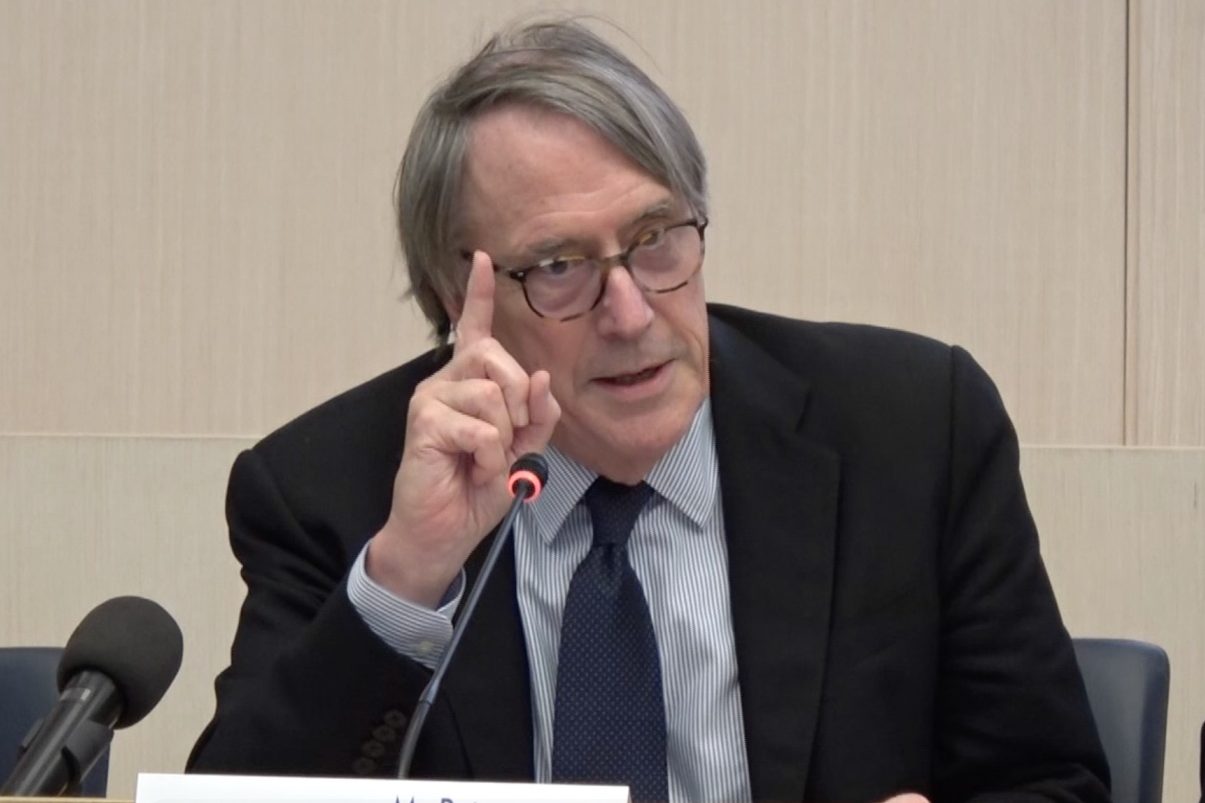
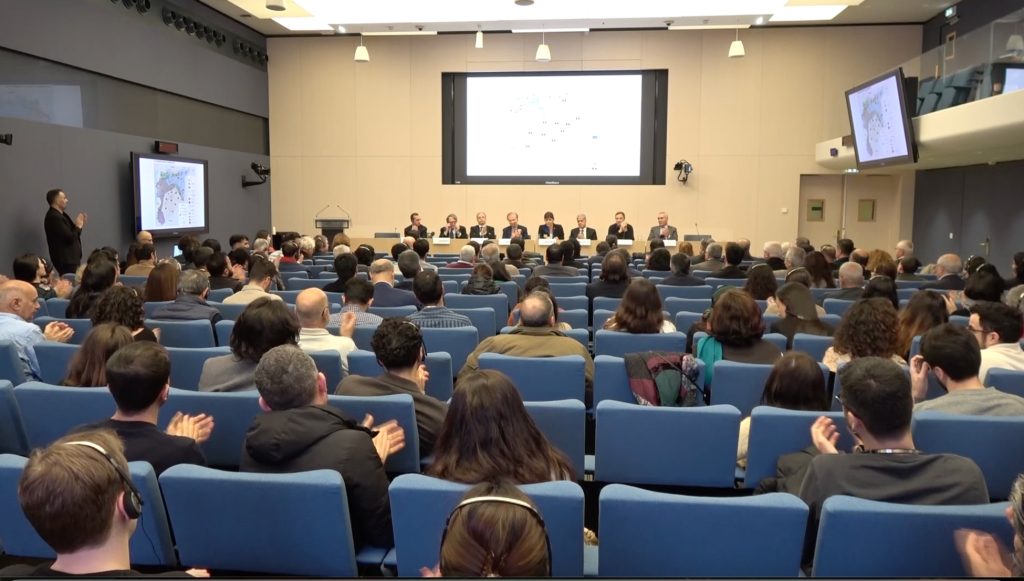
Peter Galbraith, former U.S. ambassador and constitutional expert, speaking at the French Senate on December 13, 2025, during a conference on Syria’s future and federalism.
Photo by Chris Den Hond / The Amargi
The Amargi, French Senate, Paris.
Speaking at the French Senate on December 13, 2025, former U.S. ambassador and constitutional expert Peter Galbraith warned that Syria’s only viable defense against a renewed era of centralized, authoritarian rule lies in a federal constitution written by an elected constitutional assembly, arguing that without such a process, the country’s de facto divisions will harden and its minorities and secular majority will be left unprotected.
In a vaulted hall of the French Senate on December 13, a rare convergence of Western diplomats, French lawmakers, and Kurdish officials delivered a blunt message about Syria’s future: without federalism, the country risks sliding back into authoritarianism, no matter how moderate the language of its new rulers may sound abroad.
The colloquium, which focused on the future of Northeast Syria (Rojava) and postwar Syria, brought together figures who have shaped constitutional debates from Iraq to Washington — and those now seeking to influence Syria’s next political chapter. Again and again, speakers returned to one central argument: Syria’s diversity cannot be governed through centralization, and only a genuinely elected constitutional process can prevent renewed conflict.
Peter Galbraith, the former U.S. ambassador to Croatia and one of the architects of Iraq’s post-2003 constitutional framework, laid out the case in stark, almost mathematical terms.
“We’ve had a lot of discussion of what should be written in the future Constitution of Syria and the desire for federalism,” Mr. Galbraith said. “And there is, in my view, only one way that the minorities of Syria, the secular part of the population of Syria, will ensure the result they want: through an elected Constitutional Assembly. Just like what happened in Iraq. In fact, it’s the normal way in which constitutions are written.”
He dismissed any model in which Syria’s future would be shaped by decree or elite bargaining.
“They are not imposed by a dictator, they are not negotiated between a dictator and some elements of a parliament that he himself appoints,” he said. “It is an elected Constitutional Assembly.”
“And there is, in my view, only one way that the minorities of Syria, the secular part of the population of Syria, will ensure the result they want: through an elected Constitutional Assembly. Just like what happened in Iraq. In fact, it’s the normal way in which constitutions are written.”
Mr. Galbraith argued that federalism is not a marginal demand but a demographic inevitability if Syrians are allowed to vote freely.
“What will happen if you have an elected Constitutional Assembly in Syria? It’s simply mathematics,” he said. “Thirty-five to forty percent of the Syrian population are minorities: Kurds, Alawites, Druze and Christians. If you have an elected assembly, there is a significant group of voters that is going to want a federal system. I know we use the word decentralized, but the correct word is federal.”
He then turned to Syria’s Sunni majority, challenging the widespread assumption that it would naturally favor Islamist rule.
“Secondly, of the 50 to 60 percent of Sunnis, a large number of Sunni Syrians are secular. They do not want an Islamic state,” he said. “So if the West is interested in not having an Islamist state in Syria, the best guarantee is to have the future of Syria decided by an elected Constitutional Assembly.”
Until such a process exists, Mr. Galbraith warned, Syria’s fragmented reality will persist — by default.
“What happens if you don’t have an agreement? That’s very simple,” he said. “The current situation continues until there is a new constitution decided by the Syrian people, meaning that Rojava continues with the SDF running its own institutions. The same with Suweida.”
He acknowledged that this interim reality would require pragmatic arrangements.
“There may have to be some bargaining on practical issues — for example on recognizing the degrees granted by the universities of Rojava, issues about property, marriage, these kinds of questions,” he said. “But the existing situation remains until there is a new agreement.”
Drawing on his experience in Iraq, Mr. Galbraith offered a cautionary lesson — and a strategy.
“The key to the success of the Iraqi Kurds in the constitutional negotiations in Iraq in 2005 is that they were so well prepared,” he said. “In fact, they put forward a program in 2004 which involved minimal powers to the central federal government.”
He described provisions that fundamentally reshaped Iraqi federalism.
“A provision that said, ‘If it doesn’t deal with one of those very limited powers, Kurdistan law is superior to Iraqi law.’ It included the right of the Kurdistan Parliament to amend and to cancel any Iraqi law within the Kurdistan Region. And of course to maintain their own institutions — the presidency, the parliament — but also to have their own regional guards, meaning that they have their own military force.”
The outcome, he added, was shaped as much by Kurdish preparation as by the absence of others.
“They achieved this because they were so well prepared, and to be frank, the Shia majority was not well prepared,” he said, echoing a remark by Falah Mustafa Bakir, a senior official of the Kurdistan Regional Government. “As Kak Falah Mustafa here said: ‘The Sunnis were absent.’”
Mr. Galbraith’s advice to Syrian Kurds and their allies was explicit.
“So be prepared,” he said. “Have detailed proposals about what you want in terms of decentralization or federalism. What exactly do you want in terms of the police — who controls the police, how are the governors chosen, what are the local parliaments or councils, who controls the educational system.”
He lingered on a subject often overlooked.
“Very few people pay attention to who appoints the judges,” he said. “What law applies?”
Legal diversity, he noted, is not a threat to unity.
“You can have different laws in different parts of the country,” he said. “That’s true in Iraq. Kurdistan has different laws than apply in the Arab parts of the country. That’s true in the United States. The criminal law in my state of Vermont is different from the criminal law in Texas. We don’t execute anybody.”
Political pressure on Syria’s external actors was also a recurring theme. Thomas Porte, a member of the French National Assembly from La France Insoumise and head of the parliamentary Kurdish study group, called for an end to foreign military occupations.
“It’s a goal today to build a new Syria, but I am committed to the respect of the territorial integrity of Syria. Part of Syria is occupied by Turkey and another part, the Golan Heights, is occupied by the Israeli state.”
Mr. Porte, who visited Rojava in January 2025 to mark the tenth anniversary of Kobane’s liberation from the Islamic State, highlighted legislative efforts in Paris.
“We proposed two resolutions in the French Parliament,” he said. “One to lift the defense secret on the assassination of the Kurdish comrades in Paris in 2013.”
The second resolution, he said, aimed directly at Ankara.
“We proposed another resolution to ask France to seriously increase the pressure on Turkey in order to support the peace process launched by Abdullah Öcalan to lay down arms and to disband the PKK,” he said. “It demands a counterpart from Turkey, but until now the Turkish government is not up to the situation.”
Other speakers offered warnings from inside Syria. Perwin Yousef, co-chair of the Democratic Union Party (PYD), said the Syrian regime’s conciliatory rhetoric was largely performative.
She argued that while Damascus presents moderation to foreign interlocutors, its message at home remains unchanged: the Syrian Democratic Forces must disarm.
Falah Mustafa Bakir, an adviser to the presidency of Kurdistan Region President Nechirvan Barzani, urged Kurdish political forces to speak with a single voice in negotiations with Damascus, warning that fragmentation would weaken their constitutional leverage.
And Meral Danış Beştaş, a member of Turkey’s Parliament for the pro-Kurdish DEM Party, challenged Western governments to rethink how they view Syria’s Kurds.
She argued that they should be seen not only as the West’s most effective ground force against the Islamic State, but as proponents of a broader democratic, pluralist, and feminist political project — one that could serve all of Syria.
By the end of the day, the conclusion of the Senate colloquium was unambiguous: the alternative to a federal, decentralized Syria is not stability, but the continuation of authoritarian rule under new branding — and the slow unraveling of the fragile gains achieved since the war.

Chris Den Hond
Chris Den Hond is a journalist and anthropologist, with special interest in people's struggle, Kurds and Palestinians. He worked for Med TV (later MedyaTV, RojTV and now Sterk TV) from 1997 till 2006 and made reports about Rojava for Le Monde Diplomatique and OrientXXI since 2017. He follows closely the actuality in Turkey, Syria especially in regard to the Kurdish people.