The Iraqi Presidency: From a Kurdish Prize to a Battlefield Between KDP and PUK
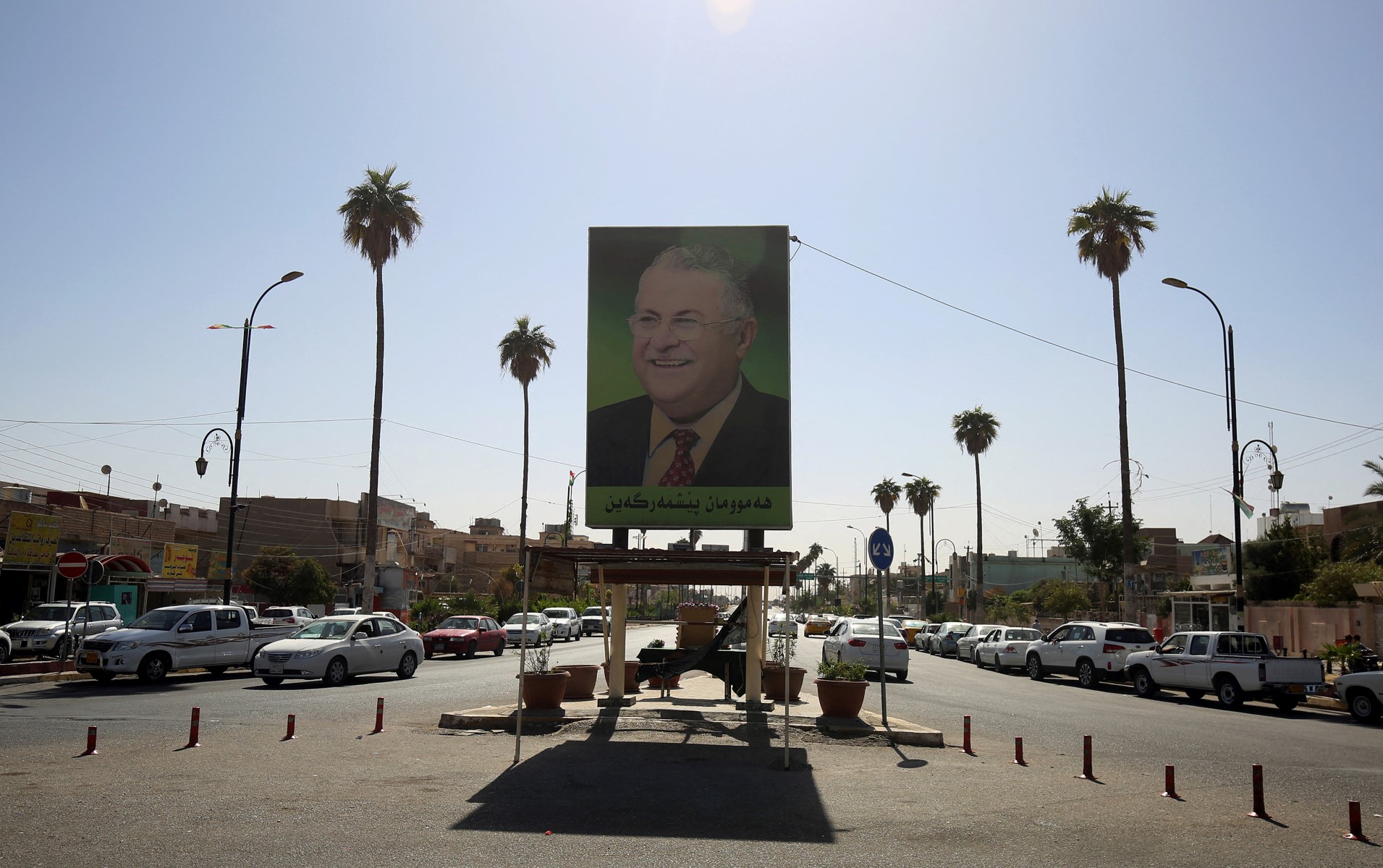
A picture taken on October 18, 2017, shows a portrait of late Iraqi president Jalal Talabani placed at a crossroad in the northern Iraqi city of Kirkuk. (Photo by AHMAD AL-RUBAYE / AFP)
Since 2003, Iraq’s political system has rested on an unwritten but rigid power-sharing formula designed to prevent the collapse of the post-Baath state. Under this arrangement, the country’s three most powerful positions were divided along ethno-sectarian lines: the prime ministership to Shi’a Arabs, the speakership of parliament to Sunni Arabs, and the presidency to the Kurds. Though never codified in the constitution, this formula became the backbone of elite consensus politics in Baghdad.
The presidency, while largely ceremonial, carries significant symbolic and procedural weight. Under the Iraqi constitution, the president formally tasks the nominee of the largest parliamentary bloc with forming a government, a role that gives the office leverage at moments of deadlock. For the Kurds, holding the presidency was not merely about symbolism but about securing a federal guarantee inside an otherwise Arab-dominated state.
For more than a decade, this arrangement appeared stable. In practice, however, the Kurdish share of the presidency depended less on Kurdish unity than on Baghdad’s internal calculations. That tension has only deepened since the death of Jalal Talabani in 2017.
From Kurdish Consensus to Kurdish Fragmentation
For years, the Patriotic Union of Kurdistan (PUK) treated the presidency as its political entitlement. Talabani’s stature as a consensus-builder, respected in Baghdad, Tehran, Ankara, and Washington, allowed the Kurds to present a unified front even when internal rivalries were intense. In the meantime, under an unwritten agreement between the KDP and the Kurdistan Democratic Party (KDP), the post of Kurdistan Region President was held by Masoud Barzani until he was forced to resign following the failed 2017 referendum on the Kurdistan Region’s independence.
In both 2018 and 2022, Kurdish disunity allowed Arab Shi’a blocs to shape the outcome of what was supposed to be a Kurdish choice.
That unity began to fracture after Talabani’s death. Without a figure capable of imposing discipline across the Kurdish house, negotiations between the PUK and the KDP repeatedly collapsed. Instead of agreeing on a single nominee, the two dominant Kurdish parties began fielding rival candidates, shifting the final decision from Erbil and Sulaimaniyah to competition in Baghdad and determining which party could guarantee more seats in the Iraqi parliament.
This change proved decisive. In both 2018 and 2022, Kurdish disunity allowed Arab Shi’a blocs to shape the outcome of what was supposed to be a Kurdish choice. The presidency, once a negotiated Kurdish position, increasingly became a byproduct of broader Iraqi bargaining.
Strong Candidates, Weak Presidents
The paradox of Iraq’s presidency since 2017 is striking: as Kurdish candidates became more divided, the individuals who ultimately won the office became politically weaker as in the case of former President Barham Salih on one hand, and on the other, this competition helped the weak unsuitable politicians to raise to the throne as in the case of former president Fuad Maasum and current President Latif Rasheed.
Barham Salih represented the last attempt to restore presidential gravitas. Internationally respected, fluent in the language of statecraft, and deeply embedded in both Kurdish and Iraqi politics, Salih was seen as a serious statesman. Yet even his victory in 2018 came only after fierce intra-Kurdish competition. For months after his appointment as President of Iraq, Barham Salih was denied entry to Erbil, as Masoud Barzani believed he had been defeated in Baghdad by Salih.
Kurdish disunity produced presidents who were more symbolic caretakers than active political brokers.
What followed marked a shift. Fuad Masum and, later, Latif Rashid, both respectable figures but lacking Salih’s political weight, emerged not because they commanded strong backing, but because they were acceptable compromises. Their strength lay precisely in their weakness: they posed no threat to dominant Shi’a blocs and no challenge to the informal balance of power. In the meantime, within the KDP and the PUK, these two presidents remained subordinate to the PUK’s new leadership and to Masoud Barzani.
In short, Kurdish disunity produced presidents who were more symbolic caretakers than active political brokers.
The Current Contest: Experience vs. “Energy”
That same logic is now playing out again, but with sharper edges.
The KDP has put forward Fuad Hussein, Iraq’s current foreign minister, a veteran diplomat, multilingual technocrat, and longtime KDP insider. For the KDP, Hussein represents institutional memory and international credibility, while he will always consult Masoud Barzani and Masrour Barzani on any critical decisions. More importantly, he is reportedly backed by understandings with key Shi’a actors, including figures close to the Shi’a Coordination Framework’s nominee for the post of Prime Minister, Nouri al-Maliki.
Yet Hussein’s candidacy faces a structural vulnerability: age and perception. In Baghdad’s rumor mills, the presidency is increasingly framed as requiring stamina—constant travel, negotiation, and presence. Critics quietly question whether an octogenarian can meet these demands amid regional volatility.
The PUK has responded with a generational contrast. Its candidate, Nizar Amedi, embodies administrative continuity with renewed energy. Having worked for years inside the presidential palace under Talabani, Masum, and Salih, Amedi brings deep procedural knowledge without carrying the baggage of high-level factional politics. He is completely supported by PUK’s President Bafel Talabani, while being rejected by the KDP’s President Masoud Barzani.
Crucially, the PUK argues that Amedi is more acceptable to both Sunni and Shi’a blocs, particularly within the Coordination Framework, making him the more “electable” option in parliament. In the meantime, the PUK believes this post belongs to them, as the Kurdistan Region President’s post remains in the hands of the KDP. Additionally, the PUK demands that both positions in Baghdad and Erbil be treated as a single package, while the KDP holds a different view. This has paralyzed the KRG cabinet formation, and the parliament has failed to convene since it was elected over a year ago.
When Kurdish Disputes Become Baghdad’s Leverage
What distinguishes the current contest from earlier rounds is how deeply Kurdish rivalries have become entangled with Iraqi power struggles.
The KDP and PUK are no longer merely lobbying Baghdad; they are competing inside Baghdad’s own fault lines. Shi’a factions are split over the prime ministership. Sunni leadership is fractured amid legal and political battles. Each side sees the Kurdish presidency not as an end in itself, but as a bargaining chip.
This dynamic explains why Kurdish unity matters less than before, and why it matters more than ever. With Sunni blocs largely aligned and Shi’a factions divided, the Kurdish presidency has become one of the few remaining variables in government formation.
In effect, Kurdish fragmentation has transferred veto power to non-Kurdish actors.
Who Are the Candidates and Why So Many?
The current race includes 18 approved candidates, narrowed from more than 80 initial applications. Beyond the main party nominees, the field includes independents and lesser-known figures who are betting on a familiar scenario: if the KDP and PUK fail to agree, they may again turn to a “third option.”
This is how compromise candidates emerge, not through strength, but through exhaustion.
Latif Rashid, the incumbent, remains technically in the race despite having prepared a withdrawal letter that has not yet been submitted. Other names circulate for the same reason: Kurdish deadlock creates opportunity for figures who would otherwise stand little chance.
How the Election Actually Works
Under Article 70 of the Iraqi Constitution, the presidency is elected by the Parliament. The rules are strict:
A quorum of two-thirds of parliament, 220 out of 329 MPs, is required.
In the first round, a candidate must win two-thirds of the total membership.
If no one succeeds, the top two candidates proceed to a second round, in which a simple majority determines the winner.
This structure makes coordination essential. In fragmented parliaments, reaching quorum alone can be difficult, let alone securing 220 votes in the first round. This is why the scheduled convention of parliament for Tuesday was cancelled, as 94 MPs signed a petition to delay, which would practically paralyze the session. As a result, most presidential elections spill into second rounds, where political bargaining intensifies. In the Iraqi parliament, even buying MPs’ votes has become a phenomenon.
The Deeper Question
At stake is not only who occupies the palace in Baghdad, but what the presidency has become.
…recent presidents have been unable to even bring the Kurdish blocs together
Once envisioned as a Kurdish safeguard within the Iraqi state, the office now risks becoming a procedural placeholder held by whoever offends the fewest actors rather than whoever can defend federalism, mediate crises, or assert constitutional norms. The late former President, Jalal Talabani, had enormous power in Iraqi politics and could bring almost all the conflicting sides together; however, recent presidents have been unable to even bring the Kurdish blocs together.
The core question facing Iraq’s parliament is therefore not whether the next president will be Kurdish, that is all but guaranteed, but whether the office will be filled by a guardian of rights or merely another resident of the presidential palace.
In today’s Iraq, that distinction matters more than ever.

The Amargi
Amargi Columnist