Turkish opposition leader Özel: Syrian Kurds’ Demands Should Not Be Treated as Threats
As violence against Kurds in Syria continues, Özgür Özel, leader of Turkey’s main opposition, the Republican People’s Party (CHP), issued a series of statements distancing his party from militarized approaches to the Kurdish issue and stressing diplomacy, equal citizenship, and democratic political solutions.
“To those once again trying to construct a discourse that equates ‘Kurd’ with ‘terrorist,’ we say this: do not harm our Kurdish brothers and sisters in Turkey, or their relatives in Syria.”
Speaking at the CHP’s parliamentary group meeting on 20 January 2026, Özel addressed the latest developments in Syria, saying the party felt a responsibility toward all communities there and emphasizing historical and social ties that transcend borders. “We are sensitive to the Kurds in Syria, just as we are sensitive to the Alawites there,” he said. “We see the Arabs, Kurds, Turkmen, Druze, and Alawites in Syria as our brothers and sisters, our relatives, our neighbors, and an inseparable part of us.”
He also criticized what he described as an aggressive and exclusionary tone in public discourse, saying: “To those once again trying to construct a discourse that equates ‘Kurd’ with ‘terrorist,’ we say this: do not harm our Kurdish brothers and sisters in Turkey, or their relatives in Syria.”
Özel’s remarks were aimed at a broader discourse that has gained traction since January 6, which frames attacks on Kurds in Syria as legitimate “security” operations and “counterterrorism” measures — a line of argument circulated not only in pro-government media but also in some outlets that identify themselves as part of the opposition.
Beginning on 6 January 2026, forces affiliated with Syria’s transitional government under Ahmed al-Sharaa launched a heavy offensive on Kurdish-majority neighborhoods in Aleppo. The operations, marked by sieges and heavy bombardment, led to substantial civilian casualties and forced thousands of residents to flee their homes.
Tuncer Bakırhan, co-chair of Turkey’s pro-Kurdish Peoples’ Equality and Democracy (DEM) Party, sharply criticized both the attacks and the language used in Turkey to justify them. He also condemned the labeling of Kurdish forces as “terrorists” and the portrayal of the operations as security measures. Calling the assault on Aleppo a “crime against humanity” and an “attempt at ethnic cleansing,” Bakırhan said those who express outrage over Gaza while remaining silent on Aleppo were complicit in turning the former into “another Gaza.” He warned that “there can be no real talk of brotherhood in a political climate where Kurdish suffering is presented as a national victory.”
Özel said the AKP-led government is deliberately trying to push the CHP out of the peace process and then portray the party as “anti-process,”
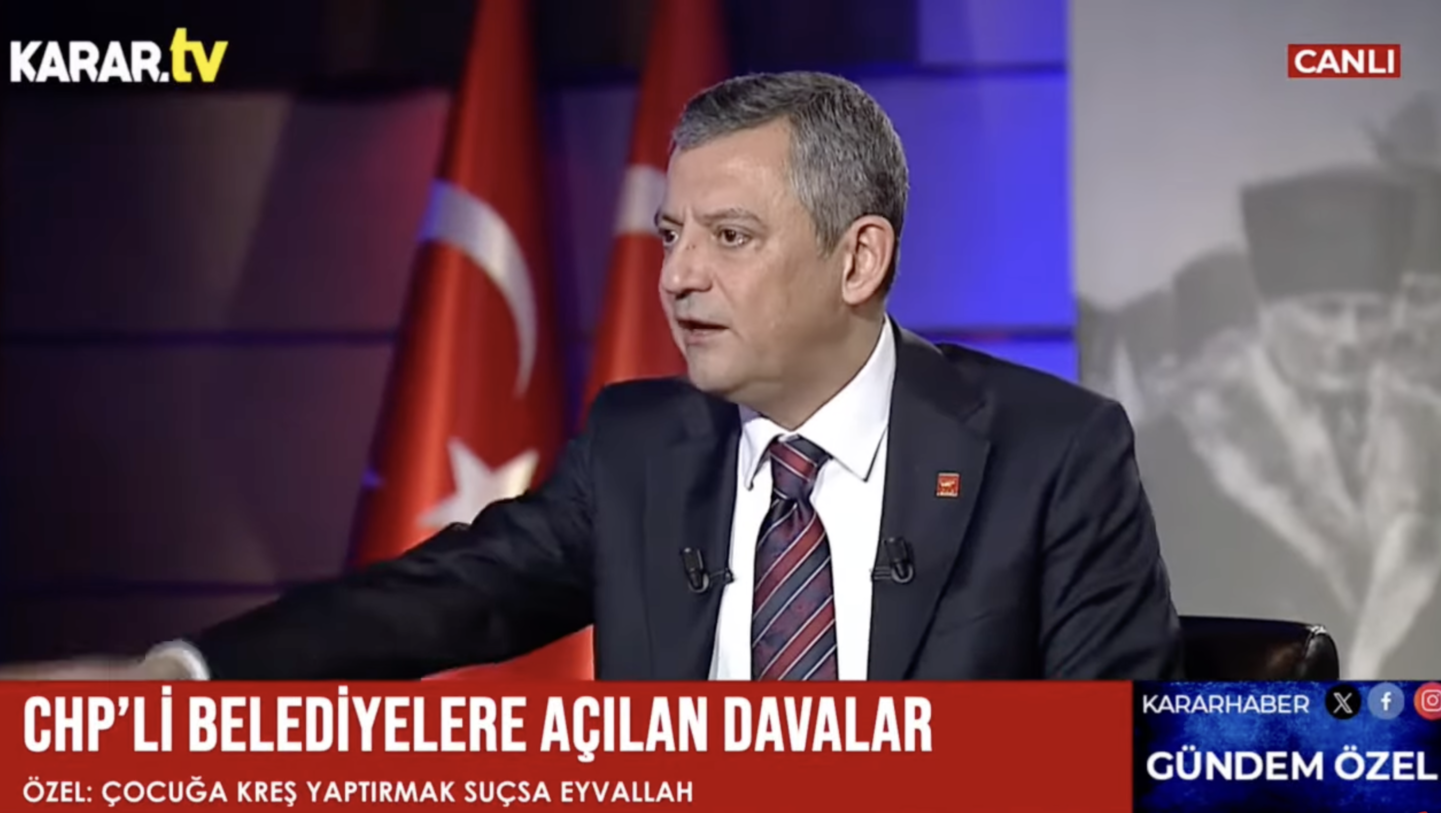
Özel’s calm, non-militaristic tone was even more evident two days later, on January 22, during an interview on Karar TV. There, he spoke about the Kurdish issue in Turkey and the wider region in terms that echoed long-standing Kurdish demands of democratic politics, equal citizenship, and meaningful local governance, without treating those demands as a threat.
Özel said the AKP-led government is deliberately trying to push the CHP out of the peace process and then portray the party as “anti-process,” referring to the government’s talks with the Kurdish movement. He argued that security-driven actions, including heavy-handed pressure on the CHP, are aimed at forcing the party away from the table so that, if the process succeeds, the CHP can be depicted as having stood outside it, and if it fails, as having opposed it. Özel said the CHP rejects conflict-oriented, security-first policies and supports a peaceful, democratic resolution to the Kurdish issue.
Özel also questioned approaches that ignore or delegitimize the presence of Kurds in Syria. “There are more than two million Kurds living there,” he said. “Why should their search for democracy, based on equal citizenship and local government, be seen as something excessive?” Framing Kurdish demands for democratic participation and local governance as security threats, he argued, serves neither peace in Turkey nor stability in the region.
“What benefit do I get from Damascus or Aleppo being burned or destroyed?”
Özel spoke sharply about rhetoric circulating in parts of the pro-government media and affiliated online networks. “There is an approach among some commentators and paid social media trolls that treats all Kurds in Syria as terrorists,” he said. Referring to discussions around the composition of the Syrian Democratic Forces (SDF), Özel said it is widely known that the number of Kurdish fighters is around 30,000 to 35,000. “Some people thought it was 100,000,” he said. “When they heard it was 30,000-35,000, the reaction suddenly became, ‘then let’s wipe them all out.’” He rejected that approach outright. “We should not ‘wipe’ even a single Kurd,” Özel said. “Why would anyone adopt such a mindset?”
Özel said protecting Syria’s territorial integrity while guaranteeing minority rights are not contradictory goals. Ensuring constitutional rights for Kurds, Turkmen, Arabs, Druze, and Alawites within a unified Syrian state, he argued, would be a gain for everyone. “What benefit do I get from Damascus or Aleppo being burned or destroyed?” Özel asked. “What benefit do you get?” Conflict across the border, he warned, does not remain contained. “If there is a disaster in your neighbor’s house, it reaches you too,” he said. “If your neighbor cooks a good meal, you get a share of it.”
Since Özgür Özel was elected CHP leader in November 2023, the party has signaled a move away from its long-standing nationalist reflexes, often marked by suspicion toward Kurdish political demands, toward a more pluralist and democratic approach. That shift produced tangible political results in the March 2024 local elections, when the CHP entered into an open, election-based alliance with Kurdish opposition forces through the “Urban Consensus” partnership with the DEM Party. The outcome was a historic victory for the CHP: it won 14 metropolitan municipalities and emerged as the largest party nationwide for the first time since 1977.
Two broader developments help explain CHP’s transformation. The first was the political rupture created by the 2013 Gezi Park protests, which reshaped opposition politics and broadened demands for democratic reform. The second was the Kurdish political movement’s shift from a single-issue focus toward a nationwide democratic agenda, a strategy that allowed the DEM’s predecessor, the Peoples’ Democratic Party (HDP), to enter parliament in 2015—first time for a pro-Kurdish party.
Still, questions remained about how sustainable the CHP’s shift on the Kurdish issue would be, given its long-standing embrace of a security-centered framework aligned with the official state narrative. The CHP’s decision not to appoint a representative to the parliamentary delegation to İmralı to meet with Abdullah Öcalan was widely seen as a step back that reinforced those doubts. While the party defended the move on democratic grounds, many Kurds—given Öcalan’s central role—interpreted the decision as a failure to cross a symbolic threshold that would have clearly signaled a break with old nationalist reflexes.
Against this backdrop, Özel’s recent statements can be read as a strong signal that the CHP has not surrendered to the government’s effort to frame it as “anti-process,” and that it remains committed to a political language that moves beyond security-based thinking on the Kurdish issue.

Serap Gunes
Serap Güneş is a freelance translator and writer based in Istanbul. She holds a PhD in International Relations and European Politics from Masaryk University, where her research focused on minority rights and EU–Turkey relations. Her work has appeared in both academic journals and independent media outlets.