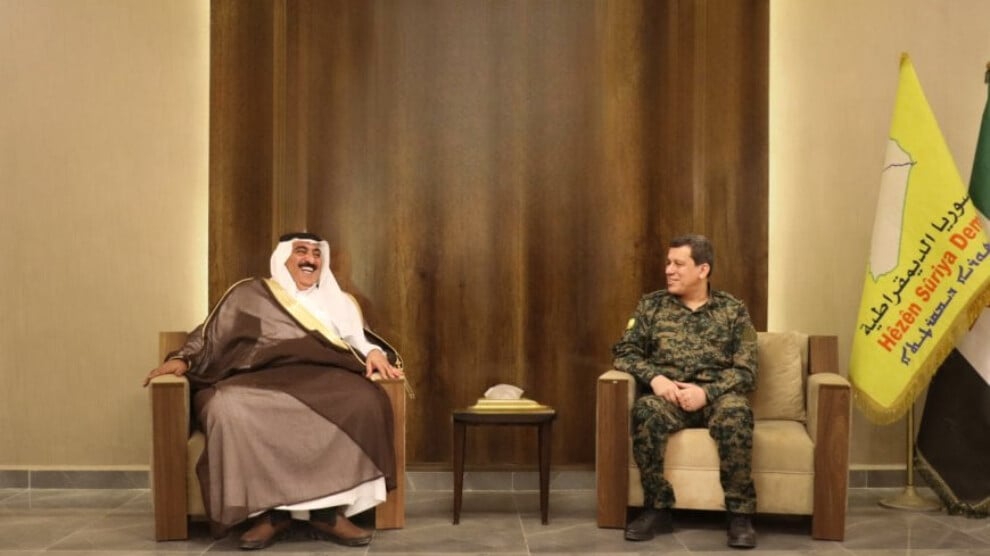
In the Zagros Mountains, PJAK’s Co-chair Says Iran has “Already Collapsed” and Warns Against “Another Dictatorship”
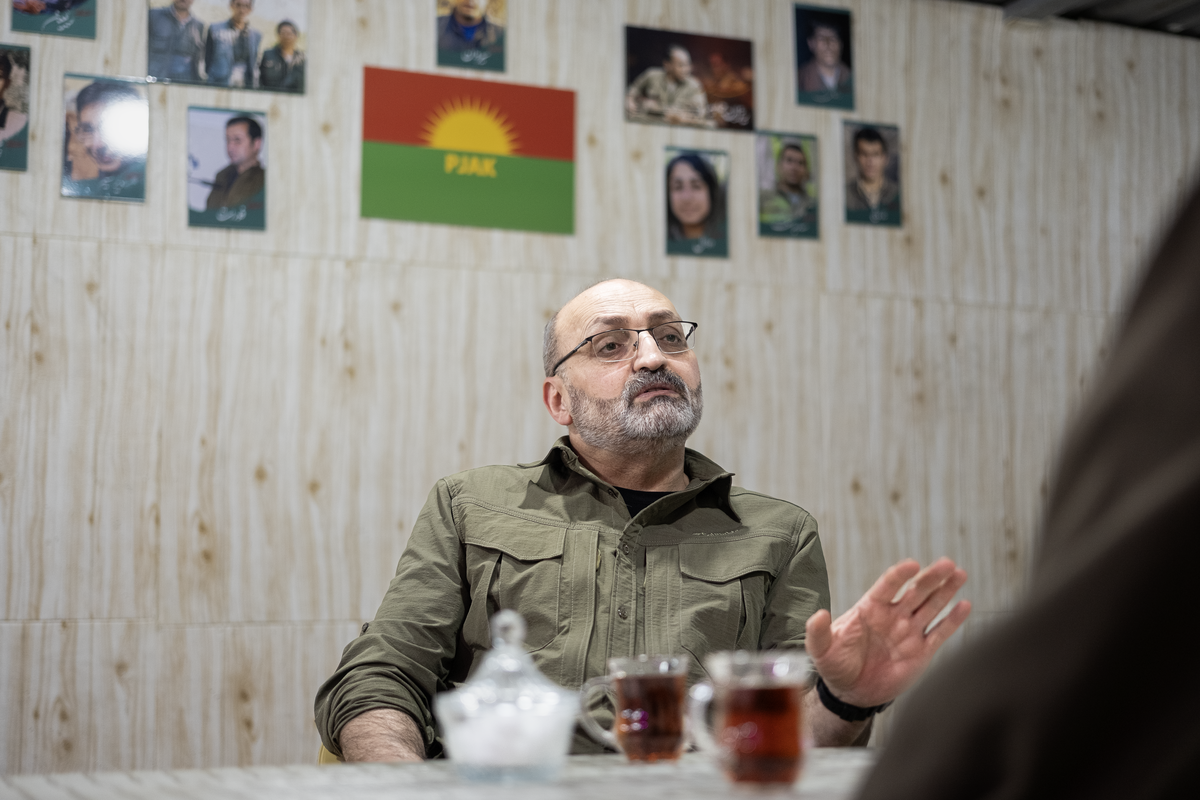
Picture Credits: Rebaz Majeed
Zagros Mountains, Iraq-Iran border – In a hideout headquarters deep in the Kurdish mountains along the Iran-Iraq frontier, Amir Karimi, the co-chair of the Kurdistan Free Life Party (PJAK), describes today’s Iran as a state still standing on paper but hollowed out in practice.
“The Islamic Republic of Iran has already collapsed,” he told Rebaz Majeed, a member of The Amargi’s editorial board, during a rare on-the-record conversation in the Zagros Mountains. “It still has a state, a bureaucracy, and a force. But… what is keeping the Islamic Republic standing now is only violence and force, nothing else.”
Karimi’s argument is not that Tehran has lost its coercive capacity, but that it has lost something more important: social legitimacy. He likens the Islamic Republic to “a human who is brain-dead; only their heart is beating.” In his telling, the current wave of unrest, intensified by severe communication blackouts, has forced Kurdish parties in Iran to rethink old rivalries and to prepare for a future in which the Kurdish question is either negotiated into a new political order or crushed by yet another centralised state.
What follows is PJAK’s view, in Karimi’s words, on the Iran protests, Kurdish unity, Reza Pahlavi, relations with Washington, Israel, PJAK’s connection to the PKK, and where the group claims to be strongest inside Iran, alongside what it says it wants from Tehran.
“A rigid 20th-century system is collapsing”
Karimi situates Iran’s turmoil inside a wider regional shift that, he argues, is eroding the classical nation-state model across the Middle East, a model he describes as “one-color, one-authority, one-language, and one-flag”.
“The Kurds have been placed outside the law, outside politics, and outside everything,” he said. “They were either supposed to assimilate or perish.”
In his view, the weakening of centralised state structures can create an opening for Kurds to move from survival to politics, but only if the direction of change is democratic.
“Now, as the structure of the nation-state is disintegrating… it is undoubtedly an opportunity for the Kurds,” Karimi said. “However, if the changes move in a direction that does not lead to democracy… it is certainly a danger to the Kurds.”
To make the warning concrete, he points to Syria, where Kurdish gains in self-administration now face pressure from a reasserting central state.
“We see this in Syria… a central state is returning to power,” he said, “which imposes its one-color… and political Islam on the Kurds… and because international law only recognizes the state, it creates a danger.”
“The Islamic Republic is like a closed North Korea”
Karimi’s sharpest language is reserved for the current protests in Iran, which are volatile and difficult to verify amid communication cutoffs and reports of heavy arrests and killings.
“For the Islamic Republic to remain standing, it has cut off all communication possibilities,” Karimi said. “Why? So it can comfortably massacre the people.”
He said he believes a large-scale killing may already have occurred, even if details remain obscured.
“We have serious doubts that it has carried out a major massacre,” he said. “It is not clear; things will become apparent later. But the current appearance of the Islamic Republic is like a closed North Korea, and it is unknown what is happening.”

Karimi argues that the regime’s earlier legitimacy tools – religion and nationalism – have decayed, leaving only repression.
“Previously, the Islamic Republic would use issues like religion, Iranian nationalism… to legitimize itself,” he said. “We can now say that is also gone.”
But he also signals a fear that regime collapse alone is not a guarantee of a better order. He returns repeatedly to the lesson of 1979: the fall of one dictatorship can produce another.
“We have the experience… in 1979… the Shah was gone, and everyone was happy,” Karimi said. “But after that, a much more dangerous dictatorial system came. Will such a thing not happen this time? There is no guarantee at all.”
“No single force can impose itself on the others”
Against this backdrop, Kurdish parties in Iran recently issued a joint statement about steps toward a shared political framework, a move that surprised many observers after years of fragmentation.
Karimi presents it as both a necessity and a self-critique.
“This time, another attempt took place,” he said. “We created a dialogue room… and a means of convergence. This is an effort; it is not something that has been fully created… Yes, it is the start of an effort.”
For Karimi, the bigger shift is a rejection of the old pattern of Kurdish party competition, where unity was often framed as one group dominating the rest.
“The Kurdish political field… has reached the conviction that it can no longer be this way,” he said. “No single force can impose itself on the others.”
He also links unity to a strategic calculation: that Kurds in Iran must help shape the broader democratic trajectory, or risk being decided for by forces in the political “center”.
“The Kurds must become a force that can raise their issue and solve it,” Karimi said. “But to raise their issue, they must be able to do so in a democratic atmosphere. Otherwise, there is no place for them.”
In his framing, Kurdish unity is not only about Kurdish leverage, but about preventing a post-Islamic Republic Iran from reverting to “one-color identity” politics.
“We feel more like a political organizing force than an armed force”
Rebaz pressed Karimi on PJAK’s presence inside Iran, not just ideologically, but geographically and operationally.
Karimi declined to give numbers for fighters or supporters, insisting PJAK cannot “take statistics” on sympathy. But he laid out a map of where the group claims to be active.
“We are strong” in places that older Kurdish parties did not reach, he said, pointing to “the Kurmanji… regions” and “Mako regions,” and adding: “In the Mukryan region, in the Sanandaj and Ardalan region, Hawraman, we have been active in all those regions for years.”
He also stressed outreach beyond the traditional Kurdish political centers of Iranian Kurdistan, naming western and southwestern areas with different dialects and histories:
“In the regions of Kermanshah, Ilam, Lorestan, Khorramabad… we have organizations in those places as well,” he said.
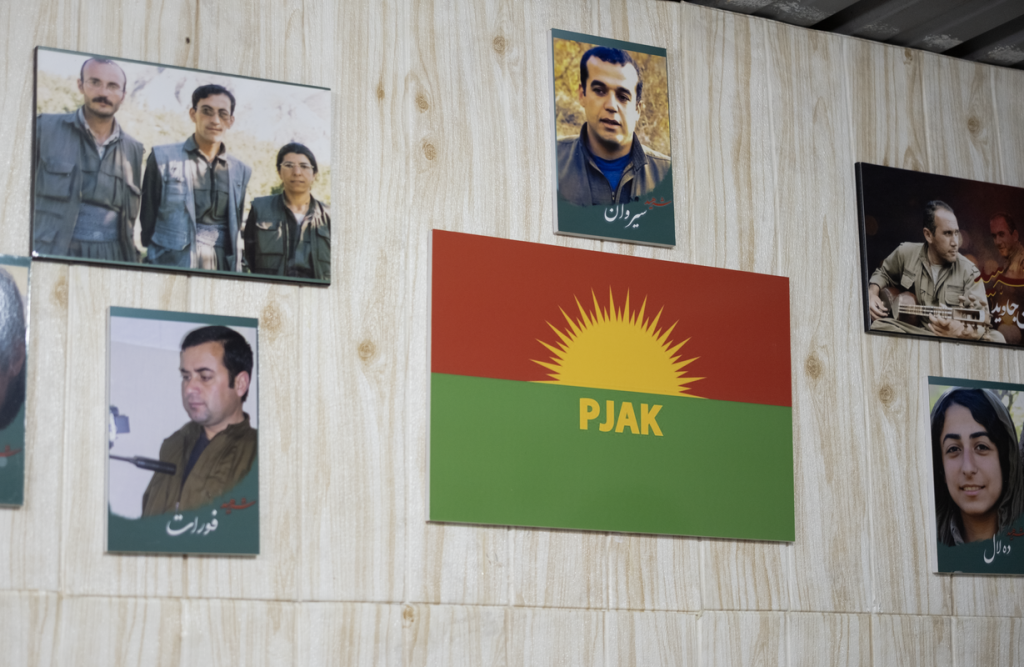
Yet Karimi pushes back against an image of PJAK as primarily a guerrilla group.
“We feel more like a political organizing force than an armed force,” he said. “Armed action for us is a means of protection, not… the key to open the lock and solve the problem.”
The concept he returns to is “Legitimate Self-Defense” as a belief that communities should not be left defenceless before state violence.
“Every society must protect itself,” he said. “It is not right that all means of violence should be in the hands of the state… society must have the force to defend itself.”
“Our line is what we call the Third Way”
Regarding the United States, Karimi confirms contacts and political discussion, while drawing a bright line against becoming a tool of foreign policy.
“PJAK has a set of relationships, dialogues, and discussions with forces,” he said. “Only the extent to which we cooperate with which force… those are very, very different.”
He frames PJAK’s conditions as twofold: support for democracy and support for Kurdish rights within a democratic system.
“If a force, a state, supports that and works toward that, we can cooperate with them,” he said. “Cooperation is never unconditional.”
Karimi also warns against the Kurdish historical experience of being used by big powers and then abandoned.
“Many times, the Kurds have cooperated with world powers, but they have been harmed,” he said. “Our history is full of such things.”
He describes PJAK’s overall stance as a “Third Way”, rejecting both the Islamic Republic and the idea of a foreign-led solution.
“We are truly against that dictatorial state,” he said. “But we also do not believe that an external force will come… to save us… We read their interests.”
In practical terms, he insists PJAK will engage in diplomacy, but will not become “someone’s soldier”.
What Amiri Says on Possible Israel Ties?
On Israel, Karimi is cautious, saying PJAK does not have an “open relationship” or cooperation, while leaving the door open to engagement if the aim is democratic change and rights for “the peoples”.
“Not that we have not had any relations, but the relations have not been at a level to understand what they want,” he said. “We do not have an open relationship with Israel now. We also do not have cooperation.”
However, Karimi added, “But we also say, if any force supports democratic change and the rights of peoples, we are open to that.”
His biggest concern is not Israel per se, but what he interprets as Israel’s tilt toward Reza Pahlavi, the exiled son of the last Shah, a figure Karimi views as a potential vehicle for restoring authoritarian rule.
“Something concerning… is Israel’s support for Reza Pahlavi,” he said. “The people… do not want to fall into another dictatorship.”
Karimi argues that exiled leadership projects risk being imposed “from outside,” and that this would “make things worse” for Iran’s diverse society, including Kurds.
“When you see a leader being created from outside and something being imposed,” he said, “if that person becomes the leader and rules in Iran, it will certainly make things worse.”
He says any outside actor, including Israel, should address those fears and clarify it is not trying to manufacture Iran’s future leadership.
On PKK-PJAK relationship: “Being of the same thought does not mean there is a decision-making center”
One of the most sensitive questions Rebaz raised was PJAK’s relationship to the PKK and Abdullah Öcalan’s ideological framework, particularly “Democratic Confederalism”, and the accusation that PJAK is merely a branch without independent will.
Karimi dismisses the claim as a past “propaganda” campaign by rivals who feared PJAK’s organising model and Öcalan’s ideas about society-led politics.
“PJAK does not take instructions from anywhere,” he said. “Being of the same thought does not mean there is a decision-making center.”
To make the point, he compares ideological families in European politics, parties that share a label but make independent decisions.
“There is the Socialist Party, the Social Democratic Party… in Sweden. Those are all Social Democrats,” he said. “Who makes decisions for them?”
At the same time, Karimi does acknowledge coordination across Kurdish movements, not as command-and-control, but as an effort to avoid Kurdish factions being pulled into regional states’ agendas against each other.
“We have a kind of coordination,” he said, “at the level that we have one issue: the Kurdish issue.”
He argues that the lack of Kurdish coordination historically forced movements into state bargains that harmed other Kurdish regions, a pattern he says PJAK wants to break.
In a notable aside, Karimi references the PKK’s dissolution and claims PJAK’s survival disproves the idea that it was controlled by the PKK.
“Now that the PKK has dissolved itself… If it were true, with the dissolution of the PKK, we should have ceased to exist,” he said. “But we are stronger than before.”
“State plus Democracy”: what PJAK says it wants from Iran
Karimi frames PJAK’s end goal as neither secession nor a return to rigid nation-states, but a deep decentralisation he associates with “Democratic Confederalism,” “Democratic Nation,” and a “Democratic Republic of Iran.”
“We have a program for Iran called the Democratic Republic of Iran,” he said. “It is a state, but a decentralized system transcending the nation-state. There is self-governance for the peoples.”
He argues this model is meant to prevent future ethnic conflict in a diverse country where borders and populations overlap.
“We cannot, and we do not have the right, to expel any nation from any geography,” he said. “They also do not have that right against us.”
In Kurdish terms, he says PJAK seeks legal and political recognition that allows Kurds to “govern themselves,” while also keeping Kurds central to Iran’s broader democratic transition.
“The Kurds must be able to govern themselves,” Karimi said. “Kurds must be powerful inside Iran. They must be at the center. They must not isolate themselves.”
He also says PJAK’s Kurdish nationalism is “democratic,” not rooted in denying others.
“PJAK is a national movement… But a democratic national movement,” he said. “Not… hollow nationalism… based on hatred for the other… It is based on coexistence.”
And he repeatedly returns to a core demand: moving the Kurdish issue out of the security file and into politics, “a political field… legal… where there is a parliament… where the society can organize itself.”
Karimi, in the meantime, did not rule out the possibility of addressing the Kurdish question through dialogue with the Islamic Republic of Iran:
“The Kurdish dialogue with the Islamic Republic has also not been very fruitful until now. Other parties have experience. We have not had a direct dialogue with the Islamic Republic so far, but we have always said this. We are ready for a democratic resolution of the Kurdish question.”
A movement betting on society and fearing the next strongman
From a mountain headquarters far from Tehran, Karimi offers a clear PJAK storyline: the Islamic Republic is surviving on violence, Kurdish parties are converging because the stakes are existential, and the real battle is not only against one regime but against a century-old nation-state model.
Yet behind the ideological language is a practical fear that is easy to read: that Iran’s unrest could end in a return to centralised authoritarianism, whether under a new religious order, a revived nationalism, or an exiled figure marketed as a saviour.
“There is no guarantee at all,” Karimi warned, recalling 1979. In PJAK’s view, that guarantee has to be built, through Kurdish unity, society-led organising, and a decentralised political blueprint that can survive whatever comes after the Islamic Republic.
To read the full transcript, you can go here, or if you want to watch the interview, click here

The Amargi
Amargi Columnist
![[Amargi Exclusive] In the Zagros Mountains, PJAK’s Co-chair Says Iran has “Already Collapsed” and Warns Against “Another Dictatorship”](https://cms.theamargi.com/wp-content/uploads/2026/01/ressize-Screenshot_2026-01-12_at_15.05.23-1.png)