Iraq on High Alert as ISIS Prison Breaks in Syria Spark Security Fears
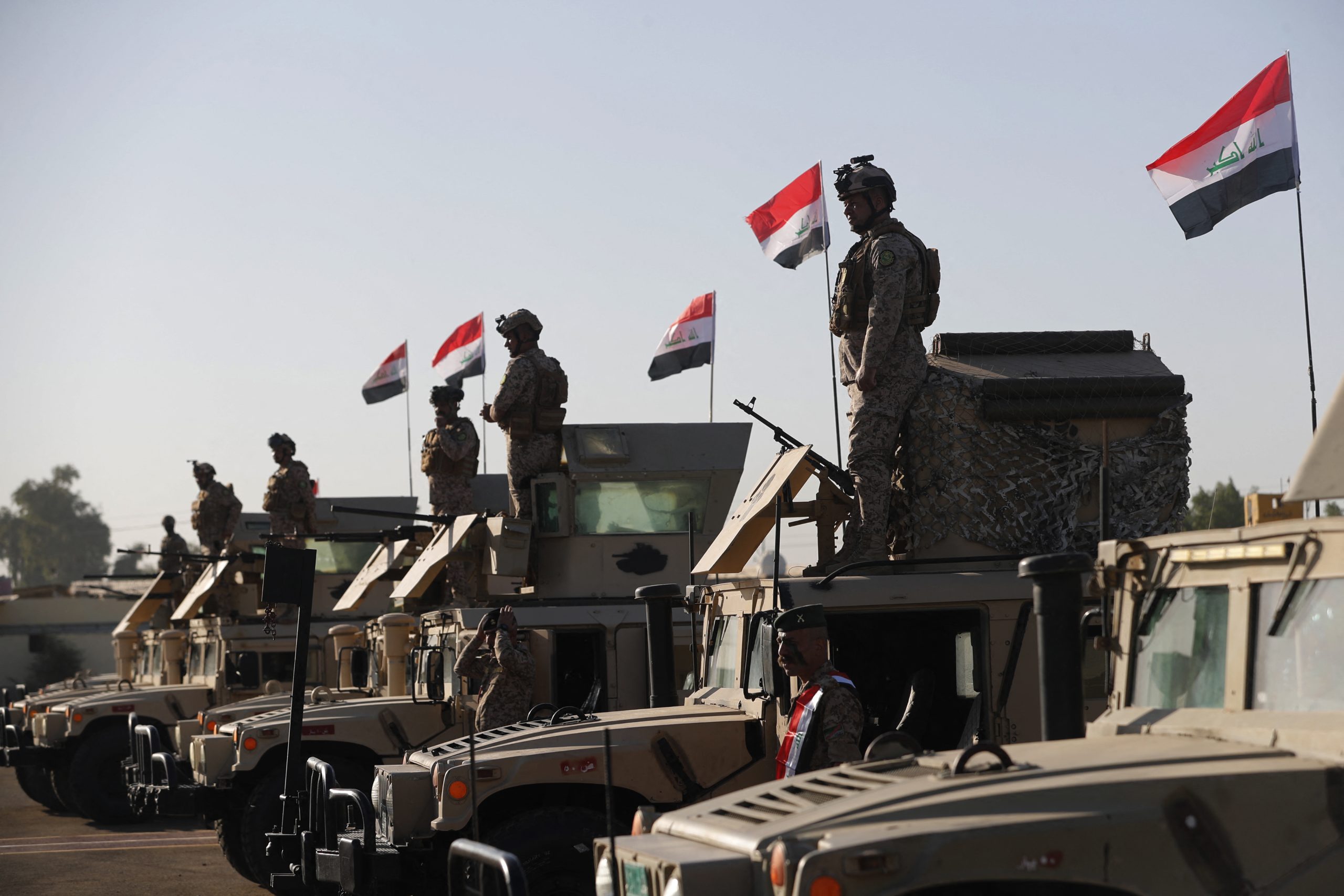
Iraqi troops attend a training session on October 6, 2025 at the Taji military base, north of Baghdad, under the supervision of French forces as part of a bilateral agreement between the two courtiers. Photo by AHMAD AL-RUBAYE / AFP
Iraq is tightening its border security due to increased violence and political uncertainty across neighboring Syria. The move, supported by Kurdish, Sunni, and Shia sides, comes in the aftermath of alarming reports that thousands of Islamic State militants have been released from detention facilities in Syria’s northeast amid the latest clashes and prison breaks.
In recent days, Mohammed Shi’a al-Sudani, Iraq’s prime minister and commander-in-chief of the armed forces, ordered a series of urgent security measures, including high-level military meetings, a rare field visit to the Syrian frontier, and direct communication with Kurdish leaders in Syria.
Iraqi officials say the goal is clear: prevent militants freed in Syria from slipping back into Iraq and reigniting an insurgency that the country has spent years trying to suppress.
Iraqi leaders fear that any increased operations by extremist networks, who often cooperate with remnants of Iraq’s former Baath regime, could once again plunge the country into the kind of mass violence seen between 2014 and 2017.
The immediate concern stems from the deteriorating security situation in Syria, particularly in areas controlled by the Syrian Democratic Forces (SDF). Amid attacks, shifting front lines, and internal unrest, several detention facilities holding former ISIS fighters were reportedly breached, allowing thousands of detainees to escape. Many of those released, Iraqi security officials say, are Iraqi nationals captured after 2015 during operations against the terrorist group.
Images and videos circulating on Iraqi Arabic social media this week appear to show armed men from Mosul, Kirkuk, Diyala, Anbar, Salahaddin and even Baghdad claiming they were freed in Syria. Some are known to Iraqi authorities and have long been considered highly dangerous.
Iraq is governed by Shiite-led political forces representing the country’s majority, who view Sunni Islamist jihadism as an existential threat to both the state and Shiite religious authority. Iraqi leaders fear that any increased operations by extremist networks, who often cooperate with remnants of Iraq’s former Ba’ath regime, could once again plunge the country into the kind of mass violence seen between 2014 and 2017.
Regarding the situation in Syria, Fuad Hussein, Iraq’s Deputy Prime Minister and Foreign Minister, stressed the need to declare a ceasefire between government forces and the SDF, and to take all necessary measures to bring Syrian prisons under control to prevent the escape of ISIS militants. He made these remarks during a meeting with Joshua Harris, the Chargé d’Affaires of the United States Embassy in Iraq, underscoring the urgency of coordinated action to avert further security threats.
Iraq’s Interior Minister, Abdul Amir al-Shammari, reassured the public that the Iraqi-Syrian border is fully secured by layered military deployments, stressing that border guards remain on high alert and that intelligence operations are ongoing to prevent any infiltration from Syria.
Against this backdrop, Prime Minister Sudani convened what his office described as an “urgent and extraordinary” security meeting with senior army commanders and leaders of the Kurdish Peshmerga forces. According to officials briefed on the meeting, he ordered that the Iraqi-Syrian border be treated as a “red line,” raising surveillance to the highest possible level and instructing troops to respond firmly to any movement that threatens border security.
In a notable gesture of coordination, Iraqi authorities pledged full logistical and operational support to the Peshmerga, emphasizing joint responsibility for securing the front. “The army and the Peshmerga are in the same trench,” one official said, summarizing the tone of the meeting.
“The wise in Iraq must now recognize the importance of these events and sense their danger and take a comprehensive national stance to not allow a return to the past.”
The prime minister also traveled to the border town of al-Qaim, where he inspected troop deployments along the frontier with Syria and chaired a security meeting at the headquarters of the Seventh Division, responsible for guarding a critical stretch of the border in Anbar Province. Joined by the interior minister, the army chief of staff, senior intelligence officials, and commanders of the ground and air forces, Mr. al-Sudani was briefed on existing challenges, military readiness, and contingency plans.
The sense of urgency has also been vocalized by Sunni politicians, as Mohammed al-Halbousi, President of the Taqadum Party and former speaker of Iraqi parliament, posted on his X account addressed Iraqi leaders: “The wise in Iraq must now recognize the importance of these events and sense their danger and take a comprehensive national stance to not allow a return to the past.” He emphasized that it is important to preserve “the security, political, and social stability” achieved after Iraq was free of ISIS.
Iraqi Officials Work to Keep Country Calm
Despite the escalating rhetoric, Iraqi officials have sought cool down internal worries. The prime minister has repeatedly stressed that, while the risks are serious, militant groups no longer possess the capacity to mount large-scale attacks inside Iraq and that the borders are “fully secured.” Still, the intensity of recent measures suggests deep unease in Baghdad.
That unease is shared by powerful political figures. Muqtada al-Sadr, the influential Shiite cleric, issued a warning that militants escaping from Syria could infiltrate Iraq if Iraqi authorities do not remain vigilant, urging security forces to act decisively.
At the same time, Prime Minister al-Sudani has sought to directly engage with actors inside Syria. In a phone call with Mazloum Abdi, General Commander of the SDF, the Iraqi prime minister discussed the rapidly evolving situation and its implications for regional security. According to a readout of the call, Mr. al-Sudani emphasized the need for dialogue at what he called a “sensitive and dangerous stage,” urging political arrangements that protect the rights of all Syrian communities while preserving Syria’s unity and preventing terrorists from exploiting the chaos.
For Iraq, the stakes are existential. Since declaring victory over the Islamic State in 2017, the country has struggled to rebuild institutions and restore trust in areas devastated by years of war. Officials fear that a renewed influx of experienced militants could destabilize fragile Iraqi provinces and inflame sectarian tensions.
The developments also underscore a broader regional dilemma. With Syria fragmented and international attention focused elsewhere, local actors are increasingly left to manage the consequences of conflict spillover. Iraqi officials have called on the international community to intervene urgently to halt the fighting in Syria, warning that continued violence risks setting the entire region ablaze.
Security analysts say the situation highlights a persistent vulnerability: detention camps and prisons in northeastern Syria have long been viewed as ticking time bombs. “These facilities were holding thousands of hardened militants with minimal international support,” said one regional analyst. “Once control weakens, the fallout is almost inevitable, and Iraq is the first to feel it.”
Signs of an ISIS re-emergence are already being felt in northern Iraq, according to Iraq’s Ministry of Defense’s statement issued on 21 January, which announced the arrest of a senior ISIS operative in Kirkuk who had previously held leadership roles within the group and was involved in transferring militants across borders. Officials said the case underscores the persistence of ISIS networks and the ongoing security threat they pose despite the group’s territorial defeat.
For now, Iraqi forces remain on high alert along the desert border, scanning for movement and reinforcing checkpoints. Whether these measures will be enough depends largely on how events unfold across the border, in a Syria where instability once again threatens to reshape the region’s security landscape.

The Amargi
Amargi Columnist