Rojava Is the Kurds’ Existential Struggle
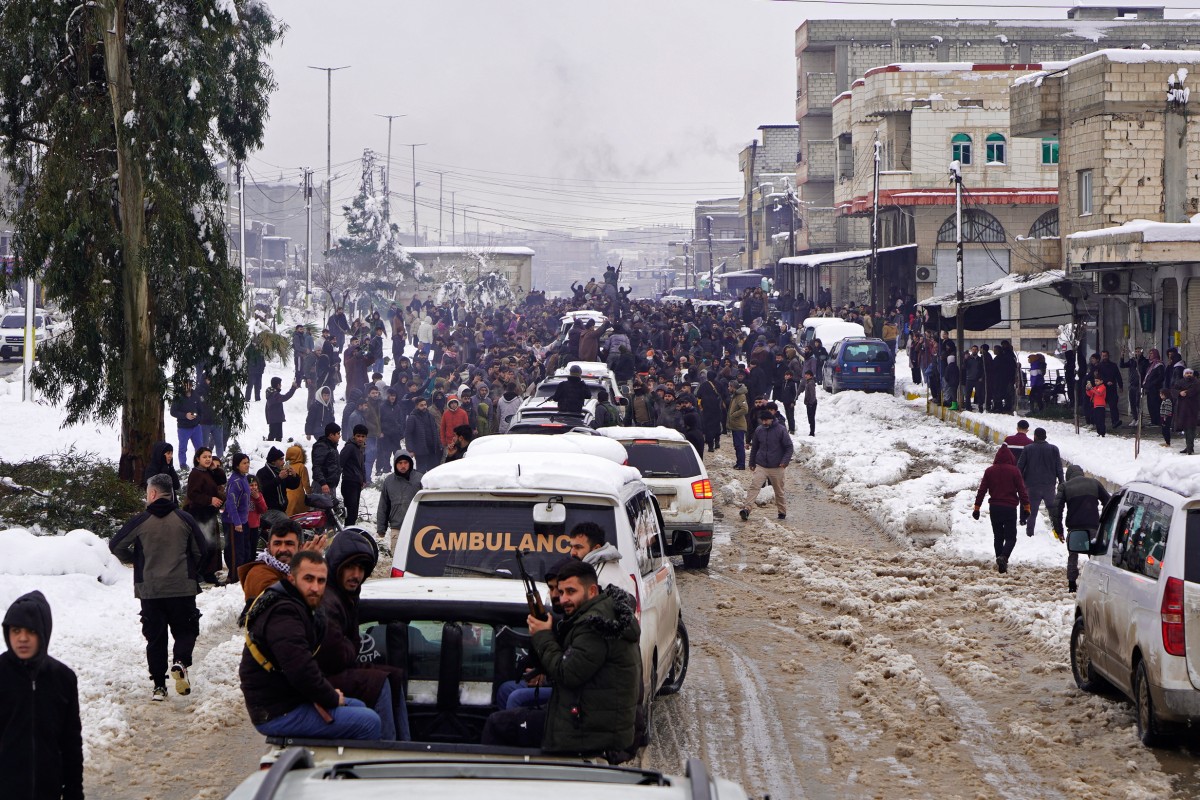
Members of Kurdish-led Syrian Democratic Forces (SDF) arrive at the Kurdish-held city of Ain al-Arab, also known as Kobane on January 23, 2026 (Photo by AFP)
What is unfolding today in Rojava is not another chapter in Syria’s long war. It is an existential struggle over whether Kurds can exist as political beings and sustain the conditions that make life possible. This is not a conflict to be resolved by shifting frontlines or temporary ceasefires, but a confrontation with the very foundations of Kurdish political existence.
The war waged by Hay’at Tahrir al-Sham (HTS), which assumed control of the Syrian state following the fall of the Assad regime, embodies a project of state-building rooted in the most violent traditions of nationalism: the systematic erasure of the political conditions under which Kurdish life can exist.
That logic was chillingly illustrated in a statement issued by the Syrian Ministry of Endowments on January 18, which references Saddam Hussein’s Anfal Campaign of the 1980s – a campaign widely recognized as genocidal against Kurds in Iraqi Kurdistan. Such language does not merely justify violence; it normalizes it. Within this framework, killing Kurds is not a tragedy to be mourned, but a necessity of nation-state building.
This reality is felt not only by Kurds in northern Syria, but across Kurdistan and throughout the diaspora. The defense of Rojava is therefore experienced as the defense of life itself: the right to live as Kurds.
Why Did the Kurds not Integrate?
Although Syria has formally moved beyond Ba’athist rule, the denialist mentality toward Kurds that defined the Ba’athist state remains deeply embedded in its institutions and governing imagination.
Over the past year, multiple rounds of negotiations took place over the integration of the Kurdish led-Syrian Democratic Forces (SDF) into the Syrian state as envisioned by the new powerholders in Damascus. The SDF proposed a model of political integration that would preserve elements of self-administration and regionally organized security forces. The central government rejected this outright, insisting instead on individual integration into state institutions. While this position from Damascus may appear reasonable, it has historically been the initial steps and foundation of statist denial of Kurdish existence: individualization has long been the formula through which states in the region have managed the assimilation of Kurds.
Stripped of collective identity and political organization, this approach reflects a deeply entrenched nationalist tradition in Syria – and across the region more broadly – that denies Kurds the institutional conditions necessary for collective life. When Kurds do assert the right to political life, they are immediately framed as separatists or foreign agents threatening national unity. Although Syria has formally moved beyond Ba’athist rule, the denialist mentality toward Kurds that defined the Ba’athist state remains deeply embedded in its institutions and governing imagination.
The “New” Syrian State
It is striking how quickly the international community accepted HTS and facilitated its transformation into what is effectively a one-party, strongman state. This acceptance is especially perplexing given that one of the central failures of Ba’athist Syria that precipitated the war devastating the country over the past fifteen years was precisely its one-party structure and the violent enforcement of an exclusive nationalist vision. It is equally striking given that Ahmed al-Sharaa – the political heir of al-Qaeda in Syria – carried a ten-million-dollar bounty on his head only months ago.
…he normalized the state system – and, in turn, he was normalized by the state system.
Yet al-Sharaa successfully aligned himself with the international state system. By presenting himself as Syria’s interim president and rhetorically limiting his ambitions to the country’s existing borders, he reassured key state actors that he would not disrupt the established order. In doing so, he normalized the state system – and, in turn, he was normalized by the state system.
International recognition granted him the monopoly on violence afforded to sovereign states. Once recognized, his use of force ceased to be framed as insurgent violence and became “state security.” His primary challenge now lies not in opposition from other states – many of which have accepted him into their fold – but in mounting international public opinion and the growing mobilization of Kurds worldwide, who are demanding an end to violence and meaningful political recognition.
Rojava as an Alternative Political Horizon
The Rojava model stands in stark contrast to this vision of centralized, exclusionary sovereignty. Grounded in democratic forms of self-organization that recognize the plurality of social existence, it seeks to build a political system in which difference is not merely tolerated, but actively organized around. Ethnic, religious, and gender diversity are not treated as threats, but as the foundation of a shared political life.
In a region shaped by authoritarianism, sectarianism, and enforced homogeneity, Rojava offers a hopeful yet fragile alternative: a future in which the “other” is not an enemy to be eliminated, but an inseparable part of collective existence. It challenges not only the Syrian state, but the deeper assumption that stability requires uniformity and that sovereignty must be built on exclusion.
That is precisely why Rojava is targeted. It represents an alternative compass for the future – one that exposes the violence at the heart of the nation-state model in the region. Its existence undermines the claim that there is no alternative to authoritarian centralization, and in doing so, it becomes intolerable to those seeking to rebuild Syria on familiar foundations of denial.
The struggle for Rojava is therefore both an existential struggle for the Kurds and a struggle over whether a different future … can be imagined at all
What makes the current situation an existential issue is that it concerns the survival of a political idea: that coexistence is possible, that pluralism can be institutionalized, and that life does not have to be organized around domination. The struggle for Rojava is therefore both an existential struggle for the Kurds and a struggle over whether a different future – one that moves beyond nationalist destruction – can be imagined at all.

Joost Jongerden
Joost Jongerden (PhD) is an Associate Professor of Rural Sociology at Wageningen University, the Netherlands. His research focuses on forced migration, rural development, and political and violent conflict in the Kurdistan region, with particular attention to dispossession, displacement, and how people actively pursue alternative futures—an approach he describes as Do-it-Yourself Development.