Suwayda: The Silence After the Victory Songs
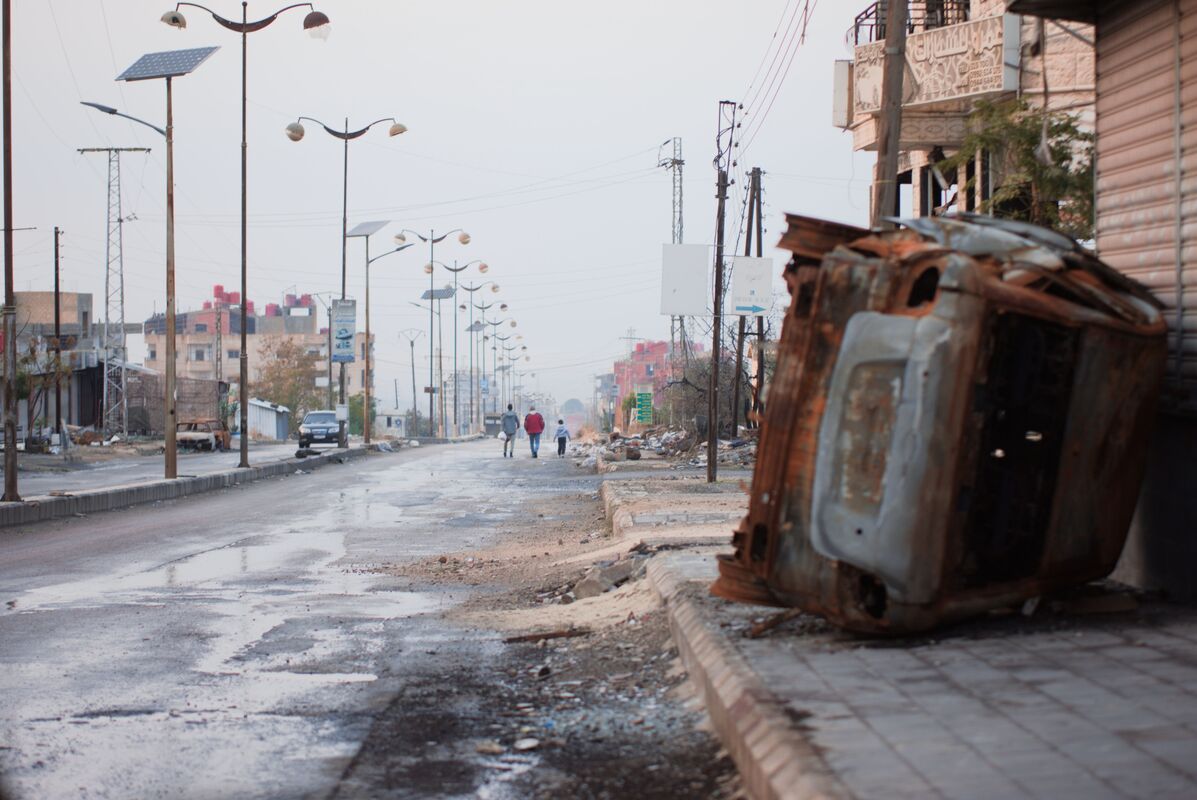
A car burned and put on its side on a sidewalk in Sweida city. On the background, a group of people is walking on the street.
The Amargi, Suwayda
This article has been co-authored by Shamil Nanuadze# and AlTair Najim Alsobih#. All photographs used in this article have been photographed by the co-authors.
The road to Suwayda, a few dozen kilometers south of Damascus, was lined with empty villages. The houses stood upright, but their ashen insides spoke their history: they were set on fire. A checkpoint marked the new frontier between the areas of the Syrian Interim Government and those under Druze control.
But Suwayda remains tightly regulated by Damascus, which has been accused of restricting the entry of food, water, and oil shipments into the region.
Over the past year, Syrian Interim President Ahmed al-Sharaa has repeatedly called for the country to unite. In his speech celebrating the first anniversary of the fall of the Assad regime on December 8th, he declared that he aims to make “victory a responsibility through diligence, action, justice, and compassion.” But behind these apparent steps towards reconciliation linger complex challenges, as sectarian tensions remain high in the country.
Since April 2025, clashes between the Druze, who are an endogamous religious group historically often persecuted due to their religion, and Bedouin tribes have been common in southern Syria. In July, the violence peaked when Bedouins and members of the General Security forces stormed Suwayda city. They methodically executed civilians in public spaces and homes, as the many videos posted online by the attackers themselves confirm.
According to the Syrian Observatory for Human Rights, 824 Druze civilians were executed by Defense and Interior Ministry forces in the Suwayda governorate during the July attack. The attack lasted for six days between July 13 and 19 until a ceasefire was declared. The Office for the Coordination of Humanitarian Affairs (OCHA, a United Nations agency) estimated that, as a result of the hostilities in the governorate , 187,200 people have been displaced since mid-July.
Vestiges of the Attack
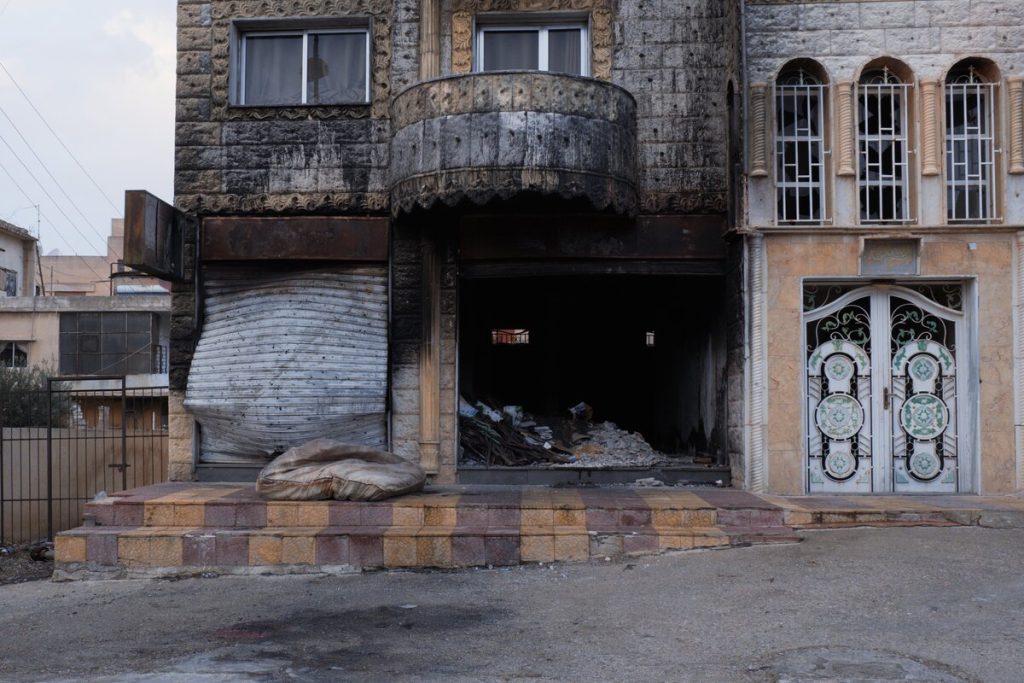
Even inside the city, many buildings still bore traces of the July attack. Our guide, Yamen Oraij*, had fought against the Assad regime throughout the civil war, beginning in 2011 when the first clashes erupted in April 2025. Oraij, father of two, took up arms once again and has since been battling along with Druze forces.
…at the Tishreen square, in the center of the city, locals had planted six Druze flags … They marked the spot where six brothers of the Saraya family were executed in cold blood.
Memorials for the victims, remnants of the General Security forces’ tanks, and burned buildings were all over the city. “They were using incendiary ammunition,” Oraij explained. This method allowed the attackers to set houses ablaze by shooting through the windows from the street.
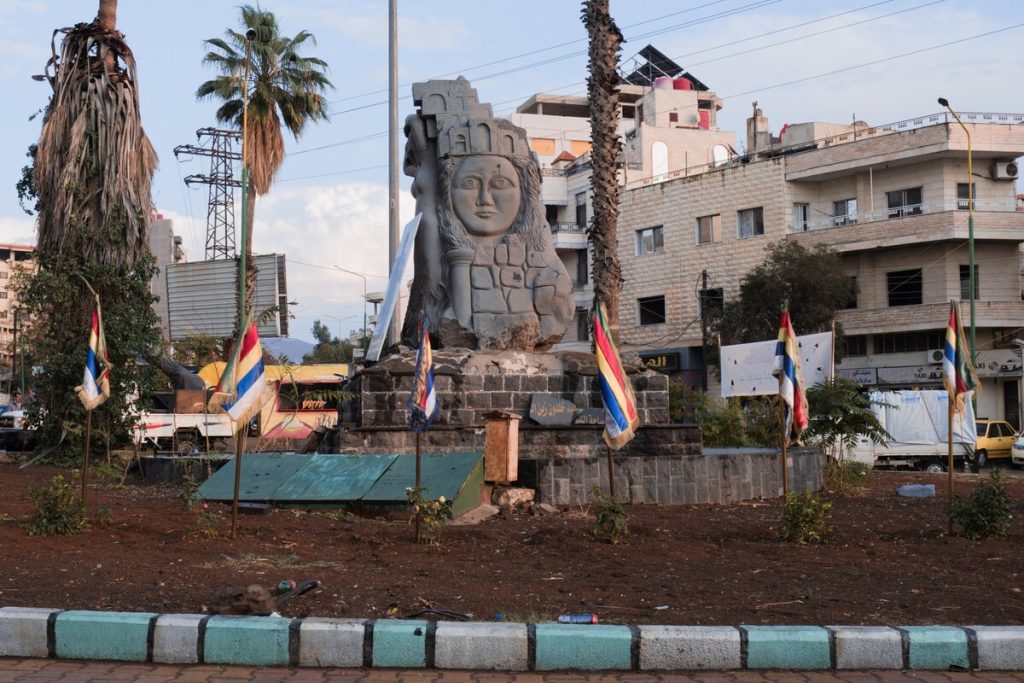
Some traces of the assault were more discreet: at the Tishreen square, in the center of the city, locals had planted six Druze flags, easily identified by their colored stripes representing the five spiritual symbols of the sect. They marked the spot where six brothers of the Saraya family were executed in cold blood.
These murders sparked strong emotional reactions across the Druze community worldwide. A baker whose shop is located near the square remembered the siblings’ abduction vividly: “The assailants were killing everyone and screaming that we have a religion of pigs,” he said with anger and sorrow in his eyes.
A Constant Threat
In his office at the National Guard Forces’ barracks – a coalition of local armed groups – in Suwayda city, Major Talal Amer said, “I’m sorry for the situation, but we have a war.” He looked tired.
Amer is the head of the media department of the relatively new organization. The National Guard Forces was created in August as an attempt to centralize Druze forces. Although several militias are yet to join the National Guard, it is currently considered the biggest military force in Suwayda.
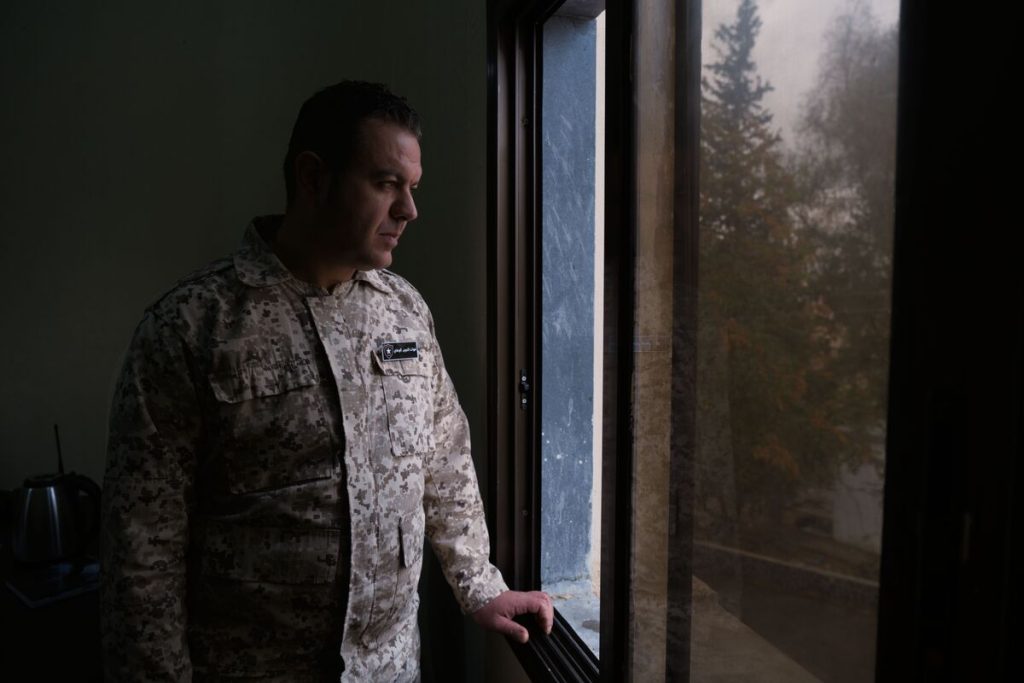
According to Major Amer, the National Guard’s posture is “purely defensive, out of respect for the agreement” concluded in July with the Syrian Interim Government. This does not mean that the hostilities have stopped, however. He accused Damascus-backed forces of “repeatedly violating the ceasefire.”
The presence of suicide drones on the outskirts of Suwayda points to the direct involvement of the Damascus authorities
Ismail al-Aqbani*, a former nurse who joined the National Guard after the July attack, recounted how he was injured in early December during a night shift at a checkpoint. After being targeted by machine-gun shots coming from a nearby village under the control of pro-government forces, his squad’s vehicle was struck by a suicide drone. The team managed to escape, only to be hit by a second explosion soon after. Two Druze fighters died on the spot, and shrapnel injured al-Aqbani’s leg.
“These attacks are constantly repeated and do not discriminate between civilians and combatants,” al-Aqbani explained. “At times, drones strike inside the city, in civilian neighborhoods.”
The presence of suicide drones on the outskirts of Suwayda points to the direct involvement of the Damascus authorities. Over the last years, the soldiers of Ahmed al-Sharaa’s Hayat Tahrir al-Sham (HTS) developed strong first-person view (FPV) drone manufacturing and operating skills, which greatly helped the group in the December 2024 offensive that toppled dictator Bashar al-Assad.
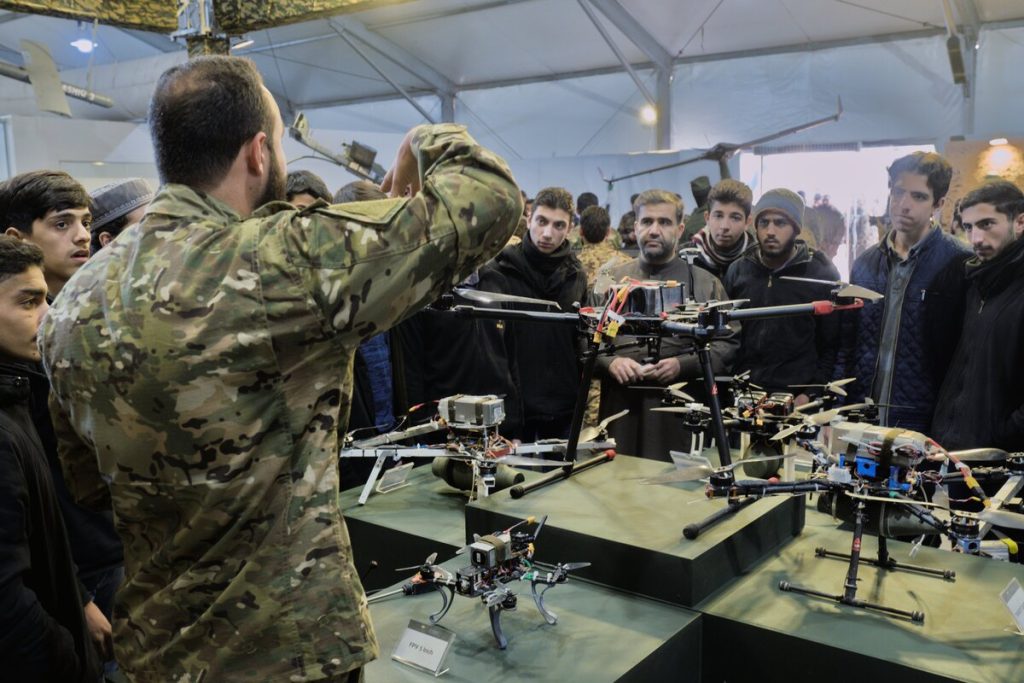
Since the change of leadership, a drone unit – the Shaheen Brigade – has been integrated into the new Syrian army, and possesses a varied arsenal of aerial vehicles designed for scouting and shelling. The “shehab” – Arabic for “shooting star” – FPV series in particular, can carry dozens of kilograms of explosives, and requires significant gear and advanced training.
A long way to unity
A video posted on Facebook in late November, after a military parade organized by the National Guard in Suwayda city, showed people taking down the word “governorate” from the region’s main administrative building, leaving only “Suwayda”. The message was clear: some locals want the region to break away from the central administration in Damascus.
A few days later, when Syria was about to celebrate its first year without Bashar al-Assad, locals in Suwayda were hesitant. WhatsApp groups were flooded with the same question: should they observe the holiday?
Since 2023 and until the collapse of the regime, locals protested the rule of Bashar al-Assad every Monday at the Karama Square in the city center; yet the victory has been bittersweet for many. Eynas Matar, a Sunni Muslim who has been living in Suwayda since 2013, had hoped to celebrate. “But it sounds disgraceful now,” she said.
Eynas is the sister of the late Ghiath Matar, a prominent figure of the Darayya uprising of 2011. Ghiath was known for distributing water bottles and flowers to the soldiers who came to suppress the demonstrations, as a form of peaceful protest. Soon after the revolution began, he was abducted and tortured to death by the Syrian security services.
Eynas Matar has become a public figure in Suwayda, and she regularly publishes messages calling for peace on her Facebook page. Since the first clashes in April, she has been speaking out against “the sectarian governance” of the new authorities.
Her voice as a Sunni Muslim living among the Druze community carries important symbolic meaning. Because of this, she has received countless death threats: “I cannot return to Damascus now, I feel like I am in great danger,” she said.
On the internet, some have publicly called for Matar’s assassination. She recently learned that during the July events, attackers were looking for her in order to “take revenge”.
“I felt as if I had returned to 2012, to the second Darayya massacre,” she said. During the massacre, between the 20th and 25th August 2012, at least 700 people were reportedly killed in a deadly raid conducted by Bashar al-Assad’s army and militias. “In Suwayda, too, families were killed brutally and thrown off balconies,” she added.
“Bashar is gone – yes – but has Syria been liberated?”
Eynas Matar lost three of her brothers to the brutal Assad regime – two of them, Anas and Hazem, disappeared in prison. On the wall of her apartment, she had their portraits where they appear smiling in front of Syria’s green, white, and black flag.
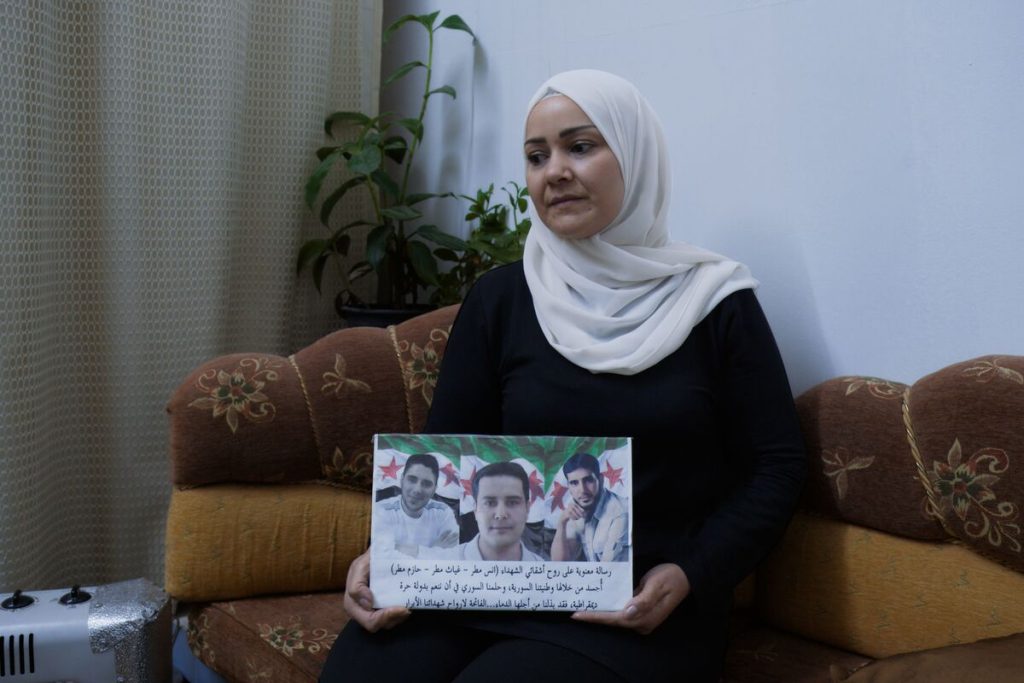
Al-Fatiha for the righteous souls of the martyrs.”
Next to them was a picture of Dr. Talaat Amer: “He was like a father, a mother, and a brother to me,” Eynas told us. The doctor was killed in July, on his way to the city’s hospital to treat the wounded. Hearing about his death “felt as if Anas, Hazem, and Ghiath had been martyred once again,” she said. “Bashar is gone – yes – but has Syria been liberated?”
*The name was changed.
# At the request of the co-authors, we have used pseudonyms for them.

The Amargi
Amargi Columnist