Iran Cracks down on Reformists
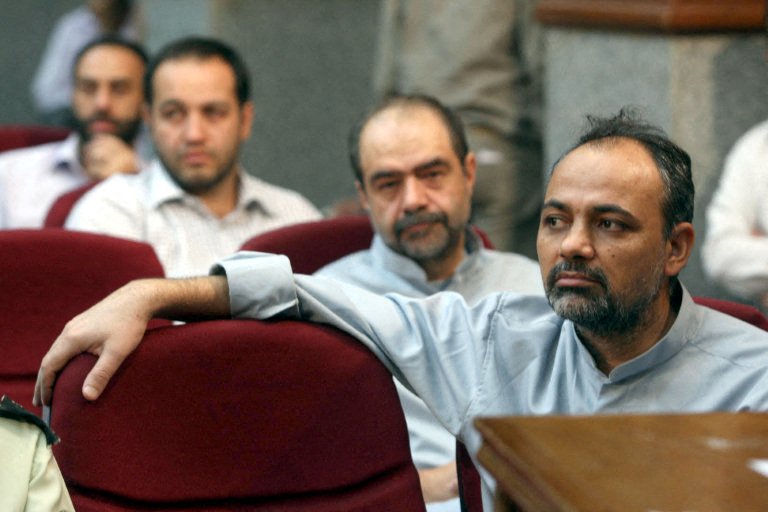
Former deputy foreign minister Mohsen Aminzadeh (2nd R) is seen during a hearing at the revolutionary court in Tehran on August 25, 2009. (Photo by Hassan Ghaedi / FARS NEWS AGENCY / AFP)
Iranian authorities have launched a wave of arrests targeting senior figures of the Reformist Front, days after the resumption of indirect U.S.-Iran talks in Muscat, Oman.
The move appears aimed at weakening internal opposition as the regime faces intensified economic and diplomatic pressure from Washington.
Tasnim News Agency warned that aligning with foreign adversaries, even under the guise of reformism or social critique, would not be tolerated.
Among those detained are Azar Mansouri, head of the Reformist Front and secretary-general of the Islamic Iran People Party, who played a key role in mobilizing votes for Masoud Pezeshkiyan in the 2024 presidential election. Other prominent figures arrested include Mohsen Aminzadeh, a former deputy foreign minister under President Mohammad Khatami, and Ebrahim Asgharzadeh, head of the front’s political committee.
State-affiliated media, including IRGC-linked outlets, said the individuals were charged with “undermining national unity, opposing the constitution, and coordinating with enemy propaganda.” Tasnim News Agency warned that aligning with foreign adversaries, even under the guise of reformism or social critique, would not be tolerated.
Kayhan newspaper, which generally reflects the views of supporters within the circle of Iran’s Supreme Leader, described those detained as a “subversive and riot-seeking network,” accusing them of “creating covert mechanisms aimed at overthrowing the system” and weakening national cohesion.
The arrests follow a statement from the Reformist Front criticizing the Iranian government’s crackdown on recent protests, which reportedly killed at least 6,000 people. The front called for the establishment of a “national assembly” and demanded “immediate, fundamental, and serious structural reforms.” The statement challenged the official narrative that many protesters were killed by rioters or foreign agents, questioning how thousands of so-called “unknown armed elements” could operate nationwide despite the presence of security forces.
Following the statement, IRGC intelligence units raided homes of several activists, arresting some and summoning others, including Mohsen Armin, vice-chairman, and Badr al-Sadat Mofidi, secretary of the Reform Front. State news agency IRNA claimed these individuals had organized activities intended to disrupt political and social stability amid threats from the U.S. and Israel.
Observers note that the Reformist factions have lost significant popular support since the December 2017 protests and the 2022 “Jin, Jiyan, Azadî” (women, Life, Freedom) movement.
Gholam-Hossein Mohseni-Ejei, head of the judiciary, said some Iranian activists and politicians were echoing the messaging of the United States and Israel, targeting the Velayat Faqih (Guardianship of the Jurist), the regime’s central pillar.
Observers note that the Reformist factions have lost significant popular support since the December 2017 protests and the 2022 “Jin, Jiyan, Azadî” (women, Life, Freedom) movement. Slogans such as “reformist or hardliner, the game is over” have become common among protesters.
The arrests also come amid heightened concern over U.S. military activity near Iran’s southern coast. U.S. President Donald Trump said on his Truth Social account on January 28 that a “massive armada” was moving toward Iran, “like with Venezuela, it is ready, willing, and able to rapidly fulfill its mission, with speed and violence, if necessary.”
Negotiations between Iran and the United States resumed on Jan. 6 in Muscat, Oman, following an eight-month hiatus triggered by last year’s 12-day war between Israel and Iran. Despite the renewed engagement, the gap between the two sides remains wide. Washington wants negotiations to address a broad set of issues, including Iran’s nuclear programme, ballistic missile development, support for regional proxy groups, and human rights practices. Senator Marco Rubio said that meaningful progress would require limits on Iran’s missile arsenal, an end to backing for militant organisations, and a halt to domestic uranium enrichment.
Tehran, however, is not willing to discuss more than its nuclear programme. Iranian Foreign Minister Abbas Araghchi, who led Tehran’s delegation, cautioned that any retreat in the talks would be open-ended. “Some argue for yielding, but this act of yielding will, in my opinion, never end,” he said.
On the same day, the U.S. escalated economic pressure by imposing sanctions on 15 entities and 14 vessels linked to Iran’s so-called “shadow fleet,” aiming to curb oil exports and restrict revenue streams. Trump also signed an executive order reaffirming the national emergency with respect to Iran and establishing tariffs on goods or services acquired from Iran.
The Iranian regime is weaker, more scared, and more fragile than at any time in its existence.
Such multifront pressures on the Iranian regime can widen the already-formed rift among Iranian officials. Many observers also indicate that the military buildup may be used to suffocate Iranian oil exports, which could further weaken Iran’s already deteriorating economy. Considering this scenario, along with Trump’s reluctance to fully support the Iranian exiled opposition, namely Reza Pahlavi, the son of the deposed Shah, some scenarios reminiscent of Venezuela appear more plausible.
The Iranian regime is weaker, more scared, and more fragile than at any time in its existence. It is aware that the U.S. administration under Trump is more willing to support an internal opposition that does not necessarily aim to dismantle the entire regime but seeks regime alteration—that is, steering the regime into the U.S. camp. Thus, the Iranian regime’s targeting of the Reformist Front can be analyzed from this angle: it is an attempt to prevent the formation of internal alternatives.
Analysts say that the crackdown on Reformist leaders reflects Tehran’s concern about internal dissent amid mounting U.S. pressure. By suppressing potential alternative political movements, the regime seeks to prevent the emergence of factions that could challenge its authority without fully dismantling the system. Observers warn that combined economic, military, and diplomatic pressures may further strain Iran’s fragile economy and political stability.

Rojin Mukriyan
Rojin Mukriyan has PhD in the Department of Government and Politics at University College Cork, Ireland. Rojin’s main research areas are in political theory, feminist and decolonial theory, and Middle Eastern politics, especially Kurdish politics. She has published articles in the Journal of International Political Theory, Philosophy and Social Criticism, and Theoria. Her research has thus far focused on the areas of Kurdish liberty, Kurdish statehood, and Kurdish political friendship. She has published many think tank commentaries and reports on recent political developments in eastern Kurdistan (Rojhelat), or north-western Iran. She has also frequently appeared on a variety of Kurdish and Persian language news channels. X account: @RojinMukriyan