Iran: The Islamic Regime’s Collapse
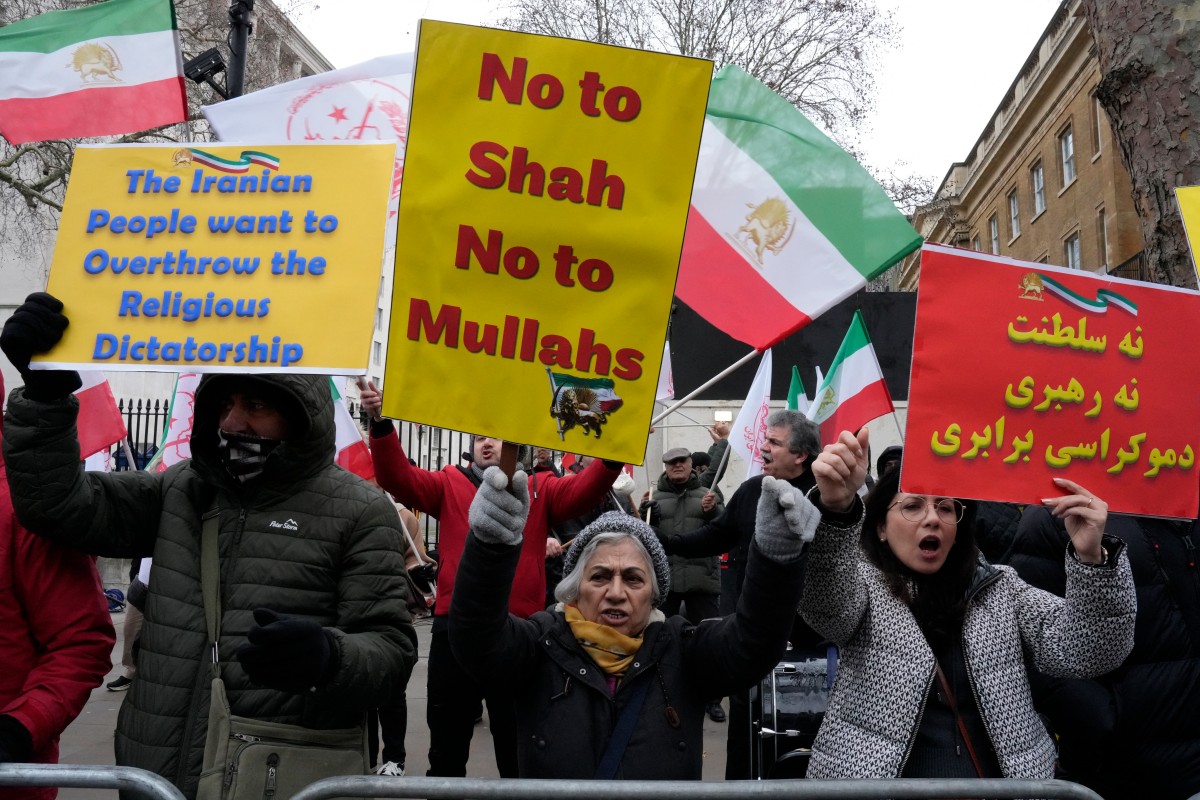
Protesters gather with placards outside the gates of Downing Street to attend a London Rally in Solidarity with Iran’s Uprising (Photo by CARLOS JASSO / AFP)
The ongoing protests in Iran highlight the conflict between a society yearning for change and a political system desperate to survive. The Islamic Regime has responded with violent crackdowns, arbitrary arrests, and killing civilians, all of which have only hardened people’s resolve.
However, though past popular movements threatening the political system failed because opposition actors could not unite, the Regime is much weaker this time, regional politics have changed, and opposition within Iran, like the Kurds, have announced a united front, opening the path for transformation.
Background
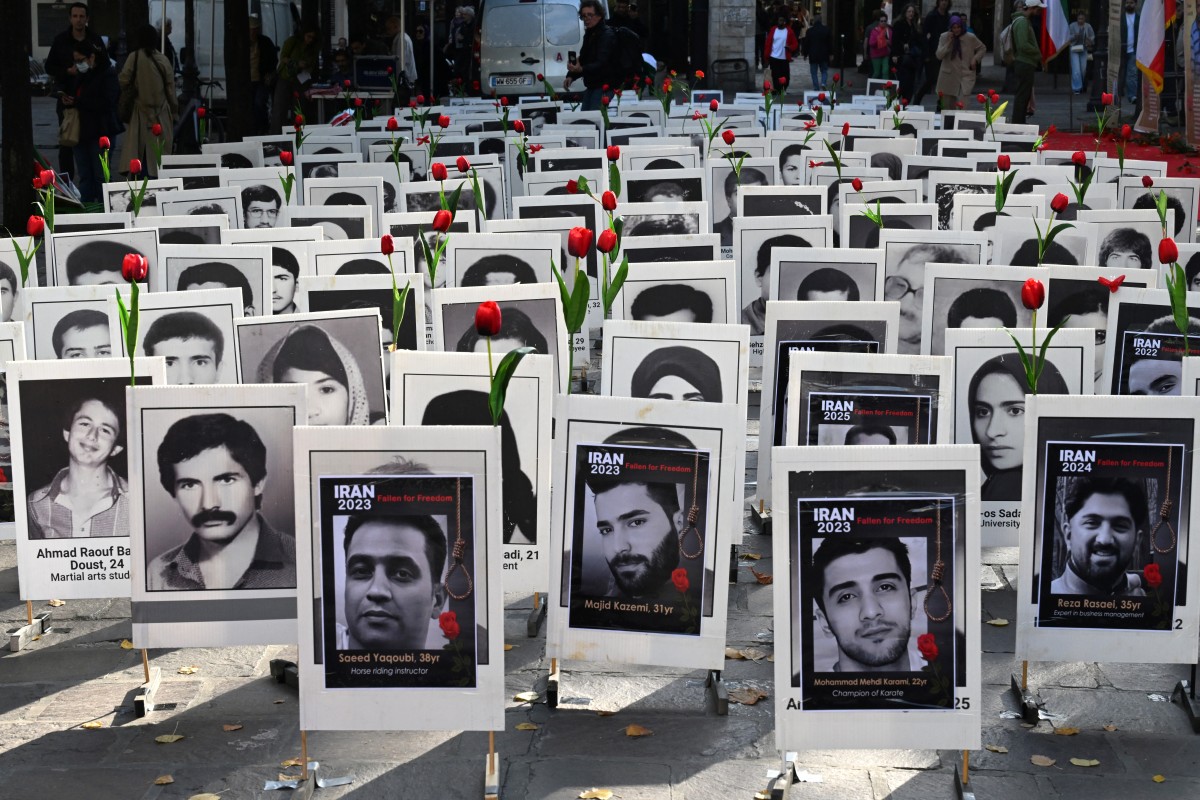
Domestically, the Islamic Regime governs through a matrix of religious legitimacy, coercive authority, patronage networks, and ideological control. Backed by at least 124,000 Islamic Revolutionary Guard Corps (IRGC) personnel, violent repression – through public executions and arbitrary arrests of adults and children, especially against ethnic minorities – has been the regime’s primary response to dissent. But while coercion can suppress visible unrest in the short term, it cannot resolve the deeper disaffection that drives it.
The generation that witnessed the 1979 Revolution and endured the Iran-Iraq War in the 1980s viewed the regime through the prism of sacrifice, dignity, and sovereignty. However, for younger people, the state increasingly appears restrictive, corrupt, and disconnected from the realities of daily life. The Woman, Life, Freedom protests ignited by Jina (Mahsa) Amini’s murder in 2022 were not merely about dress codes or the brutal “morality police”. They were an expression of profound frustration; for dignity, personal liberties, and the right to shape one’s own future, with personal and societal freedoms being non-existent, and 30% of the population living under the poverty line with barely any economic opportunity.
The violent reaction to the demonstrations strengthened the hand of opposition groups in exile, but political conflict within the opposition – including extremist Persian nationalist sentiments by Pahlavi supporters – ultimately caused the collapse of what at the time seemed like Iran’s new political roadmap.
Now, the Regime is again living through desperate times. With the 12-Day War against Israel, economic collapse, and climate crises shaking the foundations of Iran’s political structure, protestors have taken to the streets to demand their rights, while often chanting that they no longer want the Regime in power.
Self-inflicted Damage
Iran is home to Kurds, Azeris, Arabs, Baluchis, Turkmen, and others whose cultural, linguistic, and regional identities differ from the state’s dominant narrative
The Islamic Regime’s actions inside and outside the country have worsened its relations and capacity for diplomacy, opting for military interventions, proxy network building abroad, and targeted violence at home.
Iran is home to Kurds, Azeris, Arabs, Baluchis, Turkmen, and others whose cultural, linguistic, and regional identities differ from the state’s dominant narrative. The insistence on a unitary national identity has often led to suspicion, surveillance, and marginalisation of these communities, and has compounded internal pressures.
In East Kurdistan (west and northwest Iran), Kurds’ demands for education in the mother tongue are frequently framed by the state as security threats. In Baluchistan, poverty and underdevelopment coexist with heavy militarisation. While these tensions do not always translate into separatist sentiments, they foster resentment, eroding the state’s legitimacy and widening social divisions.
Furthermore, ethnic and religious minorities in Iran often face far harsher crackdowns when expressing dissent, and the state wields violence as a tool in the service of their own brand of nationalism to divide Iran’s diverse communities.
Regionally, Iran has positioned itself as the centre of an “axis of resistance” against Israel and Western influence. Its extensive networks in Iraq, Syria, Lebanon, and Yemen had been designed to extend its strategic depth and project power. Yet these entanglements have also carried significant costs.
Many neighbouring states view Iran not as a stabilising force but as a destabilising actor whose proxy alliances complicate governance and fuel conflict.
Iranian support for militias in Iraq, Hezbollah in Lebanon, and even support of the Assad regime in Syria tied Iran to some of the most destructive conflicts of the past decade. In Yemen, its backing of the Houthis has contributed to a protracted humanitarian catastrophe and added another layer of regional insecurity.
The most aggressive dimension of Iran’s external posture remains its confrontation with Israel. The Islamic Regime has consistently refused to recognise Israel’s legitimacy, framing this enmity as central to its revolutionary identity. For many ordinary Iranians, however, the confrontation with Israel appears less a strategic imperative and more a costly distraction from pressing domestic hardships. A belief that is further backed up by the Regime utilising the conflict with Israel to justify internal militarisation and curtail dissent under the banner of national security.
Iranian officials often use external pressure to strengthen themselves by framing internal grievances as foreign-inspired subversion, thereby undermining the credibility of domestic dissent. The 12-Day War in June 2025 revived the notion of external threat and allowed the Regime to ignore people’s demands, even if only temporarily.
Internationally, Iran’s position is further complicated by its fraught relationship with the U.S. and EU. Diplomatic frameworks, particularly regarding the nuclear file, remain unresolved, leaving Iran both isolated and defiant in global affairs.
In response, Iran has sought to deepen ties with Russia and China, embracing a more multipolar vision of international relations. However, these partnerships, while strategically useful, make Iran dependent on much stronger forces, who prioritize their own interests even at Iran’s expense – for example, Iranian military officials believe Russia shared intelligence with Israel during the 12-Day War, which helped the Israeli Air Force avoid Iranian defences.
The only people who benefit from the Islamic Regime are the small minority who are connected to state institutions, especially the IRGC
Additionally, ties with Russia and China do not provide a substitute for economic legitimacy or meaningful integration into the global economy. Access to Western markets, technology, and finance remains largely restricted, and the Iranian rial is currently at historic lows.
The only people who benefit from the Islamic Regime are the small minority who are connected to state institutions, especially the IRGC and semi-state economic foundations, while ordinary citizens face declining opportunities, leading to a pronounced brain drain and mass youth migration.
A Different Global Environment
The U.S. January operation in Venezuela, in which the U.S. military captured President Maduro and removed him from power, sent waves across the Middle East as a sign of shifting global dynamics. It emphasized great powers’ willingness to act unilaterally in pursuit of core interests, even at the expense of international law and long‐standing sovereignty norms.
For middle powers like the UAE and Qatar, such events signal the value of carefully calibrated diplomacy and economic influence. In contrast to Iran and Turkey, these Gulf states have managed to balance competing interests, engaging Western economic systems while maintaining regional relevance through investment, mediation, and soft power. Comparatively, Iran and Turkey today lack the capacity to majorly influence outcomes in great power confrontations without risking direct confrontation or isolation.
Do all these facts point to the Regime’s imminent collapse?
Authoritarian governments rarely fall because they are unpopular or economically weakened. They collapse when internal fractures deepen, when elites split, when security forces defect, and when opposition forces coalesce around credible alternatives.
The opposition may remain fractured for now, but the Kurds are active
Iran’s political institutions are on the edge of collapse, but while economic hardship is acute, revenue streams from energy exports, illicit networks, and regional influence still provide essential resources. And though societal restlessness is real, many Iranians remain cautious after years of protest and repression.
The opposition may remain fractured for now, but the Kurds are active. Kurdish parties have published joint statements, announcing efforts to form a unified front, making general political demands, and laying out basic conditions for a potential Regime-free future. However, as historically both republican and monarchist sides of Iranian politics have repressed them, Kurds are wary of taking up the fight alone, instead calling for countrywide civil disobedience and self-defence.
Although Iran’s leadership faces mounting pressures, it is also important to recognise the regime’s capacity for survival.
Although Iran’s leadership faces mounting pressures, it is also important to recognise the regime’s capacity for survival. The ruling elite has repeatedly demonstrated adaptability. The process of cycling presidents, recalibrating policies, alternating between repression and controlled concessions, and invoking nationalism when religious ideology loses traction. The state’s coercive apparatus remains formidable, and opposition movements often lack unified strategies or leadership. Many Iranians, particularly young people and minorities, desire a more inclusive and responsive political order. Sustainable transformation, if it occurs, will likely emerge not through external force or abrupt collapse but through a renegotiation between state and society.

Seevan Saeed
Seevan Saeed is an Associate Professor in Area Studies at Shaanxi Normal University, China and Lecturer at Rojava University, Syria. He received his BA degree in Sociology and MA in Social Policy at the University of Wolverhampton,UK. He gained a PhD in Middle East Politics at the University of Exeter in 2015. He has delivered lecturers in domestic and international universities since 2015. He published articles and papers in six languages on social and political issues in the Middle East and beyond.