Öcalan Urges Momentum on Syria’s March-10 Deal as Talks Between SDF and Damascus Stall
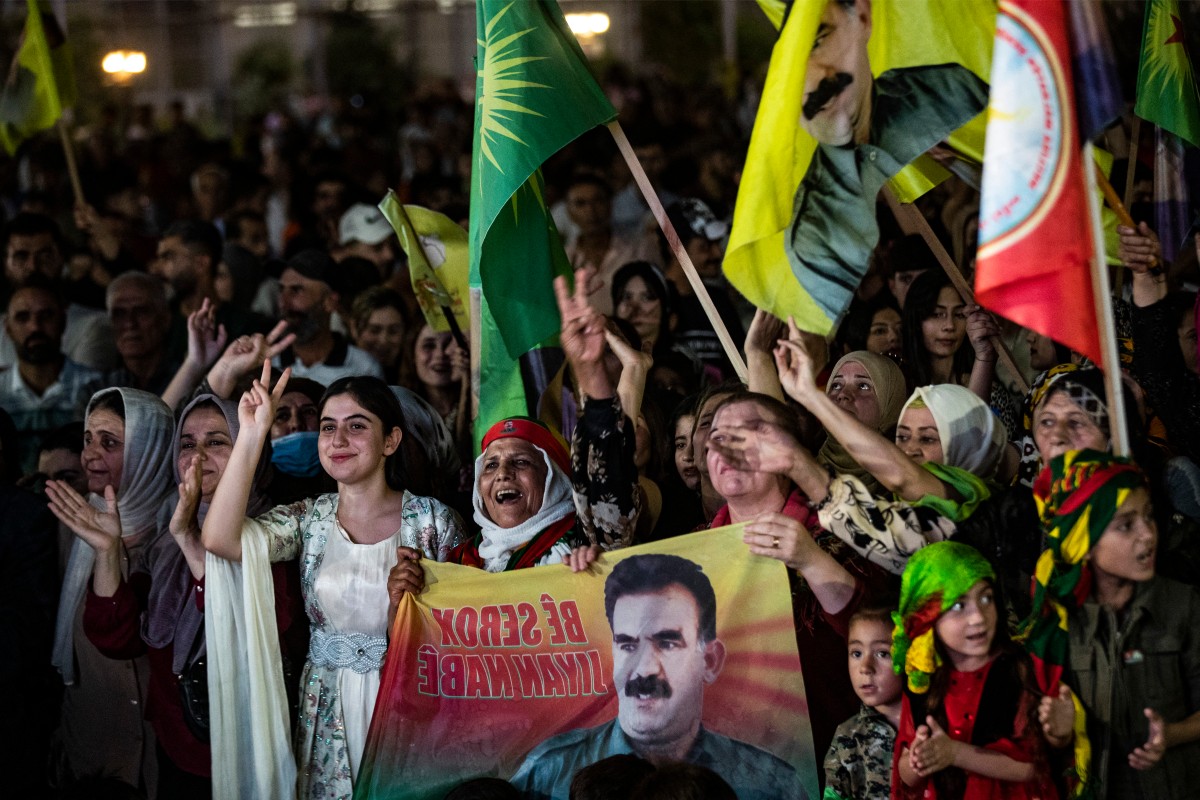
Supporters attend a rally airing a televised statement by the jailed leader and founder of Turkey’s Kurdistan Workers’ Party (PKK) Abdullah Ocalan in Syria’s predominantly-Kurdish northeastern city of Qamishli on July 9, 2025. Jailed Turkish Kurd leader Abdullah Ocalan said in a message published on December 30, 2025 that it was “crucial” for the Turkish government to broker a peace deal between the Kurdish-led Syrian Democratic Forces (SDF) and the Damascus government. (Photo by Delil SOULEIMAN / AFP)
As Syria enters its first full year after the collapse of Bashar al-Assad’s regime, a fragile political transition has been marked by halting negotiations, regional interference, and growing uncertainty over the country’s future shape. Against this backdrop, a new message issued on December 30 by imprisoned Kurdish leader Abdullah Öcalan has injected fresh urgency into one of the most consequential yet fragile political frameworks to emerge so far: the March 10 agreement between the Syrian Democratic Forces (SDF) and Syria’s new government led by transitional president Ahmed al-Sharaa in Damascus.
The agreement, reached earlier this year after months of indirect contacts, outlines a pathway toward SDF’s integration, decentralized governance, and negotiated coexistence between the Kurdish-led Autonomous Administration in northeast Syria and the new Syrian state, led by Hayat Tahrir al-Sham (HTS), a former extremist Islamist jihadist group led by Ahmed al-Sharaa.
Öcalan framed the March 10 agreement as not merely a political option but a historical necessity
Despite early optimism, recent end-of-year scheduled meetings for the implementation of the March 10 agreement were abruptly canceled, raising fears that momentum is slipping, as pressure from regional actors keeps questions about Syrian sovereignty, security, and democratic power-sharing unresolved.
Öcalan’s message appears calibrated to address this moment of stagnation, as many in Turkey and Syria were awaiting his message. Without referencing the canceled meetings directly, Öcalan framed the March 10 agreement as not merely a political option but a historical necessity – one that, if implemented, could prevent Syria from backsliding into conflict after more than a decade of war.
Öcalan has been in peace negotiations with the Turkish state since October 2024, and the Syrian file remains one of the major contentious cases between the two sides.
Öcalan said Syria “emerged from a chaotic state,” adding that many Syrians were now “awaiting and demanding a democratic solution.” He argued that systems of rule based on “centralization, suppression, and the denial of identities” were no longer viable, and said that a democratic alternative would strengthen “equality and freedom for Kurds, Arabs, Alawites, and all peoples.”
Referring directly to March 10, Öcalan said the agreement between the SDF and authorities in Damascus “outlines a democratic political model enabling all peoples and nations to exercise self-governance together.” Such a framework would allow negotiation with the central state while laying “the groundwork for democratic integration,” and implementing the agreement would “pave the way for this process and advance it.”
A Transition Under Strain
Since Assad’s fall, Damascus has sought to reassert central authority over a fractured country, while signaling openness to “national dialogue.” Yet the tension between old centralist instincts and the realities of a divided, war-torn Syria has been evident – especially with the massacres against Alawites and Druze.
But progress has been inconsistent, as the transitional Syrian government and Turkey want the SDF to dissolve itself into the Syrian Army, whereas Kurds want an integration based on a democratic power-sharing arrangement
In the northeast, the SDF, which played a decisive role in defeating ISIS alongside the U.S.-led coalition, governs a multiethnic region encompassing Kurds, Arabs, Syriac Christians, and others. The Kurds in the north and northeast, Alawites in the western coastal region, and Druze in the Syrian south demand a decentralized democratic Syria, while the transitional government pushes for an arrangement with less regional power, fearing secessionist sentiments.
The March 10 agreement attempted to bridge these realities and differences. It laid the groundwork for negotiations with the central government, mutual recognition of local self-administration, and a democratic model allowing different peoples to govern themselves collectively within Syria’s borders. But progress has been inconsistent, as the transitional Syrian government and Turkey want the SDF to dissolve itself into the Syrian Army, whereas Kurds want an integration based on a democratic power-sharing arrangement and the continuation of their local security forces, including the Women’s Protection Units (YPJ). Inside sources say disagreements over military integration, administrative autonomy, and external guarantees have repeatedly delayed formal engagement.
Turkey views the SDF as an extension of the Kurdistan Workers’ Party and has repeatedly opposed any arrangement that could legitimize Kurdish self-rule along its southern border. Turkish pressure has weighed heavily on Damascus, leading to the recent suspension of meetings.
Turkey’s Pivotal Role
Öcalan’s message departs from past rhetoric by directly calling on Turkey to play a “facilitating, constructive, and motivating role” in Syria’s peace process. Framing regional stability as inseparable from internal peace, he argued that Ankara’s cooperation is essential not only for Syria but for the wider Middle East.
This appeal comes at a moment when Turkey itself faces strategic dilemmas. Mounting pressure due to prolonged military engagement in northern Syria, tensions with Western allies, the recent Cyprus-Greece-Israel rapproachment, and the unresolved Kurdish question at home have pushed Turkey to rethink its Syrian approach. Öcalan’s intervention suggests that Ankara could choose a different path, one that supports negotiation rather than obstruction, at a time when Syria’s political architecture remains malleable.
From War to “Positive Revolution”
At its core, the message situates Syria’s crisis within a century-long history of imperialism, authoritarianism, and what Öcalan calls “negative revolutions” in the Middle East, cycles of war, suppression, and ethnic division. The antidote, he argues, lies in a “positive revolution”: rebuilding society through democracy, ethics, and social peace rather than hegemonic centralized power.
He insists that a solution to the Kurdish question is central to the region’s stability and that it cannot be resolved through military means. Only democratic consensus, grounded in popular will, can offer a sustainable solution, a theme that directly reinforces the logic of the March 10 agreement.
In his statement, Öcalan reiterated warnings against continuing cycles of war driven by authoritarianism, sectarianism, and divide-and-rule strategies
Öcalan also foregrounded women’s freedom as foundational to any lasting peace, warning that patriarchal domination perpetuates the culture of war. In northeast Syria, where women play prominent roles in political and military institutions, the emphasis resonates as both an ideological principle and a political signal.
A Possible Catalyst
In his statement, Öcalan reiterated warnings against continuing cycles of war driven by authoritarianism, sectarianism, and divide-and-rule strategies. Recent rumors also hint at a possible meeting between SDF General Commander Mazloum Abdi and Öcalan – a meeting, if it were to happen, would signal Turkey’s readiness to play a constructive role, and would strengthen hopes for a democratic solution and lay the peaceful foundation for the region.
As Syria stands at a crossroads, the coming months will test whether this appeal can move actors from rhetoric to action, or whether another opportunity for peace in Syria and Turkey will slip away between the Kurds and the central goverments, similar to the 2013-2015 peace process between the PKK and Turkey, as the differences on the future of the West Kurdistan (Rojava) became one of the key reasons why the peace process fell apart

The Amargi
Amargi Columnist